PUBLISHER: Mordor Intelligence | PRODUCT CODE: 2100530

PUBLISHER: Mordor Intelligence | PRODUCT CODE: 2100530
Asia-Pacific Pet Nutraceuticals - Market Share Analysis, Industry Trends & Statistics, Growth Forecasts (2026 - 2031)
According to Mordor Intelligence, the Asia-Pacific pet nutraceuticals market size is expected to grow from USD 1.12 billion in 2025 to USD 1.22 billion in 2026 and is forecast to reach USD 1.83 billion by 2031 at 8.54% CAGR over 2026-2031.
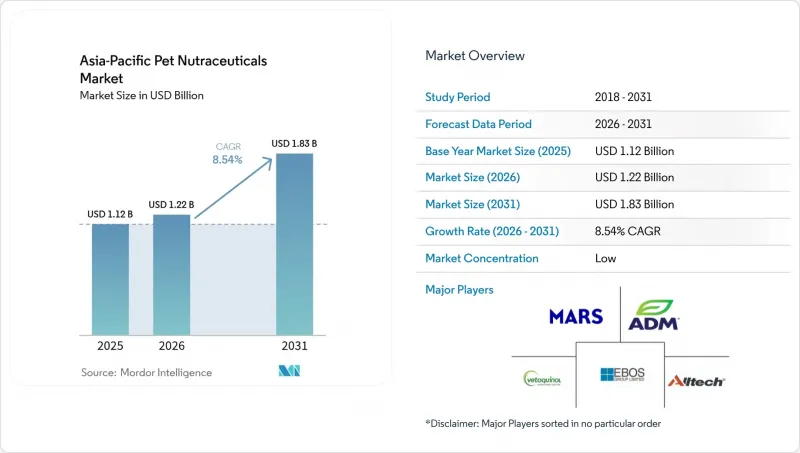
This report is Segmented by Product (Milk Bioactives, Omega-3 Fatty Acids, Probiotics, Proteins and Peptides, Vitamins and Minerals, and Other Nutraceuticals), by Pets (Cats, Dogs, and Other Pets), by Distribution Channel (Convenience Stores, Online Channel, and More), and by Country (Australia, China, and More). The Market Forecasts are Provided in Terms of Value (USD) and Volume (Metric Tons)
Asia-Pacific Pet Nutraceuticals Market Trends and Insights
Rising Pet Humanization and Premiumization Trend
Pet humanization trends across Asia-Pacific markets fundamentally reshape purchasing behaviors, with companion animals receiving healthcare investments comparable to family members. In Japan, per-pet annual food spending increased from Japanese Yen 21,650 (USD 142.45) in 2010 to Japanese Yen 37,272 (USD 245.25) in 2024, reflecting sustained premiumization that extends beyond basic nutrition into functional supplements . This behavioral shift creates market receptivity for higher-priced nutraceuticals targeting specific health outcomes. Thai research demonstrates that health-conscious pet owners show a 53% likelihood of purchasing premium products versus 25% for non-health-conscious segments, indicating clear market segmentation opportunities.
Growth in E-Commerce Companion-Animal Channels
Digital commerce penetration eliminates traditional distribution barriers, enabling specialized nutraceutical brands to reach previously underserved markets across diverse geography. Australia's pet food market demonstrates this transformation, with online channels representing approximately 26% of total sales and carrying hundreds of freeze-dried SKUs compared to supermarkets' limited 18 SKU offerings. This channel expansion proves particularly valuable for nutraceuticals requiring educational content and veterinary endorsements, as platforms like Supertails integrate telehealth consultations with product sales, creating trust-building pathways that traditional retail cannot match.
Ingredient Price Volatility
Peruvian anchovy fisheries supply over 70% of global EPA and DHA, creating single-point-of-failure risks that manifest as price volatility across Asia-Pacific nutraceutical supply chains. The 2023 El Nino event severely reduced catch volumes, though 2024-2025 seasons show recovery patterns. This volatility particularly impacts cost-sensitive markets across Southeast Asia, where price elasticity remains high and consumers readily substitute products based on cost fluctuations. Marine-sourced omega-3 price swings force manufacturers to maintain dual-sourcing strategies or accept margin compression during supply shortages, creating competitive advantages for companies investing in algae-based alternatives that offer price stability and supply security.
Other drivers and restraints analyzed in the detailed report include:
- Regulatory Relaxation on Functional Ingredients
- Veterinarian Push for Preventive Health
- Limited Clinical Validation for Asian Breeds
For complete list of drivers and restraints, kindly check the Table Of Contents.
Segment Analysis
Omega-3 fatty acids command 22.90% market share in 2025 while simultaneously achieving the fastest growth at 8.97% CAGR through 2031, reflecting both established market acceptance and ongoing innovation in sourcing and delivery mechanisms. This dual leadership position stems from breakthrough developments in microalgae cultivation, where companies like Corbion's AlgaPrime and DSM-Firmenich's DHAgold offer marine-equivalent EPA and DHA concentrations without supply chain volatilities associated with fish oil.
This segment's accelerated growth is driven by increasing awareness among pet owners about the multiple health benefits these supplements offer, including support for joint health, skin and coat maintenance, cognitive function, and cardiovascular health. The segment's growth is further bolstered by the rising trend of pet humanization and the increasing focus on preventive healthcare measures. Pet owners' growing understanding of omega-3 fatty acids in maintaining cell membrane structure and reducing health issues has made these supplements increasingly popular across the region.
Complete Report Scope:
- Sub Product
- Milk Bioactives
- Omega-3 Fatty Acids
- Probiotics
- Proteins and Peptides
- Vitamins and Minerals
- Other Nutraceuticals
- Pets
- Cats
- Dogs
- Other Pets
- Distribution Channel
- Convenience Stores
- Online Channel
- Specialty Stores
- Supermarkets/Hypermarkets
- Other Channels
- Country
- Australia
- China
- India
- Indonesia
- Japan
- Malaysia
- Philippines
- Taiwan
- Thailand
- Vietnam
- Rest of Asia-Pacific
List of Companies Covered in this Report:
- Mars, Incorporated
- Archer Daniels Midland Company
- Clearlake Capital Group, L.P. (Wellness Pet Company, Inc.)
- Nestle S.A. (Purina)
- Vetoquinol
- Virbac S.A.
- Nutramax Laboratories, Inc.
- EBOS Group Limited
- Alltech
- Kemin Industries, Inc.
- Health and Happiness (H&H) International Holdings Ltd.
- Inaba Foods Co., Ltd.
Additional Benefits:
- The market estimate (ME) sheet in Excel format
- 3 months of analyst support
TABLE OF CONTENTS
1 INTRODUCTION
- 1.1 Study Assumptions & Market Definition
- 1.2 Scope of the Study
- 1.3 Research Methodology
2 REPORT OFFERS
3 EXECUTIVE SUMMARY & KEY FINDINGS
4 KEY INDUSTRY TRENDS
- 4.1 Pet Population
- 4.1.1 Cats
- 4.1.2 Dogs
- 4.1.3 Other Pets
- 4.2 Pet Expenditure
- 4.3 Consumer Trends
5 SUPPLY AND PRODUCTION DYNAMICS
- 5.1 Trade Analysis
- 5.2 Ingredient Trends
- 5.3 Value Chain & Distribution Channel Analysis
- 5.4 Regulatory Framework
- 5.5 Market Drivers
- 5.5.1 Rising pet humanization and premiumization trend
- 5.5.2 Growth in e-commerce companion-animal channels
- 5.5.3 Regulatory relaxation on functional ingredients
- 5.5.4 Veterinarian push for preventive health
- 5.5.5 Functional ingredient cost deflation
- 5.5.6 Startup innovation in Asia-Pacific based D2C (Direct-to-customer) supplement brands
- 5.6 Market Restraints
- 5.6.1 Ingredient price volatility
- 5.6.2 Limited clinical validation for Asia-Pacific breeds
- 5.6.3 Fragmented distribution in emerging Asia-Pacific markets
- 5.6.4 Cultural resistance toward prophylactic supplements in certain countries
6 MARKET SIZE AND GROWTH FORECASTS (VALUE AND VOLUME)
- 6.1 Sub Product
- 6.1.1 Milk Bioactives
- 6.1.2 Omega-3 Fatty Acids
- 6.1.3 Probiotics
- 6.1.4 Proteins and Peptides
- 6.1.5 Vitamins and Minerals
- 6.1.6 Other Nutraceuticals
- 6.2 Pets
- 6.2.1 Cats
- 6.2.2 Dogs
- 6.2.3 Other Pets
- 6.3 Distribution Channel
- 6.3.1 Convenience Stores
- 6.3.2 Online Channel
- 6.3.3 Specialty Stores
- 6.3.4 Supermarkets/Hypermarkets
- 6.3.5 Other Channels
- 6.4 Country
- 6.4.1 Australia
- 6.4.2 China
- 6.4.3 India
- 6.4.4 Indonesia
- 6.4.5 Japan
- 6.4.6 Malaysia
- 6.4.7 Philippines
- 6.4.8 Taiwan
- 6.4.9 Thailand
- 6.4.10 Vietnam
- 6.4.11 Rest of Asia-Pacific
7 COMPETITIVE LANDSCAPE
- 7.1 Key Strategic Moves
- 7.2 Market Share Analysis
- 7.3 Brand Positioning Matrix
- 7.4 Market Claim Analysis
- 7.5 Company Landscape
- 7.6 Company Profiles (Includes Global Level Overview, Market Level Overview, Core Business Segments, Financials, Key Information, Market Rank, Market Share, Products and Services, and Analysis of Recent Developments).
- 7.6.1 Mars, Incorporated
- 7.6.2 Archer Daniels Midland Company
- 7.6.3 Clearlake Capital Group, L.P. (Wellness Pet Company, Inc.)
- 7.6.4 Nestle S.A. (Purina)
- 7.6.5 Vetoquinol
- 7.6.6 Virbac S.A.
- 7.6.7 Nutramax Laboratories, Inc.
- 7.6.8 EBOS Group Limited
- 7.6.9 Alltech
- 7.6.10 Kemin Industries, Inc.
- 7.6.11 Health and Happiness (H&H) International Holdings Ltd.
- 7.6.12 Inaba Foods Co., Ltd.
8 KEY STRATEGIC QUESTIONS FOR PET NUTRACEUTICALS CEOS

