
PUBLISHER: Mordor Intelligence | PRODUCT CODE: 2098486

PUBLISHER: Mordor Intelligence | PRODUCT CODE: 2098486
North America Green IT Software - Market Share Analysis, Industry Trends & Statistics, Growth Forecasts (2026 - 2031)
According to Mordor Intelligence, the North America green IT software market size is projected to expand from USD 7.22 billion in 2025 and USD 8.14 billion in 2026 to USD 16.18 billion by 2031, registering a CAGR of 14.73% between 2026 and 2031.
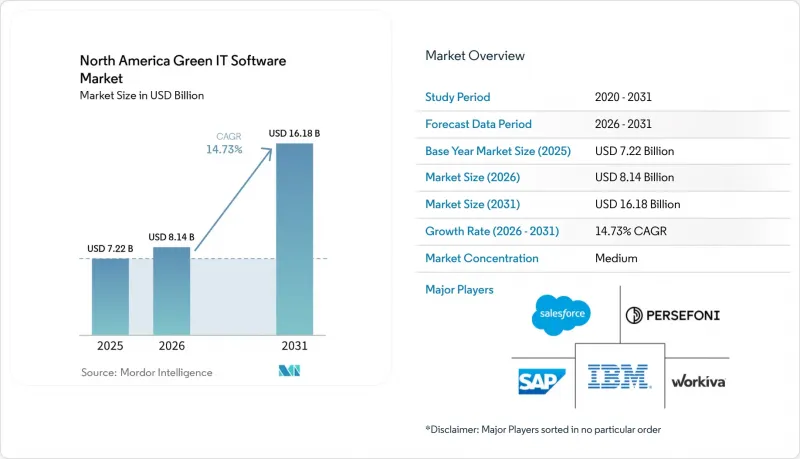
This report is Segmented by Offering (Software, and Services), Deployment Mode (Cloud, On-Premises, and Hybrid), Organization Size (Large Enterprises, and SMEs), End-User Industry (IT and Telecom, BFSI, Manufacturing, Energy and Utilities, and More), Solution Type (Carbon Management and Accounting Software, and More), and Geography. The Market Forecasts are Provided in Terms of Value (USD).
North America Green IT Software Market Trends and Insights
Rising Enterprise Demand for Carbon-Ready IT Workflows
The North America green IT software market is being pushed by a clear shift in enterprise behavior, as sustainability programs are moving from periodic disclosure exercises into continuous data workflows inside finance, procurement, and operations. Buyers increasingly want systems that can trace emissions data back to operational records, because internal review teams and external stakeholders now expect a clearer chain of evidence than spreadsheet-based processes can provide. This change is also increasing demand for workflow tools that can connect business activity, carbon factors, approval steps, and audit logs in the same environment. Vendors are responding by adding automation and scenario tools that help users work with carbon data in a more operational way, instead of as a reporting afterthought. The North America green IT software market benefits from this transition because enterprise buyers are no longer selecting tools only for disclosure; they are selecting platforms that can support repeatable decisions across business functions.
Regulatory Push for Audit-Ready Sustainability Reporting
The North America green IT software market is also advancing as regional regulations are becoming more layered, even though the federal climate disclosure approach in the United States remains unsettled. The U.S. Securities and Exchange Commission proposed rescinding its climate-related disclosure rules in May 2026, yet enterprises still face strong pressure from state rules, customer requirements, and cross-border reporting expectations. Mexico strengthened this regional compliance cycle through tools linked to IFRS-based sustainability reporting, giving issuers a more defined path for structuring their first mandatory reports. Canada is reinforcing the same direction through a carbon pricing framework that makes accurate emissions measurement more material for business planning and compliance cost control. As these obligations accumulate, the North America green IT software market is becoming less dependent on any single rule and more tied to the broader need for auditable, multi-jurisdiction data management.
Shortage Of Sustainability Data and ESG Systems Talent
The North America green IT software market still faces a practical execution problem, because many companies do not have enough staff who can manage sustainability data, enterprise systems, and assurance needs together. The gap is not limited to specialist sustainability teams, since procurement, finance, and operations staff also need to work with these platforms in day-to-day processes. When companies lack those skills, implementation slows, workflow adoption weakens, and software value is realized later than buyers expected. This pressure is one reason vendors are adding more guided automation and natural-language support to reduce the skill burden on internal teams. The North America green IT software market remains attractive, but this talent constraint continues to limit how quickly organizations can move from purchase to full operational use.
Other drivers and restraints analyzed in the detailed report include:
- Data Center Energy Cost Optimization Initiatives
- AI-Enabled Scope 3 Data Collection and Exception Handling
- High Implementation Complexity Across Legacy IT Stacks
For complete list of drivers and restraints, kindly check the Table Of Contents.
Segment Analysis
Software accounted for 76.84% of the North America green IT software market share in 2025, showing that buyers preferred platform-based systems over service-heavy delivery models when traceability and control became more important. That result reflects a structural buyer preference for systems that keep carbon records, workflow history, and reporting logic inside the enterprise technology environment. In the North America green IT software market, software is often chosen first because companies want repeatable controls instead of project-based reporting exercises. Audit readiness also matters more now because sustainability data increasingly needs the same level of review discipline that financial data receives. This keeps core platforms at the center of purchasing decisions, especially in larger organizations with multiple reporting entities and approval layers.
The software segment also benefits because it supports ongoing use across procurement, finance, operations, and corporate sustainability teams without forcing those functions into separate data environments. SAP has continued to position this embedded model around a common data foundation, which aligns well with enterprise demand for less fragmented sustainability workflows. Services, while smaller in 2025, are projected to grow at a 17.12% CAGR through 2031 because many first-time buyers still need implementation support, data setup, methodology guidance, and assurance preparation. That growth is especially important where reporting requirements are new and internal teams have not yet built stable operating routines. As a result, the North America green IT software market is not moving away from services, but it is making services more complementary to software rather than the main source of value.
Cloud held 68.92% of revenue in 2025, which shows how strongly enterprises favored scalable deployment, easier global data aggregation, and lower upfront infrastructure requirements. Cloud also fits the operating model of companies that need to gather emissions, utility, supplier, and compliance data from many sites and legal entities. In the North America green IT software market, cloud remains the default choice for many new deployments because it supports faster rollout and easier product updates. Buyers also value the way cloud architecture can support centralized governance while still allowing business units to contribute data from different systems. These advantages explain why cloud remained the leading deployment mode even as governance requirements became more demanding.
Hybrid is projected to post the fastest CAGR of 18.46% through 2031 because some organizations now want cloud flexibility without placing every sensitive record outside their internal environment. This matters most in regulated settings where personal, financial, or contractual information can sit next to carbon and supplier data. The hybrid shift also shows that the North America green IT software market is maturing, because buyers are refining early deployment choices after working through initial assurance cycles. Vendors that can support both centralized reporting and selective on-premises data handling are in a stronger position as enterprise architecture decisions become more nuanced. On-premises systems will remain relevant for legacy-heavy operators, but the demand center is clearly moving toward architectures that balance scale with governance.
Complete Report Scope:
- By Offering
- Software
- Services
- By Deployment Mode
- Cloud
- On-Premises
- Hybrid
- By Organization Size
- Large Enterprises
- SMEs
- By End-User Industry
- IT and Telecom
- BFSI
- Manufacturing
- Energy and Utilities
- Retail and E-Commerce
- Government
- Healthcare
- Construction and Infrastructure
- Other End-User Industries
- By Solution Type
- Carbon Management and Accounting Software
- ESG Reporting and Compliance Software
- Sustainability Data Management Platforms
- Decarbonization Planning Software
- Energy and Resource Optimization Software
- By Country
- United States
- Canada
- Mexico
List of Companies Covered in this Report:
- Persefoni AI Inc.
- Workiva Inc.
- IBM Corporation
- SAP SE
- Salesforce, Inc.
- Sphera Solutions, Inc.
- Schneider Electric SE
- Wolters Kluwer N.V.
- EcoVadis SAS
- Plan A Earth GmbH
- Sweep SAS
- Greenly SAS
- Benchmark Digital Partners LLC
- Cority Software Inc.
- Enablon
- FIGbytes Inc.
- Dakota Software Corporation
- EnergyCAP, LLC
- Carbmee GmbH
- Ecometrica Ltd.
- iPoint-systems GmbH
- One Click LCA Ltd.
- Sustainable Minds, LLC
Additional Benefits:
- The market estimate (ME) sheet in Excel format
- 3 months of analyst support
TABLE OF CONTENTS
1 INTRODUCTION
- 1.1 Study Assumptions and Market Definition
- 1.2 Scope of the Study
2 RESEARCH METHODOLOGY
3 EXECUTIVE SUMMARY
4 MARKET LANDSCAPE
- 4.1 Market Overview
- 4.2 Market Drivers
- 4.2.1 Rising Enterprise Demand for Carbon-Ready IT Workflows
- 4.2.2 Regulatory Push for Audit-Ready Sustainability Reporting
- 4.2.3 Data Center Energy Cost Optimization Initiatives
- 4.2.4 AI-Enabled Scope 3 Data Collection and Exception Handling
- 4.2.5 Green Cloud Migration and Virtualization Programs
- 4.2.6 Board-Level ESG Accountability and Disclosure Controls
- 4.3 Market Restraints
- 4.3.1 Shortage of Sustainability Data and ESG Systems Talent
- 4.3.2 High Implementation Complexity Across Legacy IT Stacks
- 4.3.3 Data Sovereignty and Cross-Border Hosting Constraints
- 4.3.4 Buyer Fatigue From Fragmented ESG Toolchains
- 4.4 Industry Value Chain Analysis
- 4.5 Impact of Macroeconomic Factors on the Market
- 4.6 Regulatory Landscape
- 4.7 Technological Outlook
- 4.8 Porter's Five Forces Analysis
- 4.8.1 Bargaining Power of Buyers
- 4.8.2 Bargaining Power of Suppliers
- 4.8.3 Threat of New Entrants
- 4.8.4 Threat of Substitutes
- 4.8.5 Intensity of Competitive Rivalry
5 MARKET SIZE AND GROWTH FORECASTS (VALUE)
- 5.1 By Offering
- 5.1.1 Software
- 5.1.2 Services
- 5.2 By Deployment Mode
- 5.2.1 Cloud
- 5.2.2 On-Premises
- 5.2.3 Hybrid
- 5.3 By Organization Size
- 5.3.1 Large Enterprises
- 5.3.2 SMEs
- 5.4 By End-User Industry
- 5.4.1 IT and Telecom
- 5.4.2 BFSI
- 5.4.3 Manufacturing
- 5.4.4 Energy and Utilities
- 5.4.5 Retail and E-Commerce
- 5.4.6 Government
- 5.4.7 Healthcare
- 5.4.8 Construction and Infrastructure
- 5.4.9 Other End-User Industries
- 5.5 By Solution Type
- 5.5.1 Carbon Management and Accounting Software
- 5.5.2 ESG Reporting and Compliance Software
- 5.5.3 Sustainability Data Management Platforms
- 5.5.4 Decarbonization Planning Software
- 5.5.5 Energy and Resource Optimization Software
- 5.6 By Country
- 5.6.1 United States
- 5.6.2 Canada
- 5.6.3 Mexico
6 COMPETITIVE LANDSCAPE
- 6.1 Market Concentration
- 6.2 Strategic Moves
- 6.3 Market Share Analysis
- 6.4 Company Profiles (includes Global Level Overview, Market Level Overview, Core Segments, Financials as available, Strategic Information, Market Rank/Share, Products and Services, Recent Developments)
- 6.4.1 Persefoni AI Inc.
- 6.4.2 Workiva Inc.
- 6.4.3 IBM Corporation
- 6.4.4 SAP SE
- 6.4.5 Salesforce, Inc.
- 6.4.6 Sphera Solutions, Inc.
- 6.4.7 Schneider Electric SE
- 6.4.8 Wolters Kluwer N.V.
- 6.4.9 EcoVadis SAS
- 6.4.10 Plan A Earth GmbH
- 6.4.11 Sweep SAS
- 6.4.12 Greenly SAS
- 6.4.13 Benchmark Digital Partners LLC
- 6.4.14 Cority Software Inc.
- 6.4.15 Enablon
- 6.4.16 FIGbytes Inc.
- 6.4.17 Dakota Software Corporation
- 6.4.18 EnergyCAP, LLC
- 6.4.19 Carbmee GmbH
- 6.4.20 Ecometrica Ltd.
- 6.4.21 iPoint-systems GmbH
- 6.4.22 One Click LCA Ltd.
- 6.4.23 Sustainable Minds, LLC
7 MARKET OPPORTUNITIES and FUTURE OUTLOOK
- 7.1 White-Space and Unmet Need Assessment

