PUBLISHER: Mordor Intelligence | PRODUCT CODE: 2099833

PUBLISHER: Mordor Intelligence | PRODUCT CODE: 2099833
India Lubricants Logistics - Market Share Analysis, Industry Trends & Statistics, Growth Forecasts (2026 - 2031)
According to Mordor Intelligence, the India lubricants logistics market size is expected to increase from USD 620.94 million in 2025 to USD 635.26 million in 2026 and reach USD 758.69 million by 2031, growing at a CAGR of 3.62% over 2026-2031.
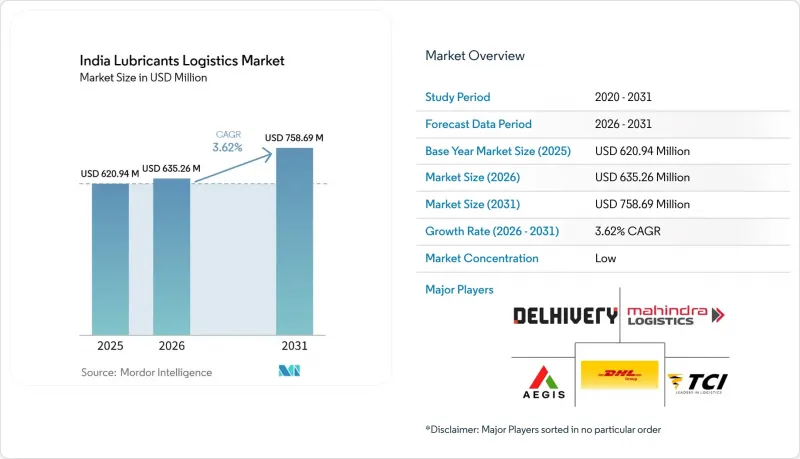
Demand is being supported by stronger commercial vehicle activity and firmer industrial output, which together are keeping refill cycles active across transport and factory-linked channels. This report is Segmented by Service Type (Transportation, Warehousing and Distribution, and More), by Handling/Shipment Format (Bulk Liquid, Ibcs, Drums, Small Retail & Commercial), and by End-User Industry (Automotive, Heavy Equipment, Steel and Metal Machining, Energy/Power Generation, Textile, Marine, Aerospace, and Others). The Market Forecasts are Provided in Terms of Value (USD).
India Lubricants Logistics Market Trends and Insights
Rising Vehicle Parc and Commercial Fleet Intensity
India's commercial vehicle base is moving through a renewal phase that keeps lubricant demand active and raises delivery frequency across service networks. Commercial vehicle retail sales reached 1,060,906 units in FY2026, which was the first time the segment crossed 10 lakh units, and sales rose 11.74% year over year. A larger operating fleet means more routine oil changes, more workshop visits, and tighter reorder cycles across highway-led service corridors. That pushes the India lubricants logistics market toward denser less-than-truckload runs, especially where fleet garages and dealer workshops cluster near freight routes. As BS-VI trucks replace older vehicles, lubricant handling requirements become more specification-sensitive, which increases the value of controlled delivery and accurate stock positioning.
Manufacturing, Construction, and Mining Activity Lifting Industrial Lubricant Flows
Industrial activity is sustaining a strong pull on hydraulic fluids, gear oils, and metalworking fluids across plant-heavy corridors. MoSPI recorded 8.1% manufacturing output growth in December 2025, and the updated series showed manufacturing growth at 6.2% year over year in April 2026, while capital goods rose 16.0%, signaling continued additions to productive capacity. The Government of India's Economic Survey FY2026 also placed industrial GVA growth at 6.2% for the year and manufacturing GVA growth at 9.13% in Q2 FY2026. Even as equipment sales softened during the transition to emission norms, the existing installed fleet still required preventive maintenance and steady lubricant replenishment. The India lubricants logistics market therefore benefits not only from more industrial output, but also from a higher-value lubricant mix that needs cleaner storage, better dispatch control, and more disciplined handling.
Base-Oil Import Dependence and Raw-Material Volatility
Base-oil dependence remains the clearest supply-side risk for the India lubricants logistics market. India relied heavily on imported base oil in 2025, and that leaves blenders exposed to freight cost changes, geopolitical disruptions, and overseas refinery run-rate decisions. When inbound supply tightens, production planning at blending sites absorbs the first shock and logistics networks then face uneven dispatch patterns, sudden stock draws, and weaker asset utilization. Buffer storage near ports and blending plants can reduce some of that risk, but it also raises capital intensity and works poorly in soft demand phases. This keeps returns under pressure for operators that commit too much capacity to volatility protection without stable contract recovery.
Other drivers and restraints analyzed in the detailed report include:
- Post-GST Warehouse Consolidation and 3PL Adoption
- Premium and Synthetic Lubricant Shift Increasing Handling Complexity
- EV Transition Moderating Long-Run Engine-Oil Throughput in Select Channels
For complete list of drivers and restraints, kindly check the Table Of Contents.
Segment Analysis
Transportation represented 71.09% of the India lubricants logistics market share in 2025, which kept it as the largest service category. That lead came from the heavy volume of road-led movement between blending plants, depots, workshops, and industrial users. Warehousing and distribution still played an important support role because they absorbed import timing mismatches and seasonal stock builds.
Value-added services are forecast to grow at a 5.12% CAGR through 2031, which makes them the fastest-growing service segment. This part of the India lubricants logistics market is benefiting from more outsourcing of inventory management, repacking, relabeling, and kitting. The deeper reason is the rising complexity of SKUs across viscosity grades, base stocks, and use cases. More product variants mean more pick-pack combinations, more labeling checkpoints, and more order customization across dealers, workshops, and industrial buyers. That favors logistics partners with warehouse systems, compliant handling areas, and disciplined documentation. BIS labeling and quality requirements further strengthen the case for larger providers with certified infrastructure. As a result, value-added work is growing faster than pure transport, and it is steadily becoming a more important revenue pool within the India lubricants logistics industry.
Complete Report Scope:
- By Service Type
- Transportation
- Road
- Full-Truck-Load (FTL)
- Less than-Truck-Load (LTL)
- Rail
- Multimodal Transport
- Road
- Warehousing and Distribution
- Value-added Services (Inventory management, Repacking, Relabeling, and Kitting etc.)
- Transportation
- By Handling / Shipment Format
- Bulk liquid
- Intermediate Bulk Containers (IBCs)
- Drums
- Small Retail and Commercial (Bottles and Jerry Cans, Stand-up Pouches, Pails, Kegs, etc.)
- By End-user Industry
- Automotive
- Heavy Equipment
- Steel and Metal Machining
- Energy/Power Generation
- Industrial Manufacturing
- Textile
- Marine
- Aerospace
- Other End-user Industries
List of Companies Covered in this Report:
- 20Cube Logistics Pte. Ltd.
- Aegis Logistics Ltd.
- Allcargo Logistics Limited
- CJ Darcl Logistics Limited
- DHL Group
- DSV A/S
- Express Roadways Private Limited
- K D Supply Chain Solutions Pvt. Ltd.
- Kuehne+Nagel
- Mahindra Logistics, Ltd.
- MTI Logistics
- Nippon Express Holdings
- Om Logistics Limited
- Safexpress Private Limited
- Siddhartha Logistics Co. Pvt. Ltd.
- Toll Holdings Limited
- Transport Corporation of India Limited
- V Power Logistics
- Varuna Group
- VRL Logistics Limited
Additional Benefits:
- The market estimate (ME) sheet in Excel format
- 3 months of analyst support
TABLE OF CONTENTS
1 Introduction
- 1.1 Study Assumptions and Market Definition
- 1.2 Scope of the Study
2 Research Methodology
3 Executive Summary
4 Market Landscape
- 4.1 Market Overview
- 4.2 Market Drivers
- 4.2.1 Rising Vehicle Parc and Commercial Fleet Intensity
- 4.2.2 Manufacturing, Construction, and Mining Activity Lifting Industrial Lubricant Flows
- 4.2.3 Post-GST Warehouse Consolidation and 3PL Adoption
- 4.2.4 Premium and Synthetic Lubricant Shift Increasing Handling Complexity
- 4.2.5 Taluka-Level Availability Gaps Increasing District-Deep Replenishment Demand
- 4.2.6 Used-Oil EPR Expanding Reverse-Logistics Requirements
- 4.3 Market Restraints
- 4.3.1 Base-Oil Import Dependence and Raw-Material Volatility
- 4.3.2 EV Transition Moderating Long-Run Engine-Oil Throughput in Select Channels
- 4.3.3 Hazardous-Goods Compliance and Lubricant-Compliant Warehousing Capex
- 4.3.4 Channel Opacity Reducing True Retail-Demand Visibility
- 4.4 Value Chain Analysis
- 4.5 Regulatory Landscape
- 4.6 Technological Outlook
- 4.7 Porter's Five Forces Analysis
- 4.7.1 Bargaining Power of Suppliers
- 4.7.2 Bargaining Power of Buyers
- 4.7.3 Threat of New Entrants
- 4.7.4 Threat of Substitutes
- 4.7.5 Intensity of Competitive Rivalry
- 4.8 Impact of Geopolitical Events on the Market
5 Market Size and Growth Forecasts (Value)
- 5.1 By Service Type
- 5.1.1 Transportation
- 5.1.1.1 Road
- 5.1.1.1.1 Full-Truck-Load (FTL)
- 5.1.1.1.2 Less than-Truck-Load (LTL)
- 5.1.1.2 Rail
- 5.1.1.3 Multimodal Transport
- 5.1.1.1 Road
- 5.1.2 Warehousing and Distribution
- 5.1.3 Value-added Services (Inventory management, Repacking, Relabeling, and Kitting etc.)
- 5.1.1 Transportation
- 5.2 By Handling / Shipment Format
- 5.2.1 Bulk liquid
- 5.2.2 Intermediate Bulk Containers (IBCs)
- 5.2.3 Drums
- 5.2.4 Small Retail and Commercial (Bottles and Jerry Cans, Stand-up Pouches, Pails, Kegs, etc.)
- 5.3 By End-user Industry
- 5.3.1 Automotive
- 5.3.2 Heavy Equipment
- 5.3.3 Steel and Metal Machining
- 5.3.4 Energy/Power Generation
- 5.3.5 Industrial Manufacturing
- 5.3.6 Textile
- 5.3.7 Marine
- 5.3.8 Aerospace
- 5.3.9 Other End-user Industries
6 Competitive Landscape
- 6.1 Market Concentration
- 6.2 Strategic Moves
- 6.3 Market Share Analysis
- 6.4 Company Profiles (Includes Global Level Overview, Market Level Overview, Core Segments, Financials as Available, Strategic Information, Market Rank/Share for Key Companies, Products and Services, and Recent Developments)
- 6.4.1 20Cube Logistics Pte. Ltd.
- 6.4.2 Aegis Logistics Ltd.
- 6.4.3 Allcargo Logistics Limited
- 6.4.4 CJ Darcl Logistics Limited
- 6.4.5 DHL Group
- 6.4.6 DSV A/S
- 6.4.7 Express Roadways Private Limited
- 6.4.8 K D Supply Chain Solutions Pvt. Ltd.
- 6.4.9 Kuehne+Nagel
- 6.4.10 Mahindra Logistics, Ltd.
- 6.4.11 MTI Logistics
- 6.4.12 Nippon Express Holdings
- 6.4.13 Om Logistics Limited
- 6.4.14 Safexpress Private Limited
- 6.4.15 Siddhartha Logistics Co. Pvt. Ltd.
- 6.4.16 Toll Holdings Limited
- 6.4.17 Transport Corporation of India Limited
- 6.4.18 V Power Logistics
- 6.4.19 Varuna Group
- 6.4.20 VRL Logistics Limited
7 Market Opportunities and Future Outlook
- 7.1 White-space and unmet-need assessment

