PUBLISHER: Mordor Intelligence | PRODUCT CODE: 2099841

PUBLISHER: Mordor Intelligence | PRODUCT CODE: 2099841
Education Enterprise Content Management (ECM) - Market Share Analysis, Industry Trends & Statistics, Growth Forecasts (2026 - 2031)
According to Mordor Intelligence, the education enterprise content management (ECM) market size is projected to be USD 1.40 billion in 2025, USD 1.62 billion in 2026, and reach USD 3.53 billion by 2031, growing at a CAGR of 16.86% from 2026 to 2031.
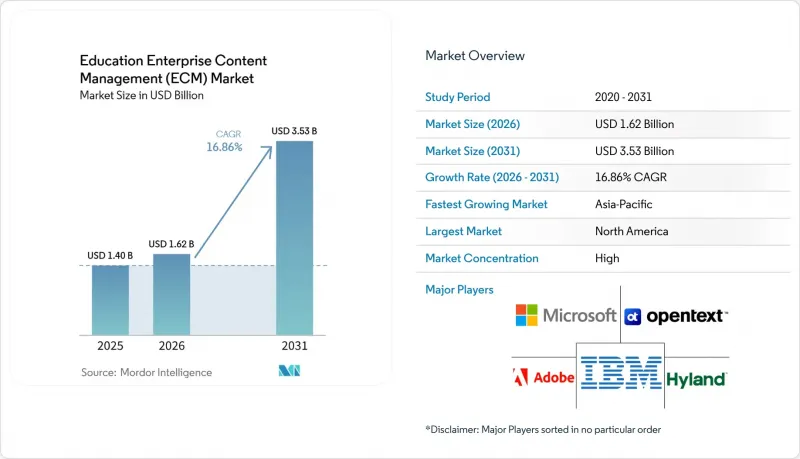
This report is Segmented by Solution Type (Document Management, Records Management, Workflow and Business Process Management, Case Management, and More), Deployment Mode (On-Premises, Cloud, and Hybrid), Enterprise Size (Small and Medium Enterprises, and Large Enterprises), Institution Type (K-12, and More), and Geography. The Market Forecasts are Provided in Terms of Value (USD).
Global Education Enterprise Content Management (ECM) Market Trends and Insights
AI-Driven Content Search, Tagging, and Retrieval in Learning Workflows
AI search and tagging are changing how the education enterprise content management (ECM) market serves faculty, administrators, and students. Semantic retrieval lets users query archived content in plain language instead of relying on rigid keyword rules. IBM launched the Content Cortex Essentials Edition in June 2026, featuring AI agents that classify, organize, and update documents at very high ingestion volumes while preserving security and governance. In the education enterprise content management (ECM) market, that kind of automation matters most for research universities and large education systems that manage grant files, course materials, and archives in many formats. The result is that content repositories are becoming more usable as living institutional knowledge bases rather than passive storage systems.
Multi-Campus Cloud Migration for Unified Content Governance
Cloud migration is accelerating because the education enterprise content management (ECM) market now faces governance fragmentation across campuses, departments, and satellite sites. Institutions are using cloud programs to standardize policies, improve content access, and reduce dependence on separate local repositories. The University of Maryland Libraries completed a full data center cloud migration on AWS in 2025, moving 95 TB of storage and shutting down all on-campus data center operations in less than 6 months. Hyland strengthened this direction in June 2026 by bringing its Content Innovation Cloud to Microsoft Azure with geography-specific data residency options and Microsoft Marketplace availability. In the education enterprise content management (ECM) market, cloud consolidation is therefore becoming a governance redesign program rather than just an infrastructure change.
Legacy Stack Integration Complexity Across Campus Systems
Legacy systems remain a major brake on the education enterprise content management (ECM) market because many institutions still run older SIS, ERP, and records systems built in isolation. These systems often have limited interfaces, proprietary data structures, and deeply embedded departmental workflows. EDUCAUSE reported that system integration remained the top technology challenge for institutions, which shows why ECM rollouts still face technical friction even when demand is strong. In the education enterprise content management (ECM) market, migration is difficult because schools must redesign processes and integrate software. This extends deployment timelines and increases the risk that institutions adopt governance tools only partially.
Other drivers and restraints analyzed in the detailed report include:
- Interoperability Pressure Between ECM, LMS, SIS, and ERP Platforms
- Record Retention, Auditability, and Accessibility Compliance for Student Content
- Budget Cycles and Public Procurement Delays in Education Institutions
For complete list of drivers and restraints, kindly check the Table Of Contents.
Segment Analysis
Document management accounted for 20.14% of the education enterprise content management (ECM) market in 2025, making it the largest solution category. Its lead reflects the need for a reliable layer that can capture, store, retrieve, and control admissions files, financial aid records, contracts, transcripts, and accreditation evidence before wider automation is added. In the education enterprise content management (ECM) market, this category stays central because institutions usually cannot standardize approvals, retention, or case workflows until core document control is in place. California Baptist University used Laserfiche to support a paperless registrar and accounting environment while integrating record access with Banner SIS, demonstrating how document management often serves as the starting point for broader institutional workflow improvement.
Workflow and business process management is projected to expand at a 19.42% CAGR through 2031, making it the fastest-growing solution type in the education enterprise content management (ECM) market. Schools are automating admissions routing, financial aid verification, student conduct handling, staff onboarding, and other processes where delays affect service quality and enrollment outcomes. Digital asset management is also gaining importance as institutions manage larger libraries of video lessons, simulations, and interactive content that require version control and rights oversight. Web content management is drawing renewed attention as the education enterprise content management (ECM) market moves toward unified governance across public websites, intranets, student portals, and learning platforms.
Cloud accounted for 74.41% of the education enterprise content management (ECM) market in 2025, making it the dominant deployment model. Institutions value cloud delivery because it supports common access across campuses, stronger disaster recovery, and less local infrastructure maintenance. In the education enterprise content management (ECM) market, cloud is also helping schools better manage governance across distributed operations and remote learning environments. Hyland and OpenText have both emphasized cloud environments that address residency and governance needs at the infrastructure and content-control level.
Cloud is also projected to expand at a 18.83% CAGR through 2031, keeping it the fastest-growing deployment model in the education enterprise content management (ECM) market. On-premises systems remain in use where national rules or internal policies limit off-site storage of student data. Hybrid setups are gaining ground among research-heavy institutions that want to keep some sensitive workloads in local environments while moving administrative content into managed cloud services. EDUCAUSE noted that cloud-based services are expected to manage a larger share of higher education IT environments over the next few years, which supports continued cloud-led procurement in the education enterprise content management (ECM) market.
Complete Report Scope:
- By Solution Type
- Document Management
- Records Management
- Workflow and Business Process Management
- Case Management
- Digital Asset Management
- Web Content Management
- Other Solutions
- By Deployment Mode
- On-Premises
- Cloud
- Hybrid
- By Enterprise Size
- Small and Medium Enterprises (SME)
- Large Enterprises
- By Institution Type
- K-12
- Higher Education
- Corporate And Professional Education
- Government and Non-Profit
- By Geography
- North America
- United States
- Canada
- Mexico
- South America
- Brazil
- Argentina
- Rest of South America
- Europe
- United Kingdom
- Germany
- France
- Rest of Europe
- Asia-Pacific
- China
- Japan
- India
- South Korea
- Australia
- Rest of Asia-Pacific
- Middle East
- United Arab Emirates
- Saudi Arabia
- Rest of Middle East
- Africa
- South Africa
- Kenya
- Rest of Africa
- North America
Geography Analysis
North America held 41.14% of the education enterprise content management (ECM) market share in 2025, making it the largest regional market. The region benefits from a dense base of institutions, a mature enterprise software ecosystem, and strong privacy and accessibility expectations that make governed content systems more necessary than simple storage tools. Microsoft expanded this environment further in June 2026 by introducing new AI-powered teaching capabilities in Microsoft 365 Education and linking them to Canvas, Brightspace, Moodle, and Schoology via LTI integrations. In the education enterprise content management (ECM) market, North America also remains a key testing ground for workflow improvements, as institutions seek faster approvals, cleaner audit trails, and better coordination across academic and administrative systems.
Asia-Pacific is projected to expand at a 19.24% CAGR through 2031, which makes it the fastest-growing region in the education enterprise content management (ECM) market. India's National Education Policy 2020 digital infrastructure push is shaping procurement cycles across universities and colleges in 2025 and 2026. Many institutions across the region are moving from paper-heavy records environments to governed cloud repositories that can support student services and digital learning growth. Europe remains an important region in the education enterprise content management (ECM) market because privacy rules, records retention requirements, and research documentation standards continue to favor auditable content systems. The NIH updated the format requirements for Data Management and Sharing Plan submissions, effective May 25, 2026, reinforcing more formal research documentation practices for universities active in global research networks.
South America, the Middle East, and Africa remain smaller in scale, but each is carving out a distinct path in the education enterprise content management (ECM) market. Brazil and Argentina are leading South American adoption as universities continue to digitize administrative records and reduce dependence on paper-heavy processes. The UAE Higher Colleges of Technology used OpenText Documentum to support a zero-bureaucracy transformation across campuses, which shows how national modernization agendas are shaping the education enterprise content management (ECM) market in the Middle East. African adoption remains at an earlier stage and leans toward a cloud-first approach, which lets institutions gain governance capabilities without a major on-premises buildout.
- Microsoft Corporation
- Adobe Inc.
- OpenText Corporation
- IBM Corporation
- Hyland Software, Inc.
- Box, Inc.
- Laserfiche
- DocuWare GmbH
- M-Files Corporation
- Alfresco Software, Inc.
- Oracle Corporation
- SAP SE
- Anthology Inc.
- Instructure Holdings, Inc.
- D2L Inc.
- PowerSchool Holdings, Inc.
- Ellucian Company L.P.
- Moodle Pty Ltd
- Workday, Inc.
- ServiceNow, Inc.
Additional Benefits:
- The market estimate (ME) sheet in Excel format
- 3 months of analyst support
TABLE OF CONTENTS
1 INTRODUCTION
- 1.1 Study Assumptions and Market Definition
- 1.2 Scope of the Study
2 RESEARCH METHODOLOGY
3 EXECUTIVE SUMMARY
4 MARKET LANDSCAPE
- 4.1 Market Overview
- 4.2 Market Drivers
- 4.2.1 AI-Driven Content Search, Tagging, and Retrieval In Learning Workflows
- 4.2.2 Multi-Campus Cloud Migration for Unified Content Governance
- 4.2.3 Interoperability Pressure Between ECM, LMS, SIS, and ERP Platforms
- 4.2.4 Record Retention, Auditability, and Accessibility Compliance for Student Content
- 4.2.5 Growth In Digital Credentials, Micro-Credentials, and Evidence-Based Assessment Repositories
- 4.2.6 Research Data, Grant Documentation, and Institutional Knowledge Preservation Needs
- 4.3 Market Restraints
- 4.3.1 Legacy Stack Integration Complexity Across Campus Systems
- 4.3.2 Budget Cycles And Public Procurement Delays in Education Institutions
- 4.3.3 Data Residency, Privacy, and Student Consent Constraints
- 4.3.4 Faculty And Administrator Change Resistance in Content Standardization Programs
- 4.4 Industry Value-Chain Analysis
- 4.5 Regulatory Landscape
- 4.6 Technological Outlook
- 4.7 Impact of Macroeconomic Factors on the Market
- 4.8 Porter's Five Forces Analysis
- 4.8.1 Threat of New Entrants
- 4.8.2 Bargaining Power of Buyers
- 4.8.3 Bargaining Power of Suppliers
- 4.8.4 Threat of Substitutes
- 4.8.5 Intensity of Competitive Rivalry
5 MARKET SIZE AND GROWTH FORECASTS (VALUE)
- 5.1 By Solution Type
- 5.1.1 Document Management
- 5.1.2 Records Management
- 5.1.3 Workflow and Business Process Management
- 5.1.4 Case Management
- 5.1.5 Digital Asset Management
- 5.1.6 Web Content Management
- 5.1.7 Other Solutions
- 5.2 By Deployment Mode
- 5.2.1 On-Premises
- 5.2.2 Cloud
- 5.2.3 Hybrid
- 5.3 By Enterprise Size
- 5.3.1 Small and Medium Enterprises (SME)
- 5.3.2 Large Enterprises
- 5.4 By Institution Type
- 5.4.1 K-12
- 5.4.2 Higher Education
- 5.4.3 Corporate And Professional Education
- 5.4.4 Government and Non-Profit
- 5.5 By Geography
- 5.5.1 North America
- 5.5.1.1 United States
- 5.5.1.2 Canada
- 5.5.1.3 Mexico
- 5.5.2 South America
- 5.5.2.1 Brazil
- 5.5.2.2 Argentina
- 5.5.2.3 Rest of South America
- 5.5.3 Europe
- 5.5.3.1 United Kingdom
- 5.5.3.2 Germany
- 5.5.3.3 France
- 5.5.3.4 Rest of Europe
- 5.5.4 Asia-Pacific
- 5.5.4.1 China
- 5.5.4.2 Japan
- 5.5.4.3 India
- 5.5.4.4 South Korea
- 5.5.4.5 Australia
- 5.5.4.6 Rest of Asia-Pacific
- 5.5.5 Middle East
- 5.5.5.1 United Arab Emirates
- 5.5.5.2 Saudi Arabia
- 5.5.5.3 Rest of Middle East
- 5.5.6 Africa
- 5.5.6.1 South Africa
- 5.5.6.2 Kenya
- 5.5.6.3 Rest of Africa
- 5.5.1 North America
6 COMPETITIVE LANDSCAPE
- 6.1 Market Concentration
- 6.2 Strategic Moves
- 6.3 Market Share Analysis
- 6.4 Company Profiles (includes Global Level Overview, Market Level Overview, Core Segments, Financials as Available, Strategic Information, Market Rank/Share for Key Companies, Products and Services, and Recent Developments)
- 6.4.1 Microsoft Corporation
- 6.4.2 Adobe Inc.
- 6.4.3 OpenText Corporation
- 6.4.4 IBM Corporation
- 6.4.5 Hyland Software, Inc.
- 6.4.6 Box, Inc.
- 6.4.7 Laserfiche
- 6.4.8 DocuWare GmbH
- 6.4.9 M-Files Corporation
- 6.4.10 Alfresco Software, Inc.
- 6.4.11 Oracle Corporation
- 6.4.12 SAP SE
- 6.4.13 Anthology Inc.
- 6.4.14 Instructure Holdings, Inc.
- 6.4.15 D2L Inc.
- 6.4.16 PowerSchool Holdings, Inc.
- 6.4.17 Ellucian Company L.P.
- 6.4.18 Moodle Pty Ltd
- 6.4.19 Workday, Inc.
- 6.4.20 ServiceNow, Inc.
7 MARKET OPPORTUNITIES AND FUTURE OUTLOOK
- 7.1 White-Space and Unmet-Need Assessment

