
PUBLISHER: Mordor Intelligence | PRODUCT CODE: 2099843

PUBLISHER: Mordor Intelligence | PRODUCT CODE: 2099843
United Kingdom Enterprise Content Management (ECM) - Market Share Analysis, Industry Trends & Statistics, Growth Forecasts (2026 - 2031)
According to Mordor Intelligence, the United Kingdom enterprise content management (ECM) market size was valued at USD 2.03 billion in 2025 and USD 2.23 billion in 2026, and is forecast to reach USD 3.76 billion by 2031, growing at an 11.01% CAGR during 2026-2031.
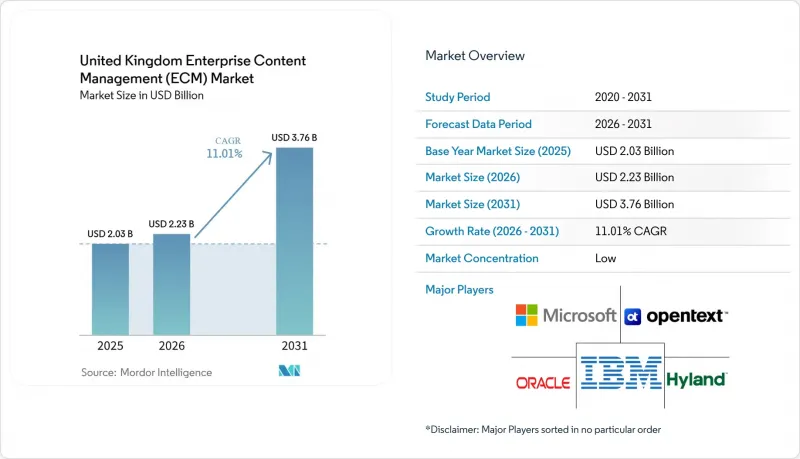
This report is Segmented by Solution Type (Document Management, Records Management, and More), Deployment Mode (On-Premises, Cloud, and Hybrid), Enterprise Size (Small and Medium Enterprises, and Large Enterprises), and End-User Industry (BFSI, Government and Public Sector, IT and Telecommunications, and More). The Market Forecasts are Provided in Terms of Value (USD).
United Kingdom Enterprise Content Management (ECM) Market Trends and Insights
Rising Digital Transformation Across UK Enterprises
The United Kingdom enterprise content management (ECM) market is gaining from a wider shift in business digitization, but many organizations still operate with uneven content practices across departments. A large share of firms already use cloud tools, yet enterprise-wide standardization of content flows, approval chains, and record handling remains incomplete, leaving room for deeper platform adoption. This gap matters because storing files in digital systems is not the same as governing them through searchable, policy-based repositories and connected workflows. The United Kingdom enterprise content management (ECM) market therefore benefits as transformation programs move from basic software rollout to process redesign, information control, and automation. Public sector modernization efforts are also reinforcing this direction by keeping document infrastructure, digital records, and service delivery systems on national procurement agendas.
Compliance-Driven Content Governance and Auditability
Regulatory pressure is making controlled document handling a day-to-day operating requirement across the United Kingdom enterprise content management (ECM) market. Financial services firms, government bodies, healthcare providers, and other regulated organizations all need stronger retention logic, clearer version control, and better proof of who accessed or changed a file. This is shifting purchase priorities toward platforms that support audit trails, record retention policies, defensible deletion, and secure retrieval without extensive customization. Buyers are also putting more weight on systems that can support AI use without weakening documentation standards or internal governance. In the United Kingdom enterprise content management (ECM) market, this keeps compliance-linked demand resilient even when broader technology budgets face scrutiny.
Integration Complexity with Legacy Line-of-Business Systems
Integration remains one of the clearest limits on how quickly the United Kingdom enterprise content management (ECM) market can scale across older enterprise estates. Large banks, insurers, and public institutions often run policy, claims, benefits, finance, or case systems that were built before current API standards became common. That makes document connectivity slower, more service-intensive, and more expensive than software buyers first expect. Even where vendors offer prebuilt connectors, teams still need to align fields, reconcile inconsistent metadata, and test access rules across multiple repositories. This means many large deployments in the United Kingdom enterprise content management (ECM) market still behave like multi-stage transformation programs rather than simple software implementations.
Other drivers and restraints analyzed in the detailed report include:
- AI-Based Content Classification and Search Accuracy Gains
- Cloud Migration of Legacy Document Repositories
- Data Residency and Sovereignty Constraints for Sensitive Content
For complete list of drivers and restraints, kindly check the Table Of Contents.
Segment Analysis
Document Management held 30.42% of the United Kingdom enterprise content management (ECM) market share in 2025, making it the largest solution category in the portfolio. This lead reflects the steady need to digitize, index, store, and retrieve business-critical records in regulated environments. Banks, legal firms, public institutions, and healthcare providers all manage high volumes of contracts, forms, case files, and controlled records that still require strong document discipline. Records Management and Case Management also remain important because many organizations need formal retention schedules, complete case histories, and evidence trails that support audits and reviews.
The United Kingdom enterprise content management (ECM) market is now moving beyond simple storage toward more active process execution. Workflow and Business Process Management is projected to grow at a 13.61% CAGR through 2031, which makes it the fastest-growing solution segment in the mix. Demand is shifting toward systems that can route approvals, escalate exceptions, link documents to ERP and CRM steps, and reduce manual handoffs between teams. Microsoft's Copilot-related SharePoint development also points to a stronger buyer expectation for action-oriented content workflows rather than passive repositories.
Cloud captured 77.18% of the United Kingdom enterprise content management (ECM) market in 2025, confirming that SaaS delivery has become the default choice for most new deployments. Buyers prefer cloud models because they reduce infrastructure maintenance, shorten upgrade cycles, and make it easier to scale storage and workflow capacity. This model also aligns well with subscription pricing, which lowers entry barriers for organizations that do not want large upfront license commitments. At the same time, on-premises deployments remain relevant in defense, high-security public workloads, and some tightly controlled financial environments.
Cloud is also the fastest-growing deployment model, with a projected 14.03% CAGR through 2031. The United Kingdom enterprise content management (ECM) market still leaves a clear role for hybrid architecture because many large enterprises need both controlled local repositories and cloud-based automation. Hybrid adoption is strongest when firms want to preserve sensitive content on internal infrastructure while using cloud tools for collaboration, AI, or broader workflow reach. Hyland's Azure-focused partnership highlights how vendors are positioning around regional deployment flexibility, data residency, and multi-region support for enterprise buyers.
Complete Report Scope:
- By Solution Type
- Document Management
- Records Management
- Workflow and Business Process Management
- Case Management
- Digital Asset Management
- Web Content Management
- Other Solutions
- By Deployment Mode
- On-Premises
- Cloud
- Hybrid
- By Enterprise Size
- Small and Medium Enterprises
- Large Enterprises
- By End-User Industry
- BFSI
- Government and Public Sector
- Healthcare
- IT and Telecommunications
- Manufacturing
- Retail
- Media and Entertainment
- Education
- Energy and Utilities
- Other End-User Industries
List of Companies Covered in this Report:
- Microsoft Corporation
- IBM Corporation
- Oracle Corporation
- SAP SE
- Adobe Inc.
- OpenText Corporation
- Box, Inc.
- Hyland Software, Inc.
- Laserfiche
- M-Files Corporation
- Newgen Software Technologies Limited
- DocuWare GmbH
- Alfresco Software, Ltd.
- SERgroup Holding International GmbH
- Fabasoft AG
- Objective Corporation Limited
- Nuxeo Corporation
- Systemware, Inc.
- KnowledgeLake, Inc.
- DocStar
Additional Benefits:
- The market estimate (ME) sheet in Excel format
- 3 months of analyst support
TABLE OF CONTENTS
1 INTRODUCTION
- 1.1 Study Assumptions and Market Definition
- 1.2 Scope of the Study
2 RESEARCH METHODOLOGY
3 EXECUTIVE SUMMARY
4 MARKET LANDSCAPE
- 4.1 Market Overview
- 4.2 Market Drivers
- 4.2.1 Rising Digital Transformation Across UK Enterprises
- 4.2.2 Compliance-Driven Content Governance and Auditability
- 4.2.3 AI-Based Content Classification and Search Accuracy Gains
- 4.2.4 Cloud Migration of Legacy Document Repositories
- 4.2.5 Hybrid Workforces Requiring Secure Content Access
- 4.2.6 Sector-Specific Modernization in BFSI, Healthcare, and Government
- 4.3 Market Restraints
- 4.3.1 Integration Complexity with Legacy Line-of-Business Systems
- 4.3.2 Data Residency and Sovereignty Constraints for Sensitive Content
- 4.3.3 High Cost of Migration, Metadata Cleanup, and Change Management
- 4.3.4 Skills Shortage in ECM, Information Governance, and Automation
- 4.4 Industry Value-Chain Analysis
- 4.5 Regulatory Landscape
- 4.6 Technological Outlook
- 4.7 Impact of Macroeconomic Factors on the Market
- 4.8 Porter's Five Forces Analysis
- 4.8.1 Threat of New Entrants
- 4.8.2 Bargaining Power of Buyers
- 4.8.3 Bargaining Power of Suppliers
- 4.8.4 Threat of Substitutes
- 4.8.5 Intensity of Competitive Rivalry
5 MARKET SIZE AND GROWTH FORECASTS (VALUE)
- 5.1 By Solution Type
- 5.1.1 Document Management
- 5.1.2 Records Management
- 5.1.3 Workflow and Business Process Management
- 5.1.4 Case Management
- 5.1.5 Digital Asset Management
- 5.1.6 Web Content Management
- 5.1.7 Other Solutions
- 5.2 By Deployment Mode
- 5.2.1 On-Premises
- 5.2.2 Cloud
- 5.2.3 Hybrid
- 5.3 By Enterprise Size
- 5.3.1 Small and Medium Enterprises
- 5.3.2 Large Enterprises
- 5.4 By End-User Industry
- 5.4.1 BFSI
- 5.4.2 Government and Public Sector
- 5.4.3 Healthcare
- 5.4.4 IT and Telecommunications
- 5.4.5 Manufacturing
- 5.4.6 Retail
- 5.4.7 Media and Entertainment
- 5.4.8 Education
- 5.4.9 Energy and Utilities
- 5.4.10 Other End-User Industries
6 COMPETITIVE LANDSCAPE
- 6.1 Market Concentration
- 6.2 Strategic Moves
- 6.3 Market Share Analysis
- 6.4 Company Profiles (includes Global Level Overview, Market Level Overview, Core Segments, Financials as Available, Strategic Information, Market Rank/Share for Key Companies, Products and Services, and Recent Developments)
- 6.4.1 Microsoft Corporation
- 6.4.2 IBM Corporation
- 6.4.3 Oracle Corporation
- 6.4.4 SAP SE
- 6.4.5 Adobe Inc.
- 6.4.6 OpenText Corporation
- 6.4.7 Box, Inc.
- 6.4.8 Hyland Software, Inc.
- 6.4.9 Laserfiche
- 6.4.10 M-Files Corporation
- 6.4.11 Newgen Software Technologies Limited
- 6.4.12 DocuWare GmbH
- 6.4.13 Alfresco Software, Ltd.
- 6.4.14 SERgroup Holding International GmbH
- 6.4.15 Fabasoft AG
- 6.4.16 Objective Corporation Limited
- 6.4.17 Nuxeo Corporation
- 6.4.18 Systemware, Inc.
- 6.4.19 KnowledgeLake, Inc.
- 6.4.20 DocStar
7 MARKET OPPORTUNITIES AND FUTURE OUTLOOK
- 7.1 White-Space and Unmet-Need Assessment

