PUBLISHER: Mordor Intelligence | PRODUCT CODE: 2100531

PUBLISHER: Mordor Intelligence | PRODUCT CODE: 2100531
India Paints and Coatings - Market Share Analysis, Industry Trends & Statistics, Growth Forecasts (2026 - 2031)
According to Mordor Intelligence, the India paints and Coatings Market size is expected to increase from USD 11.45 billion in 2025 to USD 12.51 billion in 2026 and reach USD 19.5 billion by 2031, growing at a CAGR of 9.28% over 2026-2031.
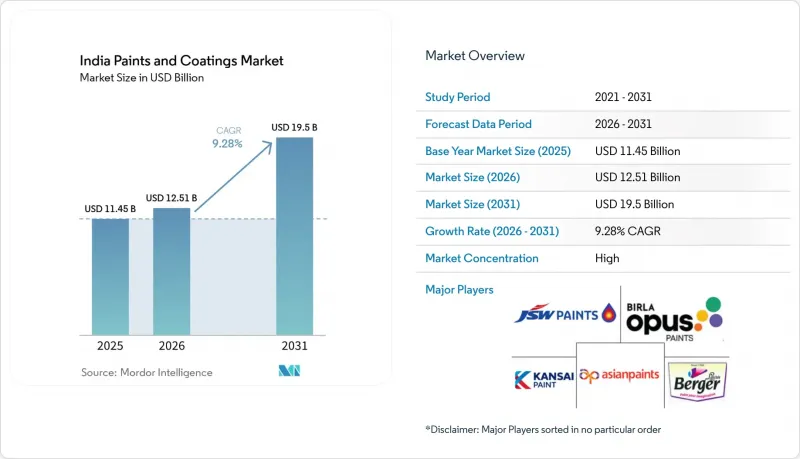
This report is Segmented by Technology (Water-Borne, Solvent-Borne, Powder Coatings, and Other Technologies), Resin Type (Acrylic, Alkyd, Polyurethane, Epoxy, Polyester, and Others), and End-User Industry (Architectural, Automotive, Wood, Protective Coatings, General Industrial, Transportation, and Packaging). The Market Forecasts are Provided in Terms of Value (USD).
India Paints and Coatings Market Trends and Insights
Booming Construction Pipeline (Housing and Infrastructure)
In 2023-24, government capital expenditure surged, marking a threefold increase from FY 2015. Initiatives like the Smart Cities Mission, Bharatmala corridors, and metro-rail expansions are fueling a consistent demand for protective, floor, and architectural coatings. The Jal Jeevan Mission, which has provided rural tap-water connections, is spurring a heightened need for anti-corrosive coatings in treatment plants and pipelines. The Pradhan Mantri Awas Yojana-Urban (PMAY-Urban) has successfully delivered houses by 2024, directly benefiting decorative coating volumes. Meanwhile, industrial coatings are in demand due to the regular maintenance needs of national highways.
Shortening Decorative Re-paint Cycle among Urban Homeowners
Disposable-income gains and digital color-visualization tools are reducing the average repaint interval by 2031. Premium low-odor emulsions allow same-day reoccupation, supporting higher-value product mixes. National manufacturers are using contractor-training programs to position water-borne offerings as cost-effective over a full repaint cycle, countering price-only pitches from local players.
Crude-Linked Raw-Material Price Volatility
In 2024-2025, titanium dioxide (TiO2), a key component constituting a significant portion of paint formulation costs, saw its prices fluctuate. These swings were largely influenced by global supply disruptions and fluctuations in crude oil prices, which in turn impact petrochemical-derived binders and solvents. Inflation in raw materials led to margin compression, with gross margins declining as companies absorbed rising input costs to maintain their volume share. Industry margins also contracted due to heightened competitive intensity, which hampers the industry's ability to fully pass on cost increases. Additionally, volatility in zinc and aluminum prices impacts color-coated steel coatings, commonly used in roofing and cladding. Compounding the challenge, import competition prices these products lower than domestic offerings, further squeezing margins for local manufacturers. The sector grapples with the challenge of passing on raw material inflation. Intense price competition, especially from new entrants like Birla Opus and JSW Paints, has led companies to optimize formulations, trim packaging costs, and ramp up automation efforts to maintain their operating leverage.
Other drivers and restraints analyzed in the detailed report include:
- Post-COVID Recovery in Automotive and Industrial Production
- Emergence of Organised Waterproofing After-market
- Stricter BIS/CPCB VOC and Lead Regulations
For complete list of drivers and restraints, kindly check the Table Of Contents.
Segment Analysis
Water-borne products held 45.41% of India's paints and coatings market share in 2025 and are projected to grow at a 9.72% CAGR through 2031. Regulatory pressure, coupled with improved film-property parity versus solvent systems, underpins adoption in both decorative and general industrial applications. Water-based UV-curable urethane-acrylate systems are gaining a foothold in wood finishes, while powder coatings continue to build in appliance and automotive exterior trims. Solvent solutions still dominate marine and heavy-duty segments that require rapid curing and extreme chemical resistance, but investments in catalytic-oxidation units raise operating costs, nudging OEMs toward hybrid or high-solid alternatives.
Second-generation water-borne emulsions use core-shell and redispersible-powder technologies to overcome scrub-resistance and humidity-cure limitations, enabling faster re-coat windows in tropical climates across the Paint Industry in India. Powder coatings are enjoying growth in the northern manufacturing corridor, supported by appliance cluster expansion around Delhi-NCR. High-solid alkyd and radiation-curable inks fill specialty gaps in metal packaging and flexible-film lamination, diversifying technology portfolios.
Complete Report Scope:
- By Technology
- Water-Borne
- Solvent-borne
- Powder Coatings
- Other Technologies
- By Resin Type
- Acrylic
- Alkyd
- Polyurethane
- Epoxy
- Polyester
- Others
- By End-user Industry
- Architectural
- Automotive
- Wood
- Protective Coatings
- General Industrial
- Transportation
- Packaging
List of Companies Covered in this Report:
- Asian Paints
- Berger Paints India Limited
- Birla Opus
- GEM PAINTS PVT. LTD
- Grand Polycoats Company Pvt. Ltd
- Hempel A/S
- Indigo Paints Ltd
- JKMaxx Paints Ltd
- Jotun
- JSW
- Kansai Paint Co., Ltd. (Kansai Nerolac Paints Limited)
- KCCL
- Nippon Paint Holdings Co. Ltd
- PPG Asian Paints
- Shalimar Paints
- Sheenlac Paints Ltd
- Sirca
- Snowcem Paints
- Surfa Coats India Private Limited
Additional Benefits:
- The market estimate (ME) sheet in Excel format
- 3 months of analyst support
TABLE OF CONTENTS
1 Introduction
- 1.1 Study Assumptions and Market Definition
- 1.2 Scope of the Study
2 Research Methodology
3 Executive Summary
4 Market Landscape
- 4.1 Market Overview
- 4.2 Market Drivers
- 4.2.1 Booming Construction Pipeline (Housing and Infrastructure)
- 4.2.2 Shortening Decorative Re-paint Cycle among Urban Homeowners
- 4.2.3 Post-COVID Recovery in Automotive and Industrial Production
- 4.2.4 Emergence of Organised Waterproofing After-market
- 4.2.5 Capacity-Doubling Plans up to FY-27 Creating Economies of Scale
- 4.3 Market Restraints
- 4.3.1 Crude-Linked Raw-Material Price Volatility
- 4.3.2 Stricter BIS/CPCB VOC and Lead Regulations
- 4.3.3 Margin Compression from Intensifying Price-Based Competition
- 4.4 Value Chain Analysis
- 4.5 Porter's Five Forces
- 4.5.1 Bargaining Power of Suppliers
- 4.5.2 Bargaining Power of Buyers
- 4.5.3 Threat of New Entrants
- 4.5.4 Threat of Substitutes
- 4.5.5 Degree of Competition
5 Market Size and Growth Forecasts (Value)
- 5.1 By Technology
- 5.1.1 Water-Borne
- 5.1.2 Solvent-borne
- 5.1.3 Powder Coatings
- 5.1.4 Other Technologies
- 5.2 By Resin Type
- 5.2.1 Acrylic
- 5.2.2 Alkyd
- 5.2.3 Polyurethane
- 5.2.4 Epoxy
- 5.2.5 Polyester
- 5.2.6 Others
- 5.3 By End-user Industry
- 5.3.1 Architectural
- 5.3.2 Automotive
- 5.3.3 Wood
- 5.3.4 Protective Coatings
- 5.3.5 General Industrial
- 5.3.6 Transportation
- 5.3.7 Packaging
6 Competitive Landscape
- 6.1 Market Concentration
- 6.2 Strategic Moves
- 6.3 Market Share (%)/Ranking Analysis
- 6.4 Company Profiles (includes Global level Overview, Market level overview, Core Segments, Financials as available, Strategic Information, Products and Services, and Recent Developments)
- 6.4.1 Asian Paints
- 6.4.2 Berger Paints India Limited
- 6.4.3 Birla Opus
- 6.4.4 GEM PAINTS PVT. LTD
- 6.4.5 Grand Polycoats Company Pvt. Ltd
- 6.4.6 Hempel A/S
- 6.4.7 Indigo Paints Ltd
- 6.4.8 JKMaxx Paints Ltd
- 6.4.9 Jotun
- 6.4.10 JSW
- 6.4.11 Kansai Paint Co., Ltd. (Kansai Nerolac Paints Limited)
- 6.4.12 KCCL
- 6.4.13 Nippon Paint Holdings Co. Ltd
- 6.4.14 PPG Asian Paints
- 6.4.15 Shalimar Paints
- 6.4.16 Sheenlac Paints Ltd
- 6.4.17 Sirca
- 6.4.18 Snowcem Paints
- 6.4.19 Surfa Coats India Private Limited
7 Market Opportunities and Future Outlook
- 7.1 White-space and Unmet-need Assessment

