PUBLISHER: Mordor Intelligence | PRODUCT CODE: 2100554

PUBLISHER: Mordor Intelligence | PRODUCT CODE: 2100554
Europe LED Packaging - Market Share Analysis, Industry Trends & Statistics, Growth Forecasts (2026 - 2031)
According to Mordor Intelligence, the Europe LED packaging market size is projected to expand from USD 2.81 billion in 2025 and USD 2.89 billion in 2026 to USD 3.50 billion by 2031, registering a CAGR of 3.86% between 2026 and 2031.
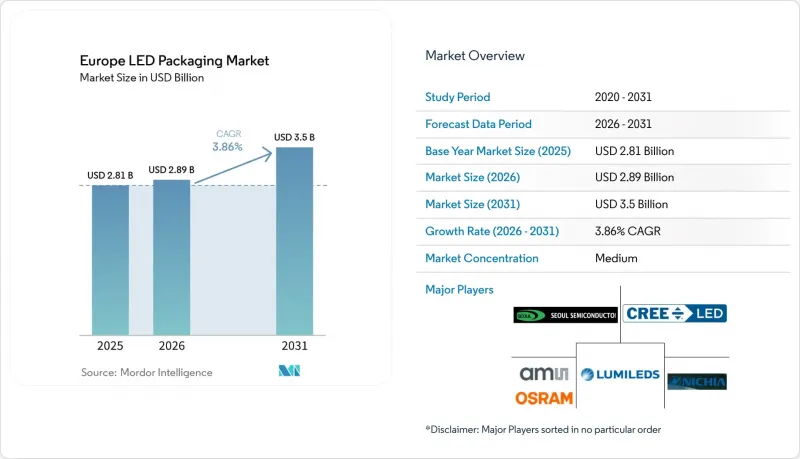
This report is Segmented by Packaging Architecture (SMD, COB, CSP, Flip-Chip, and More), Power Class (Low, Mid, High, and Ultra-High), Emission Type (Visible, IR, and UV), Material Chemistry (Substrates, Encapsulation, and More), Application (General Lighting, Automotive, and More), and Geography. The Market Forecasts are Provided in Terms of Value (USD).
Europe LED Packaging Market Trends and Insights
Surging Mini-LED Backlight Adoption In European TV And Monitor Production
Television brands introduced more than twenty mini-LED models at CES 2026, with European assembly plants in Poland and the Czech Republic ramping module lines that consume CSPs able to endure 260 °C reflow temperatures. Localized dimming zones exceed 1,000 per panel, broadening HDR1400-certified displays and compressing bill-of-materials cost by 30%. These pull-through dynamics elevate unit orders for flip-chip and CSP architectures tailored to direct-lit backlighting.
EU Ecodesign Regulations Phasing-Out Conventional Lighting
The Ecodesign Directive removed T8 fluorescents in 2023 and halogen capsules by September 2025, triggering accelerated retrofit programs such as Berlin's 220,000-fixture swap-out. Minimum efficacy thresholds of 120 lm/W disqualify legacy technologies, forcing municipal buyers toward high-power LED modules that comply with RoHS lead-free mandates.
High CAPEX For Advanced Packaging Lines Below 10 µm Pitch
A sub-10 µm bump-pitch line requires lithography steppers and mass-transfer tools that together exceed EUR 100 million (USD 113 million), stretching payback beyond five years and consolidating production among a few vertically integrated incumbents.
Other drivers and restraints analyzed in the detailed report include:
- Automotive OEM Shift Toward Pixel-LED Headlamps
- Declining Cost Curve Of Flip-Chip CSP Technology
- Supply-Chain Exposure To Asian Substrate Vendors
For complete list of drivers and restraints, kindly check the Table Of Contents.
Segment Analysis
Chip-scale packages are growing at a 4.51% rate as automotive dashboards and consumer devices demand compact footprints and low thermal resistance. The Europe LED packaging market size for CSPs is projected to reach USD 1.11 billion by 2031, while surface-mount devices decline in relative importance as flip-chip designs deliver superior lumen-per-dollar economics. Surface-mount devices accounted for 42.78% of revenue in 2025. Fixture makers increasingly specify CSPs for linear strips where smaller footprints improve heat spreading and enable tighter bend radii. Meanwhile, chip-on-board modules remain favored in stadium floodlights and high-bay industrial luminaires that require uniform beams and simplified optics.
Flip-chip packages bridge the gap between SMD heritage and CSP miniaturization by bonding die directly to ceramic carriers, achieving pixel densities above 10,000 px/cm2. Dual in-line and through-hole formats persist in legacy signage, yet their volume share keeps sliding as supply chains pivot to reflow-capable surface-mount alternatives. Component-level integration of driver and health-monitor circuits, as demonstrated by the OptiLamp series, underscores a roadmap in which package boundaries blur with system modules.
High-power packages (1-3 W) are projected to grow 4.23% annually through 2031, fueled by industrial retrofits and municipality streetlighting where reducing fixture count cuts installation labor. The Europe LED packaging market share for mid-power packages stood at 39.61% in 2025, yet their CAGR trails the segment average because CSPs deliver equivalent output in smaller footprints. Ultra-high-power devices above 3 W target stadium and horticulture installations, but thermal-management constraints cap their volumes.
Copper metal-core PCBs with >380 W/mK conductivity, coupled with ceramic substrates, maintain junction temperatures below 125 °C, thereby extending lumen maintenance. Procurement teams favor high-power LEDs on a total-cost-of-ownership basis, accepting higher unit prices in exchange for fewer luminaires and quicker payback periods.
Complete Report Scope:
- By Packaging Architecture
- Surface Mount Device (SMD)
- Chip-on-Board (COB)
- Chip Scale Package (CSP)
- Flip-Chip LED Packages
- Dual In-line Package (DIP / Through-hole)
- Others (IMD, GOB, Mini-LED display packaging)
- By Power Class
- Low Power (Less Than 0.5 W)
- Mid Power (0.5 - 1 W)
- High Power (1 - 3 W)
- Ultra-High Power (Greater Than 3 W)
- By Emission Type
- Visible LED Packages
- Infrared (IR) LED Packages
- Ultraviolet (UV) LED Packages
- By Material Chemistry
- Substrates
- Encapsulation
- Bonding / Die-Attach
- Phosphors / Coatings
- By Application
- General Lighting
- Automotive Lighting
- Display and Backlighting
- Consumer Electronics
- Industrial and Specialty
- By Geography
- Europe
- United Kingdom
- Germany
- France
- Rest of Europe
- Europe
List of Companies Covered in this Report:
- ams-OSRAM AG
- Lumileds Holding B.V.
- Nichia Corporation
- Seoul Semiconductor Co., Ltd.
- Cree LED
- Everlight Electronics Co., Ltd.
- Samsung Electronics Co., Ltd.
- LG Innotek Co., Ltd.
- Lite-On Technology Corp.
- Citizen Electronics Co., Ltd.
- Dominant Opto Technologies Sdn. Bhd.
- Epistar Corporation
- Lextar Electronics Corp.
- Bridgelux, Inc.
- Seoul Semiconductor Co., Ltd.
- Vishay Intertechnology, Inc.
- Rohm Semiconductor GmbH
- Stanley Electric Co., Ltd.
- Toyoda Gosei Co., Ltd.
Additional Benefits:
- The market estimate (ME) sheet in Excel format
- 3 months of analyst support
TABLE OF CONTENTS
1 INTRODUCTION
- 1.1 Study Assumptions and Market Definition, Scope of the Study
2 RESEARCH METHODOLOGY
3 EXECUTIVE SUMMARY
4 MARKET LANDSCAPE
- 4.1 Market Overview
- 4.2 Industry Value-Chain Analysis
- 4.3 Market Drivers
- 4.3.1 Surging Mini-LED Backlight Adoption in European TV and Monitor Production
- 4.3.2 EU Ecodesign Regulations Phasing-out Conventional Lighting
- 4.3.3 Automotive OEM Shift Toward Pixel-LED Headlamps
- 4.3.4 Declining Cost Curve of Flip-Chip CSP Technology
- 4.3.5 Vertical-integration Strategies of European IDMs
- 4.3.6 On-shoring Incentives via the EU Chips Act
- 4.4 Market Restraints
- 4.4.1 High CAPEX for Advanced Packaging Lines Below 10 µm Pitch
- 4.4.2 Supply-chain Exposure to Asian Substrate Vendors
- 4.4.3 Thermal-management Limits in Ultra-High Power Packages
- 4.4.4 Competition from Emerging Micro-OLED Displays
- 4.5 Regulatory Landscape
- 4.6 Technological Outlook
- 4.7 Impact of Macroeconomic Factors
- 4.8 Porter's Five Forces Analysis
- 4.8.1 Bargaining Power of Suppliers
- 4.8.2 Bargaining Power of Buyers
- 4.8.3 Threat of New Entrants
- 4.8.4 Threat of Substitutes
- 4.8.5 Intensity of Competitive Rivalry
5 MARKET SIZE AND GROWTH FORECASTS (VALUE)
- 5.1 By Packaging Architecture
- 5.1.1 Surface Mount Device (SMD)
- 5.1.2 Chip-on-Board (COB)
- 5.1.3 Chip Scale Package (CSP)
- 5.1.4 Flip-Chip LED Packages
- 5.1.5 Dual In-line Package (DIP / Through-hole)
- 5.1.6 Others (IMD, GOB, Mini-LED display packaging)
- 5.2 By Power Class
- 5.2.1 Low Power (Less Than 0.5 W)
- 5.2.2 Mid Power (0.5 - 1 W)
- 5.2.3 High Power (1 - 3 W)
- 5.2.4 Ultra-High Power (Greater Than 3 W)
- 5.3 By Emission Type
- 5.3.1 Visible LED Packages
- 5.3.2 Infrared (IR) LED Packages
- 5.3.3 Ultraviolet (UV) LED Packages
- 5.4 By Material Chemistry
- 5.4.1 Substrates
- 5.4.2 Encapsulation
- 5.4.3 Bonding / Die-Attach
- 5.4.4 Phosphors / Coatings
- 5.5 By Application
- 5.5.1 General Lighting
- 5.5.2 Automotive Lighting
- 5.5.3 Display and Backlighting
- 5.5.4 Consumer Electronics
- 5.5.5 Industrial and Specialty
- 5.6 By Geography
- 5.6.1 Europe
- 5.6.1.1 United Kingdom
- 5.6.1.2 Germany
- 5.6.1.3 France
- 5.6.1.4 Rest of Europe
- 5.6.1 Europe
6 COMPETITIVE LANDSCAPE
- 6.1 Market Concentration
- 6.2 Strategic Moves
- 6.3 Market Share Analysis
- 6.4 Company Profiles (includes Global Level Overview, Market Level Overview, Core Segments, Financials as available, Strategic Information, Market Rank/Share, Products and Services, Recent Developments)
- 6.4.1 ams-OSRAM AG
- 6.4.2 Lumileds Holding B.V.
- 6.4.3 Nichia Corporation
- 6.4.4 Seoul Semiconductor Co., Ltd.
- 6.4.5 Cree LED
- 6.4.6 Everlight Electronics Co., Ltd.
- 6.4.7 Samsung Electronics Co., Ltd.
- 6.4.8 LG Innotek Co., Ltd.
- 6.4.9 Lite-On Technology Corp.
- 6.4.10 Citizen Electronics Co., Ltd.
- 6.4.11 Dominant Opto Technologies Sdn. Bhd.
- 6.4.12 Epistar Corporation
- 6.4.13 Lextar Electronics Corp.
- 6.4.14 Bridgelux, Inc.
- 6.4.15 Seoul Semiconductor Co., Ltd.
- 6.4.16 Vishay Intertechnology, Inc.
- 6.4.17 Rohm Semiconductor GmbH
- 6.4.18 Stanley Electric Co., Ltd.
- 6.4.19 Toyoda Gosei Co., Ltd.
7 MARKET OPPORTUNITIES AND FUTURE OUTLOOK
- 7.1 White-space and Unmet-Need Assessment

