PUBLISHER: Mordor Intelligence | PRODUCT CODE: 2100595

PUBLISHER: Mordor Intelligence | PRODUCT CODE: 2100595
Spain Foodservice - Market Share Analysis, Industry Trends & Statistics, Growth Forecasts (2026 - 2031)
According to Mordor Intelligence, the Spain foodservice market size was valued at USD 0.17 trillion in 2025 and estimated to grow from USD 0.19 trillion in 2026 to reach USD 0.34 trillion by 2031, at a CAGR of 12.87% during the forecast period (2026-2031).
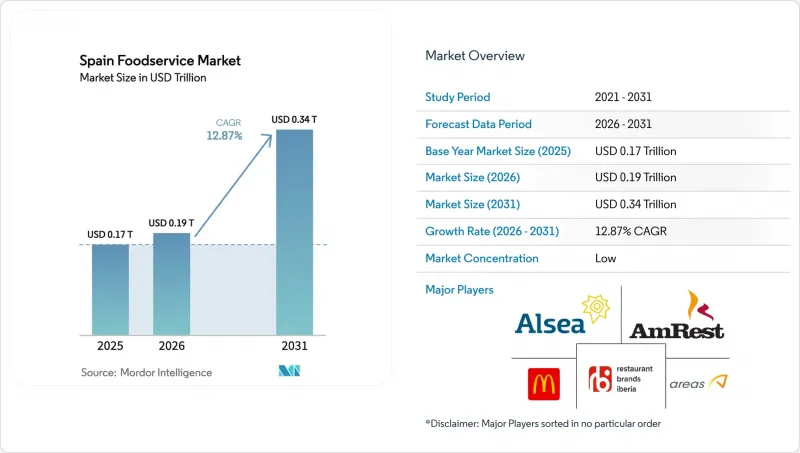
This report is Segmented by Foodservice Type (Cafes and Bars, Cloud Kitchen, Full-Service Restaurants, Quick Service Restaurants and More), Outlet (Chained Outlets and Independent Outlets), Location (Leisure, Lodging, Retail, Standalone, and More), Service Type (Takeaway, Delivery and More). The Market Forecasts are Provided in Terms of Value (USD).
Spain Foodservice Market Trends and Insights
Branded Cafe Formats and Specialty Coffee Chains Rolling Out at Accelerated Pace
Specialty coffee chains are leveraging Spain's cafe culture to convert traditional bar-and-terrace operators into branded, premium-priced destinations. Starbucks, operated under AmRest's franchise agreement, expanded its international footprint by 264 net stores in Q1 fiscal 2025, though the segment faced a 4% comparable-sales decline due to promotional intensity and wage investments that compressed operating margin by 40 basis points to 12.7%. This margin pressure signals that even established coffee brands must discount aggressively to defend traffic, eroding the pricing power that once justified premium real estate. Independent specialty roasters are capturing share by emphasizing single-origin beans and barista craftsmanship, a positioning that resonates with younger consumers willing to pay EUR 3 to EUR 4 for espresso-based drinks versus EUR 1.50 at traditional bars. The shift toward third-wave coffee aesthetics, minimalist interiors, pour-over stations, transparency in sourcing, creates a differentiation moat that legacy chains struggle to replicate without alienating their core convenience-seeking customer base.
Cloud Kitchens and Delivery-Only Models Scaling Up Rapidly
Cloud kitchens are rewriting unit economics by eliminating front-of-house labor and prime-location rent, enabling operators to test multiple virtual brands from a single production facility. The segment is expanding at 13.01% CAGR through 2031, the fastest pace across all foodservice types, as delivery platforms provide turnkey customer acquisition and logistics. However, Glovo's reclassification of riders as employees in 2024 imposed an estimated EUR 100 million in additional costs, forcing the platform to renegotiate commission structures with restaurant partners and pass through higher delivery fees to consumers. This regulatory shift compresses margins for delivery-dependent operators, particularly those without dine-in or takeaway channels to absorb volume fluctuations. Ghost-kitchen aggregators are responding by consolidating production into fewer, larger hubs to achieve density-driven efficiency, yet this centralization increases vulnerability to single-point failures in food safety or equipment downtime.
Cold-Chain Logistics and Perishable Goods Face Reliability Challenges
Temperature-controlled distribution remains a bottleneck for operators sourcing fresh produce, dairy, and proteins, particularly in Spain's island territories and rural interior regions where infrastructure investment lags coastal corridors. EU Regulation 852/2004 mandates continuous cold-chain integrity from farm to fork, yet compliance audits reveal gaps in last-mile delivery, where ambient temperatures during summer months can exceed 35°C and compromise product safety. Independent restaurants lacking centralized procurement absorb higher spoilage rates and must source locally to mitigate risk, a strategy that increases ingredient costs and limits menu standardization. Chains with vertically integrated supply networks, such as McDonald's, which operates dedicated distribution centers, achieve tighter quality control and negotiate volume discounts that independents cannot match. CaixaBank However, this relief is unevenly distributed, benefiting large buyers with forward contracts while spot-market purchasers remain exposed to seasonal volatility.
Other drivers and restraints analyzed in the detailed report include:
- Mobile App-Based Ordering Seeing High Penetration and Fluency
- Dine-Out Habits Deeply Entrenched, Bolstered by Culture of Socializing
- Food Safety Practices and Hygiene Compliance Show Notable Variability
For complete list of drivers and restraints, kindly check the Table Of Contents.
Segment Analysis
Cloud kitchens will expand at 13.01% CAGR through 2031, the fastest rate among foodservice types, as operators exploit asset-light models to serve delivery demand without front-of-house costs. Full-service restaurants held 35.44% market share in 2025, anchored by Spain's entrenched dine-out culture, where lunch spans 2 to 4 pm, and dinner extends from 9 to 11 pm, reflecting social dining norms. Cafe and bar formats benefit from specialty coffee momentum, with Starbucks adding 16 Iberian stores in 2025 and McCafe capturing urban commuters. Vicio's hybrid model, 6 physical restaurants plus 24 dark kitchens generating EUR 55 million revenue in 2024, illustrates how operators blend formats to maximize reach while controlling capital expenditure. Regulatory compliance under AESAN applies uniformly, yet cloud kitchens' lack of dine-in seating exempts them from front-of-house hygiene inspections, compressing compliance costs.
The segment's evolution reflects a broader unbundling of foodservice economics. Traditional full-service restaurants absorb rent, labor, and ambiance costs that cloud kitchens avoid, yet they capture higher average tickets. Quick-service operators such as Goiko Grill, which operates 130 locations and targets 250-plus units, compete on speed and consistency, leveraging standardized menus and centralized procurement. Cafe and bar formats occupy a middle ground, offering lower ticket sizes but higher frequency, as remote workers and students use them as co-working spaces. The interplay among these formats will determine whether cloud kitchens cannibalize dine-in traffic or expand the total addressable market by serving occasions, late-night cravings, and office lunches that traditional formats underserve.
Independent outlets commanded 65.77% market share in 2025, reflecting Spain's fragmented ownership structure, where family-run bars, neighborhood restaurants, and single-unit concepts outnumber corporate chains. Yet chained outlets are expanding at 13.56% CAGR through 2031, driven by franchising models that transfer capital risk to franchisees while preserving brand control and royalty streams for franchisors. Goiko Grill exemplifies this trajectory: the premium-burger chain operates 130 locations in 2025 and plans to exceed 250 units within 5 to 7 years, fueled by L Catterton's 80% equity stake and a disciplined site-selection process that prioritizes urban cores with high foot traffic. Restaurant Brands Iberia opened Burger King's first Cantabria location in July 2024, creating 30 jobs and bringing the region's total to 10 outlets, while Popeyes launched its third Palma de Mallorca restaurant the same month, expanding the brand to 139 Spanish units.
Independents face structural disadvantages in procurement, marketing, and technology. They pay higher per-unit costs for ingredients, lack national advertising budgets, and often rely on third-party delivery platforms that charge 15% to 30% commissions, eroding already thin margins. However, independents retain agility to customize menus, pivot concepts, and cultivate local loyalty that chains cannot easily replicate. The OECD noted in 2024 that Spanish SMEs, 99% of businesses and 67% of employment, depend on bank loans for 90% of financing, with limited access to public equity markets, constraining their ability to scale or invest in digital infrastructure. Chains, by contrast, access private equity, venture capital, and securitized franchise royalties to fund multi-unit rollouts, creating a bifurcated market where scale begets further scale.
Complete Report Scope:
- By Foodservice Type
- Cafe and Bars
- By Cuisine
- Bars and Pubs
- Cafe
- Juice/Smoothie/Desserts Bars
- Specialist Coffee and Tea Shops
- By Cuisine
- Cloud Kitchen
- Full Service Restaurants
- By Cuisine
- Asian
- European
- Latin American
- Middle Eastern
- North American
- Other FSR Cuisines
- By Cuisine
- Quick Service Restaurants
- By Cuisine
- Bakeries
- Burger
- Ice Cream
- Meat-based Cuisines
- Pizza
- Other QSR Cuisines
- By Cuisine
- Cafe and Bars
- By Outlet
- Chained Outlets
- Independent Outlets
- By Locations
- Leisure
- Lodging
- Retail
- Sandalone
- Travel
- By Service Type
- Dine-in
- Takeaway
- Delivery
List of Companies Covered in this Report:
- AmRest Holdings SE
- Telepizza Group S.A.
- Restalia Grupo de Eurorestauracion
- Restaurant Brands Iberia
- McDonald's
- Alsea SAB de CV
- Areas SAU
- Zena Restaurants
- Eat Out Group
- Beer&Food
- Autogrill Espana
- Goiko Grill
- Rodilla Sanchez S.L.
- Granier-Consupan S.L.
- Vips & Ginos (under Alsea)
- Foodbox, S.A.
- SSP Spain
- Udon Espana
- Smooy
- Tastia Group
Additional Benefits:
- The market estimate (ME) sheet in Excel format
- 3 months of analyst support
TABLE OF CONTENTS
1 INTRODUCTION
- 1.1 Study Assumptions and Market Definition
- 1.2 Scope of the Study
2 RESEARCH METHODOLOGY
3 EXECUTIVE SUMMARY
4 KEY INDUSTRY TRENDS
- 4.1 Number of Outlets
- 4.2 Average Order Value
- 4.3 Regulatory Framework
5 MARKET LANDSCAPE
- 5.1 Market Overview
- 5.2 Market Drivers
- 5.2.1 Branded cafe formats and specialty coffee chains are rolling out at an accelerated pace
- 5.2.2 Cloud kitchens and delivery-only models are scaling up rapidly
- 5.2.3 Halal-compliant positioning is gaining prominence in brand architecture
- 5.2.4 Mobile app-based ordering is seeing high penetration and fluency
- 5.2.5 Dine-out habits are deeply entrenched, bolstered by a culture of socializing
- 5.2.6 International operators are progressively localizing their menus
- 5.3 Market Restraints
- 5.3.1 Cold-chain logistics and perishable goods face reliability challenges
- 5.3.2 Food safety practices and hygiene compliance show notable variability
- 5.3.3 Independent operators and street-food vendors intensify competitive pressures
- 5.3.4 Concepts face rapid imitation, resulting in differentiation fatigue
- 5.4 Porter's Five Forces
- 5.4.1 Threat of New Entrants
- 5.4.2 Bargaining Power of Buyers
- 5.4.3 Bargaining Power of Suppliers
- 5.4.4 Threat of Substitutes
- 5.4.5 Competitive Rivalry
6 MARKET SIZE AND GROWTH FORECASTS (VALUE)
- 6.1 By Foodservice Type
- 6.1.1 Cafe and Bars
- 6.1.1.1 By Cuisine
- 6.1.1.1.1 Bars and Pubs
- 6.1.1.1.2 Cafe
- 6.1.1.1.3 Juice/Smoothie/Desserts Bars
- 6.1.1.1.4 Specialist Coffee and Tea Shops
- 6.1.1.1 By Cuisine
- 6.1.2 Cloud Kitchen
- 6.1.3 Full Service Restaurants
- 6.1.3.1 By Cuisine
- 6.1.3.1.1 Asian
- 6.1.3.1.2 European
- 6.1.3.1.3 Latin American
- 6.1.3.1.4 Middle Eastern
- 6.1.3.1.5 North American
- 6.1.3.1.6 Other FSR Cuisines
- 6.1.3.1 By Cuisine
- 6.1.4 Quick Service Restaurants
- 6.1.4.1 By Cuisine
- 6.1.4.1.1 Bakeries
- 6.1.4.1.2 Burger
- 6.1.4.1.3 Ice Cream
- 6.1.4.1.4 Meat-based Cuisines
- 6.1.4.1.5 Pizza
- 6.1.4.1.6 Other QSR Cuisines
- 6.1.4.1 By Cuisine
- 6.1.1 Cafe and Bars
- 6.2 By Outlet
- 6.2.1 Chained Outlets
- 6.2.2 Independent Outlets
- 6.3 By Locations
- 6.3.1 Leisure
- 6.3.2 Lodging
- 6.3.3 Retail
- 6.3.4 Sandalone
- 6.3.5 Travel
- 6.4 By Service Type
- 6.4.1 Dine-in
- 6.4.2 Takeaway
- 6.4.3 Delivery
7 COMPETITIVE LANDSCAPE
- 7.1 Market Concentration
- 7.2 Strategic Moves
- 7.3 Market Share Analysis
- 7.4 Company Profiles (includes Global level Overview, Market level overview, Core Segments, Financials as available, Strategic Information, Market Rank/Share for key companies, Products and Services, and Recent Developments)
- 7.4.1 AmRest Holdings SE
- 7.4.2 Telepizza Group S.A.
- 7.4.3 Restalia Grupo de Eurorestauracion
- 7.4.4 Restaurant Brands Iberia
- 7.4.5 McDonald's
- 7.4.6 Alsea SAB de CV
- 7.4.7 Areas SAU
- 7.4.8 Zena Restaurants
- 7.4.9 Eat Out Group
- 7.4.10 Beer&Food
- 7.4.11 Autogrill Espana
- 7.4.12 Goiko Grill
- 7.4.13 Rodilla Sanchez S.L.
- 7.4.14 Granier-Consupan S.L.
- 7.4.15 Vips & Ginos (under Alsea)
- 7.4.16 Foodbox, S.A.
- 7.4.17 SSP Spain
- 7.4.18 Udon Espana
- 7.4.19 Smooy
- 7.4.20 Tastia Group
8 MARKET OPPORTUNITIES AND FUTURE OUTLOOK

