PUBLISHER: Mordor Intelligence | PRODUCT CODE: 2100607

PUBLISHER: Mordor Intelligence | PRODUCT CODE: 2100607
France Foodservice - Market Share Analysis, Industry Trends & Statistics, Growth Forecasts (2026 - 2031)
According to Mordor Intelligence, France foodservice market size in 2026 is estimated at USD 86.71 billion, growing from 2025 value of USD 82.06 billion with 2031 projections showing USD 114.27 billion, growing at 5.67% CAGR over 2026-2031.
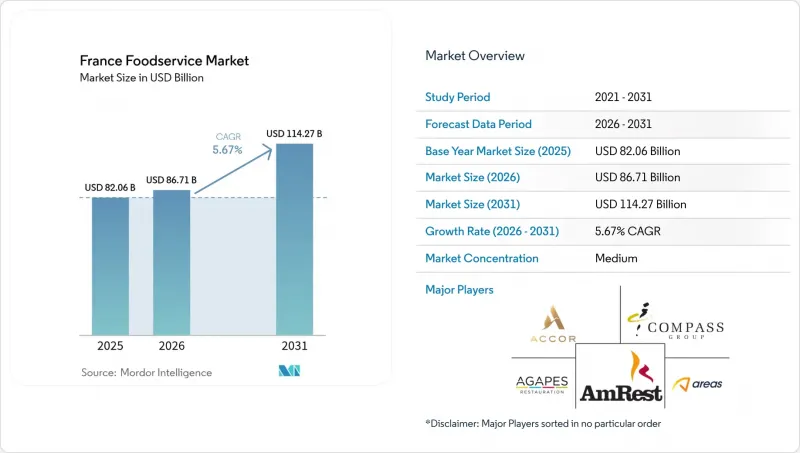
This report is Segmented by Foodservice Type (Cafe and Bars, Cloud Kitchen, Full Service Restaurants, and More), Outlet (Chained Outlets, and Independent Outlets), Locations (Leisure, Lodging, Retail, and More) and Service Type (Dine-In, Takeaway, and Delivery). The Market Forecasts are Provided in Terms of Value (USD).
France Foodservice Market Trends and Insights
Increasing Demand for Plant-Based and Organic Menu Options
Plant-based menu adoption gained momentum after the Paris 2024 Olympics, where 60% of meals served included plant-based options, setting a new standard for large-scale foodservice operations . French consumers increasingly view plant-based dining as a premium experience rather than a dietary limitation, with organic food sales in the foodservice sector growing at an annual rate of 15%. This trend reflects broader cultural changes, where sustainability is becoming a status symbol, particularly among urban millennials and Gen Z consumers who prioritize environmental considerations in their dining choices. Restaurant chains report that plant-based menu items yield 23% higher profit margins compared to traditional offerings, driven by lower ingredient costs and consumer acceptance of premium pricing. This trend is not limited to vegetarian-specific establishments; traditional bistros and brasseries are also incorporating plant-forward dishes to attract growing market segments while preserving their culinary identity.
Adoption of Sustainability Initiatives
The MICHELIN Green Star program, introduced in France with over 100 certified restaurants, highlights the role of sustainability certifications in fostering competitive differentiation and customer loyalty. French establishments are increasingly seeking Ecotable labels and conducting carbon footprint assessments, while collective catering facilities are required to report their environmental impact by 2025 under ADEME guidelines . This regulatory framework provides first-mover advantages for operators adopting comprehensive sustainability initiatives, such as waste reduction and renewable energy integration. Beyond regulatory compliance, restaurants are utilizing sustainability credentials to achieve premium market positioning and attract talent in competitive labor markets. Additionally, sustainability investments often lead to operational cost savings through reduced waste and energy consumption, creating a reinforcing cycle that strengthens market positions over time.
Labor Shortages and Challenges Attracting/Retaining Skilled Staff
The French hospitality sector is grappling with significant staffing challenges, with a large proportion of establishments reporting difficulties in recruiting, particularly for skilled roles such as chefs and service managers . Labor shortages become even more pronounced during peak tourism seasons when demand rises sharply, but the workforce remains constrained due to factors like high housing costs and preferences for seasonal employment. These challenges often compel operators to make difficult decisions, such as increasing wages, reducing operating hours, or scaling back service offerings, all of which can hinder their potential for revenue growth. Independent operators face additional pressure, as they often find it challenging to compete with the comprehensive benefits packages and career advancement opportunities provided by chain restaurants. In response, many establishments are turning to solutions like automation and cross-training programs to optimize productivity with their existing staff. However, these approaches require considerable capital investment and may not fully address the labor shortages in service-intensive areas of the industry.
Other drivers and restraints analyzed in the detailed report include:
- Rising Interest in Health-Conscious and Allergen-Free Menus
- Proliferation of Cloud Kitchens and Virtual Restaurant Brands
- Seasonal Fluctuations in Demand, Especially for Tourism-Driven Locations
For complete list of drivers and restraints, kindly check the Table Of Contents.
Segment Analysis
Quickservice Restaurants are anticipated to account for 49.48% of the market share in 2025, underscoring the increasing preference among French consumers for fast-casual dining options. These formats successfully combine the convenience of quick service with the quality that consumers expect, making them a popular choice. Meanwhile, Cloud Kitchens are emerging as the fastest-growing segment, with a compound annual growth rate (CAGR) of 11.83% projected through 2031. This growth is largely attributed to the expansion of delivery platforms and the cost-efficiency of operating without traditional dine-in spaces. These factors enable businesses to test new concepts quickly and enter the market with reduced financial risk.
Fullservice Restaurants continue to cater to traditional dining preferences, offering a more formal experience. However, they are increasingly facing challenges such as rising labor costs and a noticeable shift in consumer preferences toward more casual dining experiences. Across all segments, digital transformation is playing a pivotal role in shaping the industry. Quick Service Restaurant operators, in particular, are leveraging technologies such as mobile ordering, kitchen automation, and AI-powered menu optimization to enhance operational efficiency and maintain a competitive edge in the evolving market landscape.
Independent outlets are projected to maintain a 68.05% market share in 2025, reflecting the enduring consumer preference for locally-owned establishments. These outlets continue to attract customers by offering personalized service and unique culinary experiences that resonate with those seeking authenticity and a connection to local culture. This strong market presence underscores the value placed on individuality and the distinctive character that independent operators bring to the dining experience.
On the other hand, chained outlets are expected to grow at a CAGR of 6.88% through 2031, capitalizing on their ability to leverage operational efficiencies, standardized processes, and purchasing power. These advantages enable them to offer competitive pricing and deliver consistent quality, appealing to consumers who prioritize convenience and predictability. The contrasting growth trends highlight a shift in consumer priorities, where independent operators are responding by forming purchasing cooperatives, adopting shared technology platforms, and developing unique brand identities to stand out from the standardized offerings of chain establishments.
Complete Report Scope:
- By Foodservice Type
- Cafe and Bars
- By Cuisine
- Bars & Pubs
- Cafe
- Juice/Smoothie/Desserts Bars
- Specialist Coffee and Tea Shops
- By Cuisine
- Cloud Kitchen
- Full Service Restaurants
- By Cuisine
- Asian
- European
- Latin American
- Middle Eastern
- North American
- Other FSR Cuisines
- By Cuisine
- Quick Service Restaurants
- By Cuisine
- Bakeries
- Burger
- Ice Cream
- Meat-based Cuisines
- Pizza
- Other QSR Cuisines
- By Cuisine
- Cafe and Bars
- By Outlet
- Chained Outlets
- Independent Outlets
- By Locations
- Leisure
- Lodging
- Retail
- Sandalone
- Travel
- By Service Type
- Dine-in
- Takeaway
- Delivery
List of Companies Covered in this Report:
- Agapes Restauration
- AmRest Holdings SE
- Areas SAU
- Compass Group PLC
- Accor S.A.
- Domino's Pizza Enterprises Ltd.
- Groupe Bertrand
- Groupe Delineo
- Groupe Le Duff
- Hana Group
- La Mie Caline
- Lagardere Group
- McDonald's Corporation
- QSR Platform Holding SCA
- Groupe Flo
- Starbucks Corporation
- The Blachere Group
- Yum! Brands Inc.
- Big Fernand
- Pokawa
Additional Benefits:
- The market estimate (ME) sheet in Excel format
- 3 months of analyst support
TABLE OF CONTENTS
1 INTRODUCTION
- 1.1 Study Assumptions and Market Definition
- 1.2 Scope of the Study
2 RESEARCH METHODOLOGY
3 EXECUTIVE SUMMARY
4 KEY INDUSTRY TRENDS
- 4.1 Number of Outlets
- 4.2 Average Order Value
- 4.3 Regulatory Framework
5 MARKET LANDSCAPE
- 5.1 Market Overview
- 5.2 Market Drivers
- 5.2.1 Increasing demand for plant-based and organic menu options
- 5.2.2 Adoption of sustainability initiatives
- 5.2.3 Rising interest in health-conscious and allergen-free menus
- 5.2.4 Proliferation of cloud kitchens and virtual restaurant brands
- 5.2.5 Innovation in menu personalization and smart kitchen solutions
- 5.2.6 Expansion of convenience-focused takeaway and ready-to-eat offerings
- 5.3 Market Restraints
- 5.3.1 Labor shortages and challenges attracting/retaining skilled staff
- 5.3.2 Seasonal fluctuations in demand, especially for tourism-driven locations.
- 5.3.3 Limited space for kitchen expansion and automation in historic sites
- 5.3.4 Risks associated with food allergen management and legal liability
- 5.4 Regulatory Outlook
- 5.5 Porter's Five Forces
- 5.5.1 Threat of New Entrants
- 5.5.2 Bargaining Power of Buyers/Consumers
- 5.5.3 Bargaining Power of Suppliers
- 5.5.4 Threat of Substitute Products
- 5.5.5 Intensity of Competitive Rivalry
6 MARKET SIZE AND GROWTH FORECASTS (VALUE)
- 6.1 By Foodservice Type
- 6.1.1 Cafe and Bars
- 6.1.1.1 By Cuisine
- 6.1.1.1.1 Bars & Pubs
- 6.1.1.1.2 Cafe
- 6.1.1.1.3 Juice/Smoothie/Desserts Bars
- 6.1.1.1.4 Specialist Coffee and Tea Shops
- 6.1.1.1 By Cuisine
- 6.1.2 Cloud Kitchen
- 6.1.3 Full Service Restaurants
- 6.1.3.1 By Cuisine
- 6.1.3.1.1 Asian
- 6.1.3.1.2 European
- 6.1.3.1.3 Latin American
- 6.1.3.1.4 Middle Eastern
- 6.1.3.1.5 North American
- 6.1.3.1.6 Other FSR Cuisines
- 6.1.3.1 By Cuisine
- 6.1.4 Quick Service Restaurants
- 6.1.4.1 By Cuisine
- 6.1.4.1.1 Bakeries
- 6.1.4.1.2 Burger
- 6.1.4.1.3 Ice Cream
- 6.1.4.1.4 Meat-based Cuisines
- 6.1.4.1.5 Pizza
- 6.1.4.1.6 Other QSR Cuisines
- 6.1.4.1 By Cuisine
- 6.1.1 Cafe and Bars
- 6.2 By Outlet
- 6.2.1 Chained Outlets
- 6.2.2 Independent Outlets
- 6.3 By Locations
- 6.3.1 Leisure
- 6.3.2 Lodging
- 6.3.3 Retail
- 6.3.4 Sandalone
- 6.3.5 Travel
- 6.4 By Service Type
- 6.4.1 Dine-in
- 6.4.2 Takeaway
- 6.4.3 Delivery
7 COMPETITIVE LANDSCAPE
- 7.1 Market Concentration
- 7.2 Strategic Moves
- 7.3 Market Ranking Analysis
- 7.4 Company Profiles (includes Global-level Overview, Market-level Overview, Core Segments, Financials (if available), Strategic Information, Market Rank/Share, Products and Services, Recent Developments)
- 7.4.1 Agapes Restauration
- 7.4.2 AmRest Holdings SE
- 7.4.3 Areas SAU
- 7.4.4 Compass Group PLC
- 7.4.5 Accor S.A.
- 7.4.6 Domino's Pizza Enterprises Ltd.
- 7.4.7 Groupe Bertrand
- 7.4.8 Groupe Delineo
- 7.4.9 Groupe Le Duff
- 7.4.10 Hana Group
- 7.4.11 La Mie Caline
- 7.4.12 Lagardere Group
- 7.4.13 McDonald's Corporation
- 7.4.14 QSR Platform Holding SCA
- 7.4.15 Groupe Flo
- 7.4.16 Starbucks Corporation
- 7.4.17 The Blachere Group
- 7.4.18 Yum! Brands Inc.
- 7.4.19 Big Fernand
- 7.4.20 Pokawa
8 MARKET OPPORTUNITIES AND FUTURE OUTLOOK

