PUBLISHER: Mordor Intelligence | PRODUCT CODE: 2100725

PUBLISHER: Mordor Intelligence | PRODUCT CODE: 2100725
North America Specialty Fertilizer - Market Share Analysis, Industry Trends & Statistics, Growth Forecasts (2026 - 2031)
According to Mordor Intelligence, the North America specialty fertilizer market size is projected to expand from USD 5.14 billion in 2025 and USD 5.30 billion in 2026 to USD 6.64 billion by 2031, registering a CAGR of 4.6% during the forecast period.
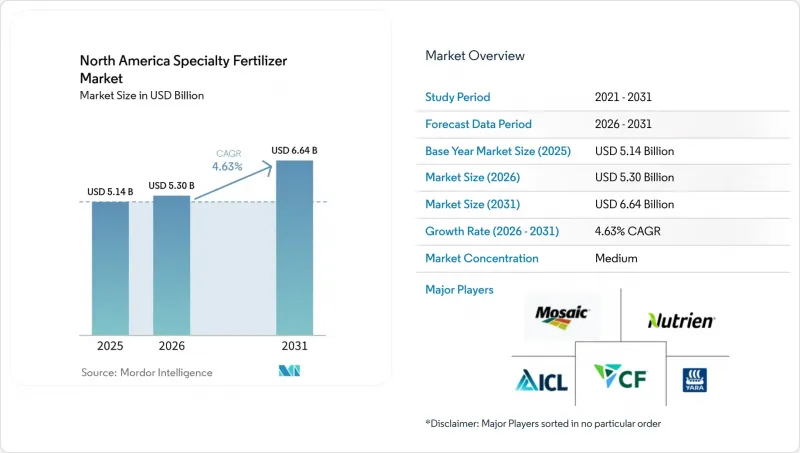
This report is Segmented by Specialty Type (CRF, Liquid Fertilizer, SRF, and Water Soluble), by Application Mode (Fertigation, Foliar, and Soil), by Crop Type (Field Crops, Horticultural Crops, and Turf and Ornamental), and by Geography (Canada, Mexico, The United States, and the Rest of North America). The Market Forecasts are Provided in Terms of Value (USD) and Volume (Metric Tons).
North America Specialty Fertilizer Market Trends and Insights
Precision Agriculture Adoption Accelerating Demand for Water-Soluble Inputs
The North America specialty fertilizer market is moving toward water-soluble and liquid products because variable-rate application and sensor-led irrigation depend on precise nutrient delivery. USDA reported in December 2024 that 68% of large crop farms used precision decision tools such as yield monitors, soil maps, and automated guidance systems. The same USDA survey showed that variable-rate technology reached 45% on large crop farms and autosteering reached 70% on large farms, versus 9% on small farms. That adoption pattern matters because the strongest economic case for specialty inputs lies with large farms that can monetize better placement and timing across wide-acre bases. As fertigation expands from California specialty crops into Ontario greenhouse vegetables and the U.S. Southeast, fully soluble formulations become a system requirement rather than an optional upgrade.
Regulatory Focus on Nutrient-Use Efficiency and 4R Stewardship
The North America specialty fertilizer market is also benefiting from a tighter focus on nutrient-use efficiency and 4R stewardship. The Fertilizer Institute said in its 2025 sustainability report that the 4R program is on track to exceed 70 million certified acres by 2030. Controlled-release blends, polymer-coated urea, and inhibitor-treated products align with this direction because they help document lower nitrogen loss and improved nutrient placement. Rules linked to the Chesapeake Bay, the Great Lakes, and state nitrate reduction programs are increasing pressure on growers to use products that improve timing and use efficiency. This policy setting supports premium nutrition products across row crops and higher-value cropping systems, broadening the commercial base of the North American specialty fertilizer market.
Price Premium Versus Conventional Fertilizers
The North American specialty fertilizer market still faces a clear adoption barrier due to the price gap with conventional fertilizers. Specialty products in the input text carry a 2-4 times premium over standard nitrogen and phosphate blends. That difference is hardest to absorb in smallholder and row-crop systems where margins are tighter and yield response must be visible. The challenge is lower in greenhouse and permanent crop systems because growers can connect nutrition precision more directly to crop quality, reduced waste, and labor efficiency. Producers that want broader adoption still need to prove field-level economics, or buyers can shift back toward standard blends when crop prices weaken.
Other drivers and restraints analyzed in the detailed report include:
- Integration of Biostimulants Requiring Compatible Specialty Nutrition
- Carbon Credit Programs Rewarding Slow-Release Fertilizer Use
- Volatile Supply of Specialty Raw Materials
For complete list of drivers and restraints, kindly check the Table Of Contents.
Segment Analysis
Controlled-release fertilizer held 37.4% of the North America specialty fertilizer market size in 2025, giving it the largest position within the specialty type segmentation. Its lead came from turf, golf, nursery, and expanding row-crop use, where nutrient timing can be monetized through 4R programs. Polymer-coated and polymer-sulfur-coated products still account for most controlled-release volume because they align nutrient release with soil conditions and labor planning. This keeps controlled-release products central to the North America specialty fertilizer market even as coating technology is being reevaluated under tighter environmental scrutiny.
Water-Soluble Fertilizer is projected to grow at a 6.7% CAGR through 2031, making it the fastest-growing specialty type in the North American specialty fertilizer market. Its growth is tied to greenhouse systems, closed-loop irrigation, and open-field fertigation programs that need full solubility and stable tank mixing. Liquid fertilizer and slow-release fertilizer serve different channels, with liquid products fitting established distribution systems and slow-release grades maintaining demand in ornamental and turf programs. The balance of growth shows that premium spending is shifting toward products that fit managed delivery systems without displacing the installed base of controlled-release products.
Complete Report Scope:
- Specialty Type
- CRF
- Polymer Coated
- Polymer-Sulfur Coated
- Others
- Liquid Fertilizer
- SRF
- Water Soluble
- CRF
- Application Mode
- Fertigation
- Foliar
- Soil
- Crop Type
- Field Crops
- Horticultural Crops
- Turf and Ornamental
- Country
- Canada
- Mexico
- United States
- Rest of North America
List of Companies Covered in this Report:
- CF Industries Holdings, Inc.
- The Mosaic Company
- Nutrien Ltd.
- Yara International ASA
- ICL Group Ltd.
- Koch Agronomic Services, LLC
- The Andersons, Inc.
- Helena Agri-Enterprises, LLC
- Wilbur-Ellis Holdings, Inc.
- SQM S.A.
- Tessenderlo Group NV
- Haifa Chemicals Ltd.
- Verdesian Life Sciences, LLC
- K+S Aktiengesellschaft
- J. R. Simplot Company
Additional Benefits:
- The market estimate (ME) sheet in Excel format
- 3 months of analyst support
TABLE OF CONTENTS
1 INTRODUCTION
- 1.1 Study Assumptions and Market Definition
- 1.2 Scope of the Study
- 1.3 Research Methodology
2 REPORT OFFERS
3 EXECUTIVE SUMMARY AND KEY FINDINGS
4 KEY INDUSTRY TRENDS
- 4.1 Acreage Of Major Crop Types
- 4.1.1 Field Crops
- 4.1.2 Horticultural Crops
- 4.2 Average Nutrient Application Rates
- 4.2.1 Micronutrients
- 4.2.1.1 Field Crops
- 4.2.1.2 Horticultural Crops
- 4.2.2 Primary Nutrients
- 4.2.2.1 Field Crops
- 4.2.2.2 Horticultural Crops
- 4.2.3 Secondary Macronutrients
- 4.2.3.1 Field Crops
- 4.2.3.2 Horticultural Crops
- 4.2.1 Micronutrients
- 4.3 Agricultural Land Equipped For Irrigation
- 4.4 Regulatory Framework
- 4.5 Value Chain and Distribution Channel Analysis
- 4.6 Market Overview
- 4.7 Market Drivers
- 4.7.1 Precision-agriculture adoption accelerating demand for water-soluble inputs
- 4.7.2 Regulatory focus on nutrient-use efficiency and 4R stewardship
- 4.7.3 Expansion of greenhouse and controlled environment farming across North America
- 4.7.4 Integration of bio-stimulants requiring compatible specialty nutrition
- 4.7.5 Carbon-credit programs rewarding slow-release fertilizer use
- 4.7.6 Acreage shift toward high-value berries, nuts, and hemp
- 4.8 Market Restraints
- 4.8.1 Price premium versus conventional fertilizers
- 4.8.2 Volatile supply of specialty raw materials
- 4.8.3 Nano-fertilizer adoption cannibalizing polymer-coated demand
- 4.8.4 Forthcoming micro-plastic regulations on polymer coatings
5 MARKET SIZE AND GROWTH FORECASTS (VALUE AND VOLUME)
- 5.1 Specialty Type
- 5.1.1 CRF
- 5.1.1.1 Polymer Coated
- 5.1.1.2 Polymer-Sulfur Coated
- 5.1.1.3 Others
- 5.1.2 Liquid Fertilizer
- 5.1.3 SRF
- 5.1.4 Water Soluble
- 5.1.1 CRF
- 5.2 Application Mode
- 5.2.1 Fertigation
- 5.2.2 Foliar
- 5.2.3 Soil
- 5.3 Crop Type
- 5.3.1 Field Crops
- 5.3.2 Horticultural Crops
- 5.3.3 Turf and Ornamental
- 5.4 Country
- 5.4.1 Canada
- 5.4.2 Mexico
- 5.4.3 United States
- 5.4.4 Rest of North America
6 COMPETITIVE LANDSCAPE
- 6.1 Key Strategic Moves
- 6.2 Market Share Analysis
- 6.3 Company Landscape
- 6.4 Company Profiles (Includes Global Level Overview, Market Level Overview, Core Business Segments, Financials, Headcount, Key Information, Market Rank, Market Share, Products and Services, and Analysis of Recent Developments)
- 6.4.1 CF Industries Holdings, Inc.
- 6.4.2 The Mosaic Company
- 6.4.3 Nutrien Ltd.
- 6.4.4 Yara International ASA
- 6.4.5 ICL Group Ltd.
- 6.4.6 Koch Agronomic Services, LLC
- 6.4.7 The Andersons, Inc.
- 6.4.8 Helena Agri-Enterprises, LLC
- 6.4.9 Wilbur-Ellis Holdings, Inc.
- 6.4.10 SQM S.A.
- 6.4.11 Tessenderlo Group NV
- 6.4.12 Haifa Chemicals Ltd.
- 6.4.13 Verdesian Life Sciences, LLC
- 6.4.14 K+S Aktiengesellschaft
- 6.4.15 J. R. Simplot Company
7 KEY STRATEGIC QUESTIONS FOR FERTILIZER CEOS

