PUBLISHER: Mordor Intelligence | PRODUCT CODE: 2100727

PUBLISHER: Mordor Intelligence | PRODUCT CODE: 2100727
Europe Specialty Fertilizers - Market Share Analysis, Industry Trends & Statistics, Growth Forecasts (2026 - 2031)
According to Mordor Intelligence, the Europe specialty fertilizers market size is projected to grow from USD 5.59 billion in 2025 to USD 5.62 billion in 2026 and is forecast to reach USD 6.86 billion by 2031 at 4.07% CAGR over 2026 to 2031.
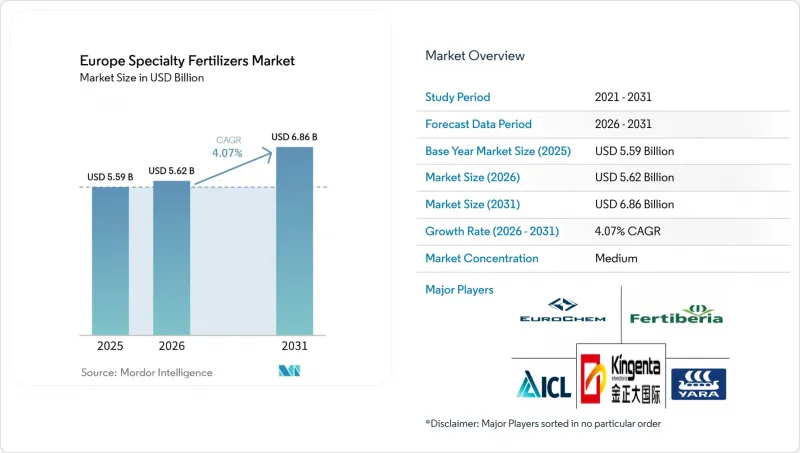
This report is Segmented by Specialty Type (CRF, Liquid Fertilizer, SRF, and More), Application Mode (Fertigation, Foliar, and Soil), Crop Type (Field Crops, Horticultural Crops, and More), and Geography (France, Germany, Italy, Netherlands, and More). The Market Forecasts are Provided in Terms of Value (USD) and Volume (Metric Tons).
Europe Specialty Fertilizers Market Trends and Insights
Growth in Protected-Cultivation Acreage
Protected growing sites now cover 10,500 hectares in the Netherlands and 64,000 hectares in Spain, advancing 15% in 2024 on export-oriented vegetable demand. Soilless systems dominate these expansions and require water-soluble or controlled-release blends that prevent nutrient lockup. Nordic countries add greenhouse capacity to improve food security, sustaining consumption of pH-balanced specialty fertilizers. Liquid products suit closed-loop recirculating systems, helping growers minimize discharge. The European specialty fertilizer market, therefore, captures volume as greenhouse operators standardize year-round nutrition programs.
Surge in Fertigation System Installations
Mediterranean farms installed fertigation at a 25% annual pace in 2024, led by Spanish olive groves and Italian vineyards facing water scarcity. Integrated sensors now trigger variable-rate dosing that can trim fertilizer use by 30-40% while maintaining yield. German and French field-crop producers also attach drip or pivot injectors to comply with nitrate-directive limits. Fertigation readiness steers buyers toward liquid and fully soluble powders, reinforcing the Europe specialty fertilizer market trajectory.
Shrinking Arable Land in Eastern Europe
Poland removed 180,000 hectares from cultivation in 2024, while Ukrainian fields faced labor shortages and infrastructure damage. Consolidation favors capital-intensive operations that adopt specialty inputs, yet total addressable hectares decline, trimming aggregate demand. Larger farms cushion the Europe specialty fertilizer market, but regional volume headwinds persist. Despite these challenges, the adoption of specialty inputs by larger farms may help stabilize the market.
Other drivers and restraints analyzed in the detailed report include:
- EU Farm to Fork Sustainability Targets
- Recovery of Horticulture Exports Post-Brexit
- Slow Digital-ag Adoption Among Smallholders
For complete list of drivers and restraints, kindly check the Table Of Contents.
Segment Analysis
Liquid fertilizers commanded 34.6% of the Europe specialty fertilizers market share in 2025 due to drip-ready compatibility and uniform distribution. Growers value rapid plant uptake and lower labor needs, especially in greenhouse vegetables. Controlled-release lines post 6.2% CAGR to 2031, lifted by Farm to Fork rules that reward nutrient-use efficiency. The Europe specialty fertilizers market size for controlled-release options is forecast to widen as polymer-coated urea and sulfur-coated urea stretch feeding intervals to 120 days.
Water-soluble crystals dominate hydroponic basil, cucumber, and strawberry systems in the Netherlands and Belgium, while slow-release granules retain niche turf and ornamental users. Micronutrient blends with zinc, boron, and iron now bundle biostimulants for stress mitigation, a trend aligned with shifting climate patterns. Patent activity for novel encapsulation rose 15% in 2024, underscoring innovation depth. s
Complete Report Scope:
- Speciality Type
- CRF
- Polymer Coated
- Polymer-Sulfur Coated
- Others
- Liquid Fertilizer
- SRF
- Water Soluble
- CRF
- Application Mode
- Fertigation
- Foliar
- Soil
- Crop Type
- Field Crops
- Horticultural Crops
- Turf & Ornamental
- Country
- France
- Germany
- Italy
- Netherlands
- Russia
- Spain
- Ukraine
- United Kingdom
- Rest of Europe
List of Companies Covered in this Report:
- Akcine bendrove "Achema"
- AGLUKON Spezialdunger GmbH & Co. KG.
- EuroChem Group AG.
- FERTIBERIA, S.A.
- Grupa Azoty S.A. (Compo Expert)
- ICL Group Ltd
- Kingenta Ecological Engineering Group Co., Ltd.
- Petrokemija DD Fertilizer Factory
- Sociedad Quimica y Minera de Chile SA
- Yara International ASA
- Borealis L.A.T.
- Timac Agro
- Haifa Group
- PhosAgro
- Uralchem
Additional Benefits:
- The market estimate (ME) sheet in Excel format
- 3 months of analyst support
TABLE OF CONTENTS
1 INTRODUCTION
- 1.1 Study Assumptions and Market Definition
- 1.2 Scope of the Studies
- 1.3 Research Methodology
2 REPORT OFFERS
3 EXECUTIVE SUMMARY AND KEY FINDINGS
4 KEY INDUSTRY TRENDS
- 4.1 Acreage of Major Crop Types
- 4.1.1 Field Crops
- 4.1.2 Horticultural Crops
- 4.2 Average Nutrient Application Rates
- 4.2.1 Micronutrients
- 4.2.1.1 Field Crops
- 4.2.1.2 Horticultural Crops
- 4.2.2 Primary Nutrients
- 4.2.2.1 Field Crops
- 4.2.2.2 Horticultural Crops
- 4.2.3 Secondary Macronutrients
- 4.2.3.1 Field Crops
- 4.2.3.2 Horticultural Crops
- 4.2.1 Micronutrients
- 4.3 Agricultural Land Equipped For Irrigation
- 4.4 Regulatory Framework
- 4.5 Value Chain and Distribution Channel Analysis
- 4.6 Market Drivers
- 4.6.1 Growth in protected-cultivation acreage
- 4.6.2 Surge in fertigation system installations
- 4.6.3 EU Farm to Fork sustainability targets
- 4.6.4 Recovery of horticulture exports post-Brexit
- 4.6.5 Scale-up of green-ammonia hubs
- 4.6.6 On-farm carbon-credit monetization pilots
- 4.7 Market Restraints
- 4.7.1 Shrinking arable land in Eastern Europe
- 4.7.2 Volatility in natural-gas derived feedstocks
- 4.7.3 Stringent cadmium limits in EU fertilizer law
- 4.7.4 Slow digital-ag adoption among smallholders
5 MARKET SEGMENTATION (VALUE AND VOLUME)
- 5.1 Speciality Type
- 5.1.1 CRF
- 5.1.1.1 Polymer Coated
- 5.1.1.2 Polymer-Sulfur Coated
- 5.1.1.3 Others
- 5.1.2 Liquid Fertilizer
- 5.1.3 SRF
- 5.1.4 Water Soluble
- 5.1.1 CRF
- 5.2 Application Mode
- 5.2.1 Fertigation
- 5.2.2 Foliar
- 5.2.3 Soil
- 5.3 Crop Type
- 5.3.1 Field Crops
- 5.3.2 Horticultural Crops
- 5.3.3 Turf & Ornamental
- 5.4 Country
- 5.4.1 France
- 5.4.2 Germany
- 5.4.3 Italy
- 5.4.4 Netherlands
- 5.4.5 Russia
- 5.4.6 Spain
- 5.4.7 Ukraine
- 5.4.8 United Kingdom
- 5.4.9 Rest of Europe
6 COMPETITIVE LANDSCAPE
- 6.1 Key Strategic Moves
- 6.2 Market Share Analysis
- 6.3 Company Landscape
- 6.4 Company Profiles (Includes Global Level Overview, Market Level Overview, Core Business Segments, Financials, Key Information, Market Rank, Market Share, Products and Services, and Analysis of Recent Developments)
- 6.4.1 Akcine bendrove "Achema"
- 6.4.2 AGLUKON Spezialdunger GmbH & Co. KG.
- 6.4.3 EuroChem Group AG.
- 6.4.4 FERTIBERIA, S.A.
- 6.4.5 Grupa Azoty S.A. (Compo Expert)
- 6.4.6 ICL Group Ltd
- 6.4.7 Kingenta Ecological Engineering Group Co., Ltd.
- 6.4.8 Petrokemija DD Fertilizer Factory
- 6.4.9 Sociedad Quimica y Minera de Chile SA
- 6.4.10 Yara International ASA
- 6.4.11 Borealis L.A.T.
- 6.4.12 Timac Agro
- 6.4.13 Haifa Group
- 6.4.14 PhosAgro
- 6.4.15 Uralchem
7 KEY STRATEGIC QUESTIONS FOR FERTILIZER CEOs

