PUBLISHER: Mordor Intelligence | PRODUCT CODE: 2100723

PUBLISHER: Mordor Intelligence | PRODUCT CODE: 2100723
China Specialty Fertilizer - Market Share Analysis, Industry Trends & Statistics, Growth Forecasts (2026 - 2031)
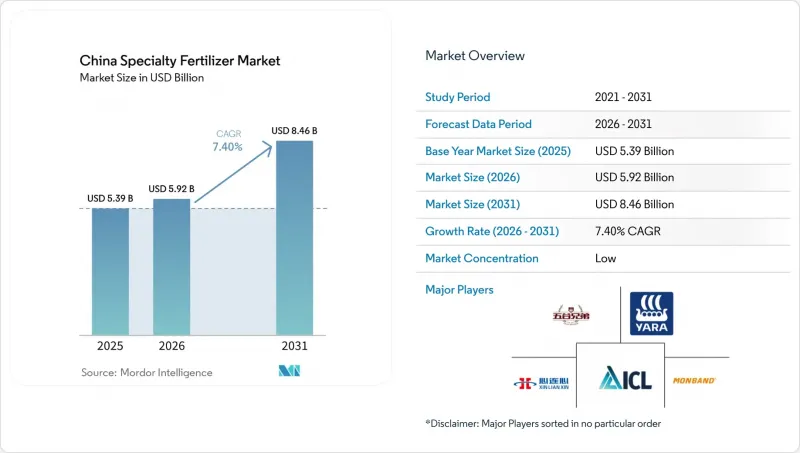
According to Mordor Intelligence, the China specialty fertilizer market size is projected to grow from USD 5.39 billion in 2025 to USD 5.92 billion in 2026 and is forecast to reach USD 8.46 billion by 2031, registering a CAGR of 7.40% during 2026-2031.
This report is Segmented by Speciality Type (CRF, Liquid Fertilizer, SRF, and Water Soluble), by Application Mode (Fertigation, Foliar, and Soil), and by Crop Type (Field Crops, Horticultural Crops, and Turf and Ornamental). The Market Forecasts are Provided in Terms of Value (USD) and Volume (Metric Tons)
China Specialty Fertilizer Market Trends and Insights
Government Subsidies for High-Efficiency Fertilizers
Central and provincial subsidy schemes reimburse up to 30% of controlled-release fertilizer costs, fundamentally altering adoption economics for commercial growers and cooperatives. The Ministry of Agriculture's 2024 policy framework extends these incentives through 2027, targeting 15 million hectares of high-efficiency fertilizer application across major grain-producing regions. This policy architecture creates a two-tier market where subsidized operations achieve cost parity with conventional fertilizers, while unsubsidized smallholders face persistent price barriers. The subsidy structure supports domestic manufacturers by requiring the use of locally sourced nutrient inputs, facilitating technology transfer, and enhancing production capacity within China.
Expansion Of Protected Horticulture and Greenhouse Cultivation
China's protected horticulture area expanded to 4.2 million hectares in 2024, with plastic-film greenhouses and solar greenhouses driving 85% of this growth, creating concentrated demand for water-soluble and liquid fertilizer formulations. Xinjiang's greenhouse vegetable production alone increased 23% year-over-year, supported by government initiatives to diversify the region's agricultural output beyond cotton. This expansion pattern generates localized supply chain opportunities, as greenhouse operators require frequent, small-batch deliveries of specialized nutrient solutions that traditional bulk fertilizer distributors cannot efficiently serve. The trend toward year-round production cycles in controlled environments necessitates precise nutrient timing, favoring suppliers with technical advisory capabilities.
Higher Per-Ton Cost Versus Conventional Fertilizers
Specialty fertilizers command prices 1.5 to 3 times higher than conventional NPK, creating adoption barriers for China's 200 million smallholder farming households with average landholdings below 0.6 hectares. Despite government subsidies covering 30% of costs for eligible operations, the absolute price differential remains prohibitive for farmers operating on thin margins, particularly in less-developed central and western provinces where agricultural incomes lag coastal regions. This cost structure creates a bifurcated market where large commercial operations and cooperatives drive specialty fertilizer adoption, while the numerically dominant smallholder segment relies on conventional products. The pricing gap widens during commodity price downturns, as farmers prioritize immediate cost reduction over long-term soil health benefits.
Other drivers and restraints analyzed in the detailed report include:
- Rising Adoption of Fertigation and Precision Irrigation Systems
- Shift of Tea and Specialty Cash Crops Toward Customized Nutrient Blends
- Stringent Environmental Regulations on Polymer Coatings
For complete list of drivers and restraints, kindly check the Table Of Contents.
Segment Analysis
Liquid fertilizers maintain the largest market share at 42.0% of the China specialty fertilizer market size in 2025, supported by established fertigation infrastructure. Liquid fertilizers account for a significant share of the market, offering advantages such as easy plant absorption and compatibility with various application methods, including irrigation and spraying systems. The SRF segment, while smaller in market share, plays a crucial role in providing sustained nutrient release over extended periods, particularly beneficial for long-duration crops. This segmentation pattern reflects underlying agricultural practices and infrastructure development, creating targeted market opportunities for specialized suppliers.
Controlled-release fertilizers emerge as the fastest-growing specialty type at 9.2% CAGR through 2031, driven by government carbon credit pilots and precision agriculture adoption. The CRF segment benefits from technological advances in polymer coating chemistry, with manufacturers developing biodegradable alternatives that meet environmental regulations while maintaining precise nutrient release. Water-soluble fertilizers are well-suited for greenhouse and hydroponic applications, particularly in protected horticulture operations that require precise nutrient control. Regional preferences vary significantly: northern provinces favor CRF for grain production efficiency, while southern regions emphasize liquid formulations for intensive vegetable cultivation.
Complete Report Scope:
- Speciality Type
- CRF
- Polymer Coated
- Polymer-Sulfur Coated
- Others
- Liquid Fertilizer
- SRF
- Water Soluble
- CRF
- Application Mode
- Fertigation
- Foliar
- Soil
- Crop Type
- Field Crops
- Horticultural Crops
- Turf & Ornamental
List of Companies Covered in this Report:
- Hebei Woze Wufeng Biological Technology Co., Ltd
- Yara International ASA
- ICL Group Ltd
- Henan XinlianXin Chemicals Group Company Limited
- Hebei Monband Water Soluble Fertilizer Co. Ltd
- Kingenta Ecological Engineering Group Co. Ltd.
- Hubei Xinyangfeng Agricultural Technology Co. Ltd.
- Compo Expert GmbH
- Haifa Group
- Sociedad Quimica y Minera de Chile SA (SQM)
- Zouping Hongyun Biotechnology Co. Ltd.
- Sinochem Fertilizer Co. Ltd.
- Shandong Lvfeng Fertilizer Co. Ltd.
- Hebei HeRong Fertilizer Co. Ltd.
- Jiangsu Huifeng Agrochemical Co. Ltd.
Additional Benefits:
- The market estimate (ME) sheet in Excel format
- 3 months of analyst support
TABLE OF CONTENTS
1 INTRODUCTION
- 1.1 Study Assumptions & Market Definition
- 1.2 Scope of the Study
- 1.3 Research Methodology
2 REPORT OFFERS
3 EXECUTIVE SUMMARY & KEY FINDINGS
4 KEY INDUSTRY TRENDS
- 4.1 Acreage Of Major Crop Types
- 4.1.1 Field Crops
- 4.1.2 Horticultural Crops
- 4.2 Average Nutrient Application Rates
- 4.2.1 Micronutrients
- 4.2.1.1 Field Crops
- 4.2.1.2 Horticultural Crops
- 4.2.2 Primary Nutrients
- 4.2.2.1 Field Crops
- 4.2.2.2 Horticultural Crops
- 4.2.3 Secondary Macronutrients
- 4.2.3.1 Field Crops
- 4.2.3.2 Horticultural Crops
- 4.2.1 Micronutrients
- 4.3 Agricultural Land Equipped For Irrigation
- 4.4 Regulatory Framework
- 4.5 Value Chain & Distribution Channel Analysis
- 4.6 Market Drivers
- 4.6.1 Government subsidies for high-efficiency fertilizers
- 4.6.2 Expansion of protected horticulture and greenhouse cultivation
- 4.6.3 Rising adoption of fertigation and precision irrigation systems
- 4.6.4 Shift of tea and specialty cash crops toward customized nutrient blends
- 4.6.5 E-commerce direct-to-farmer channels reducing distribution friction
- 4.6.6 Carbon-footprint linked ag-input credit pilots accelerating coated fertilizer demand
- 4.7 Market Restraints
- 4.7.1 Higher per-ton cost versus conventional fertilizers
- 4.7.2 Stringent environmental regulations on polymer coatings
- 4.7.3 Limited field-level agronomic advisory for smallholders
- 4.7.4 Microplastic concerns in green-food certification schemes
5 MARKET SIZE AND GROWTH FORECASTS (VALUE AND VOLUME)
- 5.1 Speciality Type
- 5.1.1 CRF
- 5.1.1.1 Polymer Coated
- 5.1.1.2 Polymer-Sulfur Coated
- 5.1.1.3 Others
- 5.1.2 Liquid Fertilizer
- 5.1.3 SRF
- 5.1.4 Water Soluble
- 5.1.1 CRF
- 5.2 Application Mode
- 5.2.1 Fertigation
- 5.2.2 Foliar
- 5.2.3 Soil
- 5.3 Crop Type
- 5.3.1 Field Crops
- 5.3.2 Horticultural Crops
- 5.3.3 Turf & Ornamental
6 COMPETITIVE LANDSCAPE
- 6.1 Key Strategic Moves
- 6.2 Market Share Analysis
- 6.3 Company Landscape
- 6.4 Company Profiles (includes Global Level Overview, Market Level Overview, Core Business Segments, Financials, Key Information, Market Rank, Market Share, Products and Services, and Analysis of Recent Developments).
- 6.4.1 Hebei Woze Wufeng Biological Technology Co., Ltd
- 6.4.2 Yara International ASA
- 6.4.3 ICL Group Ltd
- 6.4.4 Henan XinlianXin Chemicals Group Company Limited
- 6.4.5 Hebei Monband Water Soluble Fertilizer Co. Ltd
- 6.4.6 Kingenta Ecological Engineering Group Co. Ltd.
- 6.4.7 Hubei Xinyangfeng Agricultural Technology Co. Ltd.
- 6.4.8 Compo Expert GmbH
- 6.4.9 Haifa Group
- 6.4.10 Sociedad Quimica y Minera de Chile SA (SQM)
- 6.4.11 Zouping Hongyun Biotechnology Co. Ltd.
- 6.4.12 Sinochem Fertilizer Co. Ltd.
- 6.4.13 Shandong Lvfeng Fertilizer Co. Ltd.
- 6.4.14 Hebei HeRong Fertilizer Co. Ltd.
- 6.4.15 Jiangsu Huifeng Agrochemical Co. Ltd.
7 KEY STRATEGIC QUESTIONS FOR FERTILIZER CEOS

