PUBLISHER: Mordor Intelligence | PRODUCT CODE: 2100728

PUBLISHER: Mordor Intelligence | PRODUCT CODE: 2100728
Africa Specialty Fertilizers - Market Share Analysis, Industry Trends & Statistics, Growth Forecasts (2026 - 2031)
According to Mordor Intelligence, the Africa specialty fertilizers market size was USD 1.77 billion in 2025 to USD 1.97 billion in 2026 and is forecast to reach USD 3.01 billion by 2031 at 8.85% CAGR over 2026-2031.
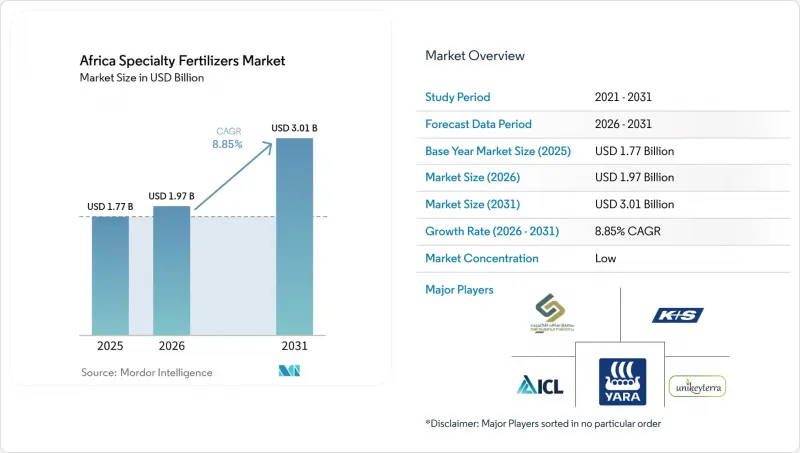
This report is Segmented by Speciality Type (Controlled-Release Fertilizer (CRF), Liquid Fertilizer, Slow-Release Fertilizer (SRF), and Water Soluble), by Application Mode (Fertigation, Foliar, and Soil), by Crop Type (Field Crops, Horticultural Crops, and Turf & Ornamental), and by Country. The Market Forecasts are Provided in Terms of Value (USD) and Volume (Metric Tons).
Africa Specialty Fertilizers Market Trends and Insights
Government Subsidies and Policy Incentives
National fertilizers subsidy reforms across Africa are redirecting over USD 1 billion toward climate-smart specialty inputs, fundamentally reshaping procurement patterns from bulk commodities to precision formulations. Nigeria's Special Agro-Processing Zones program allocated USD 500 million in 2024 specifically for specialty fertilizers distribution infrastructure, while Kenya's fertilizers subsidy program expanded to include water-soluble and controlled-release formulations for the first time . The African Union's Nairobi Declaration 2024 committed member states to achieve 50% fertilizer self-sufficiency by 2030, driving policy alignment toward specialty product manufacturing and regional value chains. These subsidy reforms create sustained demand for enhanced-efficiency formulations while reducing farmers' price sensitivity to premium specialty products.
Decreasing Arable Land Per Capita
Africa's arable land per capita declined from 0.31 hectares in 2000 to 0.23 hectares in 2024, forcing agricultural intensification through higher-efficiency nutrient solutions rather than area expansion. Sub-Saharan Africa averages only 13-20 kg nutrient application per hectare compared to 150 kg/ha in developed regions, creating substantial scope for specialty fertilizers adoption to bridge yield gaps. Soil degradation affects up to 65% of arable land across the continent, with annual productivity losses of 4.3-26.6% from topsoil depletion requiring micronutrient supplementation and enhanced-efficiency formulations. Mali's Trenabougou region exemplifies the challenge, with soil analysis revealing deficiencies in nitrogen, potassium, and magnesium alongside limited micronutrients including nickel, manganese, and boron.
Limited Distribution Infrastructure
Poor cold-chain and bulk terminal infrastructure for liquid fertilizers raises distribution costs by 12% compared to granular products, constraining adoption in remote agricultural areas. DP World's USD 3 billion African ports investment through 2029 addresses some infrastructure gaps, but rural last-mile distribution remains problematic for temperature-sensitive specialty formulations. Nigeria's fertilizers distribution network covers only 40% of farming communities with proper storage facilities, forcing farmers to rely on suboptimal ambient storage that degrades product quality. South Africa's agricultural cooperatives report 25% product loss rates for liquid fertilizers due to inadequate cold storage in rural depots.
Other drivers and restraints analyzed in the detailed report include:
- Shift Toward High-Value Horticultural Exports
- Micro-Irrigation Projects Backed by AfDB (African Development Bank)
- High Upfront Cost of Controlled-Release Fertilizer (CRF) Polymers
For complete list of drivers and restraints, kindly check the Table Of Contents.
Segment Analysis
Liquid fertilizers accounted for 47.8% of the Africa specialty fertilizers market share in 2025, driven by expanding fertigation infrastructure and export crop requirements for precise nutrition management. Liquid fertilizers have gained significant traction due to their compatibility with modern irrigation systems and advanced cultivation methods like hydroponics and aquaponics. The segment's growth is supported by developments in irrigation technology and the increasing adoption of precision farming techniques. Meanwhile, the Slow-Release Fertilizer (SRF) segment, while smaller, plays a crucial role in minimizing soil hardening and coordinating nutrient flow to plants. These fertilizers are particularly valuable in reducing application frequency and overall fertilizers costs, while also offering environmental benefits such as reduced nitrogen volatilization and leaching.
Controlled-release fertilizers (CRF) are the fastest-growing segment, with a projected CAGR of 8.4% from 2026 to 2031, primarily serving commercial farms and high-value horticulture where extended nutrient release justifies premium pricing. The segment evolution toward precision formulations creates opportunities for regional manufacturers to develop climate-adapted products while global players focus on technology transfer and local partnerships. The segment's growth is particularly notable in field crops, where the need to minimize nutrient losses through leaching and volatilization is critical. The adoption of Controlled-Release Fertilizer (CRF) is likely to accelerate as farmers increasingly recognize its benefits in reducing application frequency and improving nutrient use efficiency.
Complete Report Scope:
- Speciality Type
- Controlled-Release Fertilizer (CRF)
- Polymer Coated
- Polymer-Sulfur Coated
- Others
- Liquid Fertilizer
- Slow-Release Fertilizer (SRF)
- Water Soluble
- Controlled-Release Fertilizer (CRF)
- Application Mode
- Fertigation
- Foliar
- Soil
- Crop Type
- Field Crops
- Horticultural Crops
- Turf & Ornamental
- Country
- Nigeria
- South Africa
- Rest of Africa
List of Companies Covered in this Report:
- Yara International ASA
- ICL Group Ltd
- K+S Aktiengesellschaft
- Unikeyterra Chemical
- Safsulphur
- OCP SA
- Haifa Chemicals Ltd.
- UPL Limited
- Omnia Holdings Ltd
- EuroChem Group AG
- PhosAgro Africa Ltd
- Kynoch Holdings Pty Ltd
- Kynoch Holdings Pty Ltd
- Zimbabwe Phosphate Industries Ltd
- Gavilon South Africa (MacroSource, LLC)
Additional Benefits:
- The market estimate (ME) sheet in Excel format
- 3 months of analyst support
TABLE OF CONTENTS
1 INTRODUCTION
- 1.1 Study Assumptions & Market Definition
- 1.2 Scope of the Study
- 1.3 Research Methodology
2 REPORT OFFERS
3 EXECUTIVE SUMMARY & KEY FINDINGS
4 KEY INDUSTRY TRENDS
- 4.1 Acreage of Major Crop Types
- 4.1.1 Field Crops
- 4.1.2 Horticultural Crops
- 4.2 Average Nutrient Application Rates
- 4.2.1 Micronutrients
- 4.2.1.1 Field Crops
- 4.2.1.2 Horticultural Crops
- 4.2.2 Primary Nutrients
- 4.2.2.1 Field Crops
- 4.2.2.2 Horticultural Crops
- 4.2.3 Secondary Macronutrients
- 4.2.3.1 Field Crops
- 4.2.3.2 Horticultural Crops
- 4.2.1 Micronutrients
- 4.3 Agricultural Land Equipped For Irrigation
- 4.4 Regulatory Framework
- 4.5 Value Chain & Distribution Channel Analysis
- 4.6 Market Drivers
- 4.6.1 Government subsidies and policy incentives
- 4.6.2 Decreasing arable land per capita
- 4.6.3 Shift toward high-value horticultural exports
- 4.6.4 Micro-irrigation projects backed by AfDB (African Development Bank)
- 4.6.5 Drone-based foliar nutrient application
- 4.6.6 Carbon-credit linked premium pricing
- 4.7 Market Restraints
- 4.7.1 Limited distribution infrastructure
- 4.7.2 High upfront cost of Controlled-Release Fertilizer (CRF) polymers
- 4.7.3 Inconsistent regional heavy-metal standards
- 4.7.4 Supply-chain exposure to coating polymer imports
5 MARKET SIZE AND GROWTH FORECASTS (VALUE AND VOLUME)
- 5.1 Speciality Type
- 5.1.1 Controlled-Release Fertilizer (CRF)
- 5.1.1.1 Polymer Coated
- 5.1.1.2 Polymer-Sulfur Coated
- 5.1.1.3 Others
- 5.1.2 Liquid Fertilizer
- 5.1.3 Slow-Release Fertilizer (SRF)
- 5.1.4 Water Soluble
- 5.1.1 Controlled-Release Fertilizer (CRF)
- 5.2 Application Mode
- 5.2.1 Fertigation
- 5.2.2 Foliar
- 5.2.3 Soil
- 5.3 Crop Type
- 5.3.1 Field Crops
- 5.3.2 Horticultural Crops
- 5.3.3 Turf & Ornamental
- 5.4 Country
- 5.4.1 Nigeria
- 5.4.2 South Africa
- 5.4.3 Rest of Africa
6 COMPETITIVE LANDSCAPE
- 6.1 Key Strategic Moves
- 6.2 Market Share Analysis
- 6.3 Company Landscape
- 6.4 Company Profiles (Includes Global Level Overview, Market Level Overview, Core Business Segments, Financials, Headcount, Key Information, Market Rank, Market Share, Products and Services, and Analysis of Recent Developments).
- 6.4.1 Yara International ASA
- 6.4.2 ICL Group Ltd
- 6.4.3 K+S Aktiengesellschaft
- 6.4.4 Unikeyterra Chemical
- 6.4.5 Safsulphur
- 6.4.6 OCP SA
- 6.4.7 Haifa Chemicals Ltd.
- 6.4.8 UPL Limited
- 6.4.9 Omnia Holdings Ltd
- 6.4.10 EuroChem Group AG
- 6.4.11 PhosAgro Africa Ltd
- 6.4.12 Kynoch Holdings Pty Ltd
- 6.4.13 Kynoch Holdings Pty Ltd
- 6.4.14 Zimbabwe Phosphate Industries Ltd
- 6.4.15 Gavilon South Africa (MacroSource, LLC)
7 KEY STRATEGIC QUESTIONS FOR FERTILIZER CEOS

