PUBLISHER: Mordor Intelligence | PRODUCT CODE: 2113185

PUBLISHER: Mordor Intelligence | PRODUCT CODE: 2113185
Asia-Pacific Malt Ingredient - Market Share Analysis, Industry Trends & Statistics, Growth Forecasts (2026 - 2031)
According to Mordor Intelligence, Asia-Pacific malt ingredients market size in 2026 is estimated at USD 5.61 billion, growing from 2025 value of USD 5.34 billion with 2031 projections showing USD 7.19 billion, growing at 5.08% CAGR over 2026-2031.
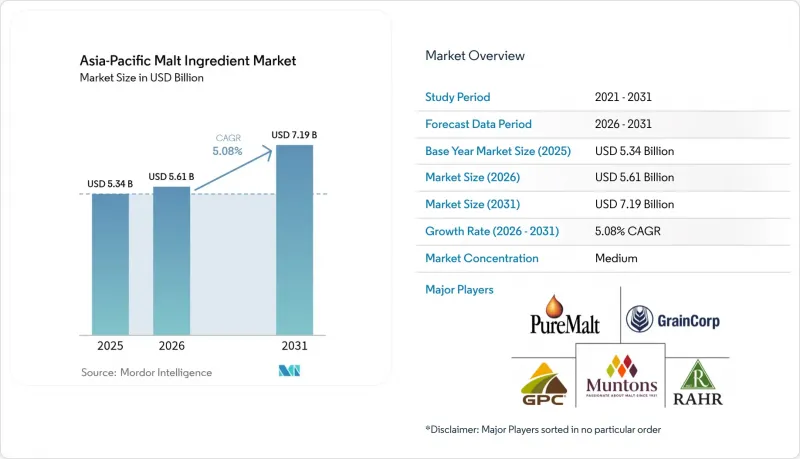
This report is Segmented by Source (Barley, Wheat, Rice, Rye, Sorghum), Form (Liquid Extract, Dry Malt Extract, Malt Flour), Application (Food and Beverages, Pharmaceuticals, Cosmetics and Personal Care, Animal Feed), and Geography (China, India, Japan, Australia, Indonesia, South Korea, Rest of Asia-Pacific). The Market Forecasts are Provided in Terms of Value (USD).
Asia-Pacific Malt Ingredient Market Trends and Insights
Rising Demand for Malt in the Booming Craft Brewing Industry
The craft brewing boom across the Asia-Pacific region is transforming malt demand, expanding its applications beyond traditional brewing. In 2023, Japan's craft beer market displayed notable growth, with tax-exempt shipments increasing by 1.8%, sales rising by 7.2%, and the market share reaching 1.72%. In Thailand, the Community Liquor Bill has removed minimum production requirements for microbreweries, fostering local craft beer production and driving demand for specialized malts. At the same time, major Japanese breweries, including Asahi, Kirin, and Sapporo, are focusing on international markets and diversifying their product portfolios to capitalize on premiumization opportunities. The growing craft brewing sector is fueling demand for specialty malts with unique flavor profiles, encouraging advancements in malting techniques and the use of alternative grains. In Karnataka, regulatory changes have reduced the minimum space requirement for microbreweries from 10,000 to 6,500 square feet, highlighting a policy environment conducive to craft brewing growth.
Growing Usage of Malt in Bakery, Confectionery, and Processed Foods
Malt extract, traditionally associated with brewing, has carved out essential roles in baking, confectionery, and breakfast cereals. It not only enhances flavor complexity and texture but also extends shelf life. Beyond its flavoring prowess, malt extract boosts dough rise, aids in crust development, and imparts natural sweetness, all while upholding a clean label appeal. The Asia-Pacific region, particularly Indonesia, is witnessing a surge in demand for premium processed foods with malt ingredients, driven by its burgeoning middle class, set to hit 135 million by 2030, as highlighted by the Food Export Organization. Food manufacturers are tapping into malt extract's 6% protein content and rich vitamin profile, bolstering their nutritional positioning and elevating sensory experiences. Once viewed primarily as a health component, malt extract is now pivoting towards functional applications, acting as a natural enzyme source for yeast activation and flavor enhancement. With Indonesia's food processing industry importing 65% of its raw materials, there's a golden opportunity for malt ingredient suppliers, especially in the bakery and confectionery sectors.
Fluctuating Barley and Wheat Prices
In the Asia-Pacific region, malt producers grapple with significant margin pressures due to commodity price volatility, which also shapes their sourcing strategies and production planning. As reported by India's Department of Economic Affairs, global wholesale prices for barley malt in India rose from USD 19.91 to USD 21.23 per quintal. In April 2025, China's grain import dynamics showcased notable fluctuations: corn imports fell to 183,000 metric tons, and wheat imports stood at 740,000 metric tons, both figures markedly below the previous year's levels, as highlighted by Dimsums. Anheuser-Busch's 2024 negotiations with farmers, marked by multiple contract changes, underscore the prevailing demand uncertainty. Initial contract prices for malting barley were set at approximately USD 6.25 per bushel, a dip from prior years, according to Agweek. Additionally, the surplus barley from earlier harvests is casting a shadow on 2024 contracts, compelling farmers to rethink their crop selections and possibly curtailing their malting barley production capacity.
Other drivers and restraints analyzed in the detailed report include:
- Increased Use of Malt Extracts in Nutritional and Functional Foods
- Development of Tailored Malt Products
- Stringent Food Safety, Quality Control, and Labeling Regulations
For complete list of drivers and restraints, kindly check the Table Of Contents.
Segment Analysis
Barley generated 70.65% of 2025 revenue, yet rice is forecast to outpace all other sources at a 6.12% CAGR through 2031. The Asia-Pacific malt ingredients market size for rice-based malts is projected to expand as breweries look for locally abundant, climate-resilient grains. University of Arkansas research indicates rice malt slashes beer production costs by up to 12%, helping margin-constrained craft brewers compete [PHYS.ORG]. Wheat remains a steady second choice, while sorghum and rye cater to niche brews. Rice's gluten-free attribute also feeds rising better-for-you beer categories, which command premium shelf pricing in markets such as Australia and Singapore.
Growth in rice malt aligns with sustainability agendas. Rice requires less irrigation than barley under tropical farming systems, reducing the embodied water footprint per ton of malt. Pilot malt houses in Thailand report up to 15% energy savings during drying because of rice's lower moisture content at harvest. Barley nonetheless retains processing efficiency advantages, with higher enzyme potential that supports shorter mash cycles. Continuous process improvements, including staged germination control, allow maltsters to extract more fermentable sugars from non-barley grains, narrowing quality gaps and encouraging brand experimentation.
Complete Report Scope:
- Source
- Barley
- Wheat
- Rice
- Rye
- Sorghum
- Form
- Liquid Extract
- Dry Malt Extract
- Malt Flour
- Application
- Food and Beverages
- Alcoholic and Non Alcoholic Beverages
- Funtional Foods
- Bakery and Confectionery
- Others
- Pharmaceuticals
- Cosmetics and Personal Care
- Animal Feed
- Food and Beverages
- By Geography
- China
- India
- Japan
- Australia
- Indonesia
- South Korea
- Rest of Asia-Pacific
List of Companies Covered in this Report:
- GrainCorp Group
- Boortmalt (Axereal)
- Muntons PLC
- Rahr Corporation
- Barrett Burston Malting
- Puremalt Products Ltd
- Malteurop Groupe
- Ireks GmbH
- Briess Malt & Ingredients
- United Malt Group
- Grain Processing Corp.
- Angel Yeast Co.
- Shun Tai Mai Malt (China)
- Baoding Jiantai Malt
- PT Brewerkz Indonesia
- Thai Malt Co.
- Vietnam Malt Co.
- Zhuhai Huamao Malt
- Yano Malt (Japan)
- VIVESCIA (Soufflet Malt)
- Puremalt Products Ltd
Additional Benefits:
- The market estimate (ME) sheet in Excel format
- 3 months of analyst support
TABLE OF CONTENTS
1 INTRODUCTION
- 1.1 Study Assumptions & Market Definition
- 1.2 Scope of the Study
2 RESEARCH METHODOLOGY
3 EXECUTIVE SUMMARY
4 MARKET LANDSCAPE
- 4.1 Market Overview
- 4.2 Market Drivers
- 4.2.1 Rising demand for malt in the booming craft brewing industry
- 4.2.2 Growing usage of malt in bakery, confectionery, and processed foods
- 4.2.3 Increased use of malt extracts in nutritional and functional foods
- 4.2.4 Growing Adoption of Malt Ingredients
- 4.2.5 Development of tailored malt products
- 4.2.6 Rising Demand for Malt Ingredients in Animal Feed
- 4.3 Market Restraints
- 4.3.1 Fluctuating barley and wheat prices
- 4.3.2 Competition from substitute ingredients
- 4.3.3 Stringent food safety, quality control, and labeling regulations
- 4.3.4 Seasonality of raw material supplies
- 4.4 Supply Chain Analysis
- 4.5 Regulatory Outlook
- 4.6 Porter's Five Forces
- 4.6.1 Threat of New Entrants
- 4.6.2 Bargaining Power of Buyers/Consumers
- 4.6.3 Bargaining Power of Suppliers
- 4.6.4 Threat of Substitute Products
- 4.6.5 Intensity of Competitive Rivalry
5 MARKET SIZE AND GROWTH FORECAST
- 5.1 Source
- 5.1.1 Barley
- 5.1.2 Wheat
- 5.1.3 Rice
- 5.1.4 Rye
- 5.1.5 Sorghum
- 5.2 Form
- 5.2.1 Liquid Extract
- 5.2.2 Dry Malt Extract
- 5.2.3 Malt Flour
- 5.3 Application
- 5.3.1 Food and Beverages
- 5.3.1.1 Alcoholic and Non Alcoholic Beverages
- 5.3.1.2 Funtional Foods
- 5.3.1.3 Bakery and Confectionery
- 5.3.1.4 Others
- 5.3.2 Pharmaceuticals
- 5.3.3 Cosmetics and Personal Care
- 5.3.4 Animal Feed
- 5.3.1 Food and Beverages
- 5.4 By Geography
- 5.4.1 China
- 5.4.2 India
- 5.4.3 Japan
- 5.4.4 Australia
- 5.4.5 Indonesia
- 5.4.6 South Korea
- 5.4.7 Rest of Asia-Pacific
6 COMPETITIVE LANDSCAPE
- 6.1 Market Concentration
- 6.2 Strategic Moves
- 6.3 Market Ranking Analysis
- 6.4 Company Profiles (includes Global-level Overview, Market-level Overview, Core Segments, Financials (if available), Strategic Information, Market Rank/Share, Products & Services, Recent Developments)
- 6.4.1 GrainCorp Group
- 6.4.2 Boortmalt (Axereal)
- 6.4.3 Muntons PLC
- 6.4.4 Rahr Corporation
- 6.4.5 Barrett Burston Malting
- 6.4.6 Puremalt Products Ltd
- 6.4.7 Malteurop Groupe
- 6.4.8 Ireks GmbH
- 6.4.9 Briess Malt & Ingredients
- 6.4.10 United Malt Group
- 6.4.11 Grain Processing Corp.
- 6.4.12 Angel Yeast Co.
- 6.4.13 Shun Tai Mai Malt (China)
- 6.4.14 Baoding Jiantai Malt
- 6.4.15 PT Brewerkz Indonesia
- 6.4.16 Thai Malt Co.
- 6.4.17 Vietnam Malt Co.
- 6.4.18 Zhuhai Huamao Malt
- 6.4.19 Yano Malt (Japan)
- 6.4.20 VIVESCIA (Soufflet Malt)
- 6.4.21 Puremalt Products Ltd
7 MARKET OPPORTUNITIES AND FUTURE OUTLOOK

