PUBLISHER: Mordor Intelligence | PRODUCT CODE: 2115184

PUBLISHER: Mordor Intelligence | PRODUCT CODE: 2115184
Asia-Pacific Clean Ingredients - Market Share Analysis, Industry Trends & Statistics, Growth Forecasts (2026 - 2031)
According to Mordor Intelligence, the Asia-Pacific clean ingredients market size is expected to grow from USD 11.07 billion in 2025 to USD 11.33 billion in 2026 and is forecast to reach USD 12.71 billion by 2031 at 2.33% CAGR over 2026-2031.
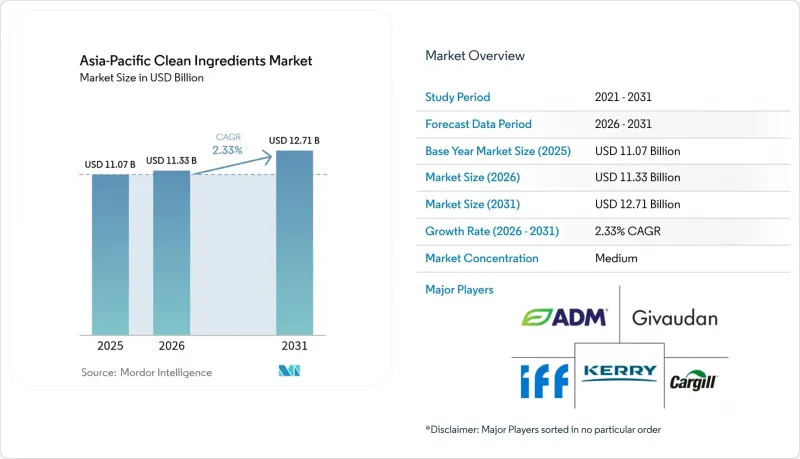
This report is Segmented by Ingredient (Food Preservatives, Food Sweeteners, Food Colorants, Food Hydrocolloids, and More), Form (Dry, Liquid), Application (Bakery and Confectionery, Dairy and Frozen Desserts, Beverages, and More), and Geography (Australia, China, India, Indonesia, Japan, and More). The Market Forecasts are Provided in Terms of Value (USD) and Volume (Tons).
Asia-Pacific Clean Ingredients Market Trends and Insights
Rising processed and convenience-food penetration
As urban migration surges in China, India, Indonesia, and Vietnam, households increasingly turn to packaged snacks, ready meals, and shelf-stable drinks. This trend is propelling the adoption of clean-label preservatives and flavor systems in mainstream recipes. In a bid to align with retailer clean-label mandates without sacrificing microbial stability, manufacturers are replacing synthetic sorbates and benzoates with fermentation-derived lactic and acetic acids. In India, the Production Linked Incentive scheme has allocated a substantial INR 109 billion (USD 1.3 billion) to modernize domestic processing plants. This initiative not only elevates baseline ingredient standards but also accelerates innovation cycles. Furthermore, enhanced cold-chain capacities in major cities are reducing spoilage and extending ingredient declaration periods. This development is particularly advantageous for suppliers of natural antioxidants and texture systems. Together, these industry shifts are driving up unit demand, even as per-unit inclusion rates stabilize due to reformulation efficiencies.
Shift toward natural/clean-label additives
In Japan, South Korea, and Australia, label-literacy campaigns are intensifying consumer scrutiny of ingredient lists. As a result, brands are increasingly replacing artificial colors and flavors with options derived from botanicals or fermentation. Japan has updated its 2024 guidelines, mandating the disclosure of synthetic processing aids. This has led producers of instant noodles and confections to pivot towards using extracts from turmeric, beet, and spirulina. Data from South Korea indicates a surge in the volumes of natural colorants being imported, as manufacturers actively seek out compliant alternatives. Meanwhile, Australia's Clean Label Standard, though voluntary, has taken a firm stance by banning 47 synthetic additives. This move is steering investments towards enzyme-based processing and fermentation methods. In response to these regional shifts, multinational brands are aligning their recipes with the strictest local regulations. This harmonization is compelling regional suppliers to enhance their purification and documentation practices.
Stringent multi-jurisdiction regulatory approvals
Due to differing safety tests and disclosure rules in China, India, Japan, and Australia, suppliers face a clearance wait of up to 24 months for novel proteins or botanical extracts. China's GB 2760-2024 has tightened purity standards for natural colorants, requiring suppliers to resubmit dossiers that were previously accepted in other regions, thereby increasing regulatory hurdles. India mandates local clinical trials for probiotic strains, even those already recognized by U.S. or EU agencies, significantly inflating entry costs by an additional USD 200,000-500,000 per strain. This requirement not only raises financial barriers but also prolongs the approval process. In Australia and New Zealand, public consultations are mandatory for any novel food, which can extend launch timelines by six to nine months. These fragmented and region-specific protocols compel suppliers to stagger their rollouts across markets, resulting in delayed returns on investment and a slowdown in overall market growth, as companies struggle to navigate the complex regulatory landscape.
Other drivers and restraints analyzed in the detailed report include:
- Expansion of functional/fortified food and beverage launches
- Investments in precision-fermentation ingredient platforms
- Volatile prices of botanical/fermentation feedstocks
For complete list of drivers and restraints, kindly check the Table Of Contents.
Segment Analysis
In 2025, Food Flavors and Enhancers dominated the Asia-Pacific clean ingredients market, capturing a 23.32% share. Their significance is underscored by their pivotal role in masking taste and adapting to regional flavors, particularly in beverages, baked goods, and savory snacks. This segment's growth is bolstered by a surge in beverage and ready-to-drink (RTD) coffee launches in China and Japan. Additionally, there's a growing trend among meat processors in Southeast Asia to adopt amino acid-based umami enhancers. To ensure consistent quality and supply, manufacturers are increasingly leaning on fermentation-derived solutions. Moreover, encapsulation technologies are being utilized to bolster flavor stability, especially in intricate processing settings.
Food Colorants are set to be the fastest-growing segment, with an anticipated expansion at a 4.86% CAGR through 2031, outpacing the broader market. Regulatory moves, like the ban on titanium dioxide in Australia and Japan, have hastened the shift towards natural pigments sourced from spirulina, beetroot, and turmeric. These clean-label options not only cater to consumer demands for safety and transparency but also ensure hue stability under varying pH and temperature conditions. Continuous research and development, coupled with enhanced extraction methods, are amplifying the performance and cost-effectiveness of these natural color systems, establishing them as pivotal innovation catalysts in the region's clean ingredient landscape.
Complete Report Scope:
- By Ingredient
- Food Preservatives
- Food Sweeteners
- Food Colorants
- Food Hydrocolloids
- Food Flavors and Enhancers
- Other Ingredients Types
- By Form
- Dry
- Liquid
- By Application
- Bakery and Confectionery
- Dairy and Frozen Desserts
- Beverages
- Meat and Meat Products
- Sauces, and Condiments
- Other Applications
- Country
- Australia
- China
- India
- Indonesia
- Japan
- Malaysia
- South Korea
- Thailand
- Vietnam
- Rest of Asia-Pacific
List of Companies Covered in this Report:
- Cargill Inc.
- Archer Daniels Midland Co.
- Kerry Group plc
- Givaudan SA
- International Flavors & Fragrances Inc.
- Chr. Hansen Holding A/S
- Sensient Technologies Corp.
- Dohler GmbH
- DDW The Colour House
- Firmenich SA
- Symrise AG
- BASF SE
- Ingredion Inc.
- Tate & Lyle plc
- Ajinomoto Co. Inc.
- DSM-Firmenich AG
- Novozymes A/S
- PureCircle Ltd.
- COFCO Biochemical
- RZBC Group Co. Ltd.
- Corbion N.V.
Additional Benefits:
- The market estimate (ME) sheet in Excel format
- 3 months of analyst support
TABLE OF CONTENTS
1 INTRODUCTION
- 1.1 Study Assumptions and Market Definition
- 1.2 Scope of the Study
2 RESEARCH METHODOLOGY
3 EXECUTIVE SUMMARY
4 MARKET LANDSCAPE
- 4.1 Market Overview
- 4.2 Market Drivers
- 4.2.1 Rising processed and convenience-food penetration
- 4.2.2 Shift toward natural/clean-label additives
- 4.2.3 Expansion of functional/fortified food and beverage launches
- 4.2.4 Investments in precision-fermentation ingredient platforms
- 4.2.5 Government-backed food-manufacturing corridor projects
- 4.2.6 E-commerce-enabled micro-batch beverage start-ups
- 4.3 Market Restraints
- 4.3.1 Stringent multi-jurisdiction regulatory approvals
- 4.3.2 Volatile prices of botanical/fermentation feedstocks
- 4.3.3 Nano- and micro-particle safety scrutiny in additive supply chains
- 4.3.4 Sugar-reduction mandates curbing high-intensity sweetener demand
- 4.4 Supply Chain Analysis
- 4.5 Regulatory Landscape
- 4.6 Porter's Five Forces
- 4.6.1 Bargaining Power of Suppliers
- 4.6.2 Bargaining Power of Buyers
- 4.6.3 Threat of New Entrants
- 4.6.4 Threat of Substitutes
- 4.6.5 Competitive Rivalry
5 MARKET SIZE AND GROWTH FORECASTS (VALUE AND VOLUME)
- 5.1 By Ingredient
- 5.1.1 Food Preservatives
- 5.1.2 Food Sweeteners
- 5.1.3 Food Colorants
- 5.1.4 Food Hydrocolloids
- 5.1.5 Food Flavors and Enhancers
- 5.1.6 Other Ingredients Types
- 5.2 By Form
- 5.2.1 Dry
- 5.2.2 Liquid
- 5.3 By Application
- 5.3.1 Bakery and Confectionery
- 5.3.2 Dairy and Frozen Desserts
- 5.3.3 Beverages
- 5.3.4 Meat and Meat Products
- 5.3.5 Sauces, and Condiments
- 5.3.6 Other Applications
- 5.4 Country
- 5.4.1 Australia
- 5.4.2 China
- 5.4.3 India
- 5.4.4 Indonesia
- 5.4.5 Japan
- 5.4.6 Malaysia
- 5.4.7 South Korea
- 5.4.8 Thailand
- 5.4.9 Vietnam
- 5.4.10 Rest of Asia-Pacific
6 COMPETITIVE LANDSCAPE
- 6.1 Market Concentration
- 6.2 Strategic Moves
- 6.3 Market Positioning Analysis
- 6.4 Company Profiles (includes Global level Overview, Market level overview, Core Segments, Financials as available, Strategic Information, Market Rank/Share for key companies, Products and Services, and Recent Developments)
- 6.4.1 Cargill Inc.
- 6.4.2 Archer Daniels Midland Co.
- 6.4.3 Kerry Group plc
- 6.4.4 Givaudan SA
- 6.4.5 International Flavors & Fragrances Inc.
- 6.4.6 Chr. Hansen Holding A/S
- 6.4.7 Sensient Technologies Corp.
- 6.4.8 Dohler GmbH
- 6.4.9 DDW The Colour House
- 6.4.10 Firmenich SA
- 6.4.11 Symrise AG
- 6.4.12 BASF SE
- 6.4.13 Ingredion Inc.
- 6.4.14 Tate & Lyle plc
- 6.4.15 Ajinomoto Co. Inc.
- 6.4.16 DSM-Firmenich AG
- 6.4.17 Novozymes A/S
- 6.4.18 PureCircle Ltd.
- 6.4.19 COFCO Biochemical
- 6.4.20 RZBC Group Co. Ltd.
- 6.4.21 Corbion N.V.
7 MARKET OPPORTUNITIES AND FUTURE OUTLOOK

