PUBLISHER: Mordor Intelligence | PRODUCT CODE: 2114317

PUBLISHER: Mordor Intelligence | PRODUCT CODE: 2114317
Asia-Pacific Fruits And Vegetables Ingredients - Market Share Analysis, Industry Trends & Statistics, Growth Forecasts (2026 - 2031)
According to Mordor Intelligence, the Asia-Pacific fruits and vegetables ingredients market size is expected to grow from USD 64.54 million in 2025 to USD 69.78 million in 2026 and is forecast to reach USD 103.09 million by 2031 at 8.12% CAGR over 2026-2031.
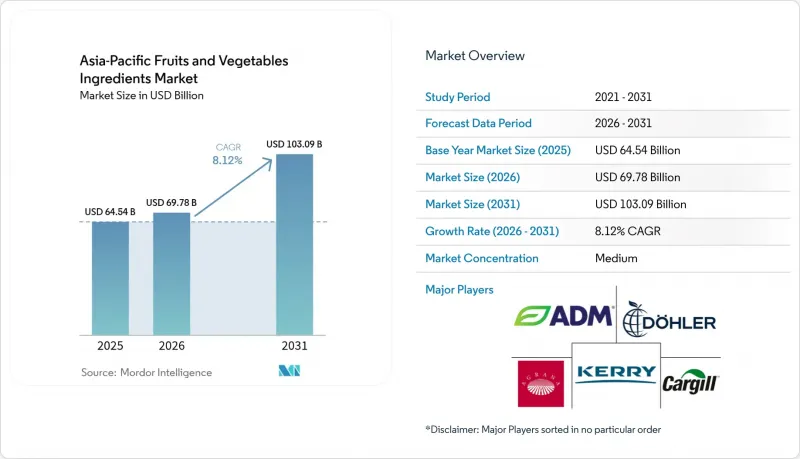
This report is Segmented by Ingredient Type (Fruits: Apple, Orange, Pineapple, and More; Vegetables: Carrots, Beetroots, and More), Form (Concentrates, Pastes and Purees, and More), Application (Beverages, Confectionary, Bakery, and More), and Geography (China, India, Japan, Australia, South Korea, and More). Market Forecasts are Provided in Terms of Value (USD Million).
Asia-Pacific Fruits And Vegetables Ingredients Market Trends and Insights
Rising Demand for Clean-Label and Natural Ingredients in Packaged Foods
Regulatory pressure and rising consumer awareness are driving packaged-food makers to replace synthetic additives with fruit- and vegetable-based ingredients. Indonesia's 2024 draft Nutri-Level labeling requires front-of-pack warnings for high sugar, salt, or saturated fat, prompting reformulation with natural sweeteners and colorants, such as dragon fruit and beetroot, according to BPOM. Thailand's Phase 4 sugar tax (effective April 2025) and Singapore's 2024 Nutri-Grade labeling similarly encourage manufacturers to shift toward fruit concentrates and monk fruit extracts, while Vietnam introduces a new tax on sweetened beverages. Consumer trends support this shift: Cargill's 2025 APAC survey reveals that 58% are willing to pay more for recognizable, natural ingredients, and over 70% actively check labels. Global influences, such as the U.S. FDA's updated "healthy" claim rules, effective as of 2028, are also shaping Asia-Pacific ingredient strategies and increasing the value of clean-label offerings.
Growing Adoption of Fruit-Based Sugar-Replacers by Beverage Formulators
Beverage makers are increasingly replacing refined sucrose with fruit-derived sweeteners to meet sugar tax regulations and tap into the premiumization trend, thereby boosting demand for concentrates, NFC juices, and powdered fruit extracts. Thailand's April 2025 sugar tax hike targets drinks with more than 10 g/100 ml. The 2018-2023 reformulations saw producers reduce the average sugar content by 18% using blends of cane sugar, monk fruit, stevia, and fruit concentrates, according to the Thai FDA. Innovations like NutraEx Food's July 2024 BI-Sugar, which combines L-arabinose with sucrose and stevia to reduce glycemic response while maintaining sweetness, exemplify technical advances. Meanwhile, Samyang Corporation's September 2024 KRW 140 billion specialty plant in Ulsan, South Korea, now produces 13,000 tons per year of allulose, a rare low-calorie sugar gaining traction in APAC beverages. Rising fiscal penalties and consumer demand for "no artificial sweeteners" labels are expected to expand the fruit-based sugar-replacer market by roughly 1.5 percentage points of CAGR through 2030.
Raw-Material Price Volatility Due to Climate and Pests
Extreme weather and pest outbreaks are disrupting fruit and vegetable harvests across the Asia-Pacific region, resulting in supply shortages, price spikes, and increased processing costs. In 2024, typhoons and heavy rains in the Philippines damaged leafy greens, tomatoes, and root crops, driving up local prices by 30-50%. Meanwhile, droughts in northern Thailand reduced mango and longan yields, forcing processors to source from India and Pakistan at higher costs, according to the FAO. China's apple regions in Shaanxi and Shandong also faced lower-than-expected harvests due to temperature extremes and irregular rainfall. Pest pressures, including fruit flies and aphids, further reduce yields and increase post-harvest sorting costs by 12-18%. The FAO Food Price Index showed month-to-month swings of over 10% for tropical fruits and 8% for processed vegetables, complicating long-term contracts. This volatility is expected to reduce short-term market CAGR by 0.8 percentage points, with relief anticipated as climate-resilient crops and better irrigation systems are introduced.
Other drivers and restraints analyzed in the detailed report include:
- Functional-Food Launches Featuring Super-Fruit Phytonutrients
- Growth of Plant-Based and Vegan Foods
- Competition from Synthetic Substitutes
For complete list of drivers and restraints, kindly check the Table Of Contents.
Segment Analysis
Vegetable ingredients are projected to grow at the fastest rate, with a 9.05% CAGR from 2026 to 2031, despite fruits holding a 62.10% share in 2025. The rise of plant-based and functional foods is driving demand for vegetable-derived proteins, fibers, and phytonutrients in meat alternatives, dairy substitutes, and fortified snacks. Kagome's January 2025 pivot from a "tomato company" to a "vegetable company" highlights opportunities to expand beyond pastes and purees into freeze-dried powders, concentrated extracts, and fermented derivatives. Carrots, beets, and tomatoes dominate volumes, with beetroot powder replacing synthetic Red 40 and carmine in plant-based burgers and dairy-free yogurts. Meanwhile, pumpkins and butternuts add natural texture and mild sweetness to bakery and confectionery applications.
Fruits remain the largest ingredient segment due to their entrenched use in beverages, confectionery, and bakery products, with apples, oranges, pineapples, mangoes, and bananas providing both flavor and functional benefits, such as pectin and natural acidity. Berries, including strawberries, blueberries, and raspberries, are the fastest-growing fruit segment, driven by the health benefits of anthocyanins and their positioning as superfoods in functional beverages and dairy products. Exotic fruits like kiwi cater to premium niches in Japan, South Korea, and urban China. Regional launches, such as I.P. Natural Products' May 2024 Ivy-brand tamarind and plum juices in Thailand packaged in SIG XSlimBloc cartons, showcase on-the-go commercialization of local flavors. Vegetable ingredients also benefit from simpler regulatory approval under FSSAI and ASEAN frameworks, while novel fruit extracts often require toxicology dossiers, influencing innovation and market strategy.
Complete Report Scope:
- By Ingredient Type
- Fruits
- Apple
- Orange
- Pineapple
- Mango
- Banana
- Kiwi
- Berries
- Other Fruits
- Vegetables
- Carrots
- Beetroots
- Tomato
- Butternuts
- Pumpkins
- Other Vegetables
- Fruits
- By Form
- Concentrates
- Pastes and Purees
- Pieces and Slices
- Powders
- NFC Juices
- Others
- By Application
- Beverages
- Confectionary Products
- Bakery Products
- Soups and Sauces
- Dairy Products
- RTE Products
- Others
- By Geography
- China
- India
- Japan
- Australia
- South Korea
- Indonesia
- Thailand
- Singapore
- Rest of Asia-Pacific
List of Companies Covered in this Report:
- Archer Daniels Midland Co.
- AGRANA Beteiligungs-AG
- Cargill Inc.
- Dohler GmbH
- Kerry Group plc
- SunOpta Inc.
- Sensient Technologies Corp.
- Olam International Ltd.
- Symrise AG
- SVZ International B.V.
- Tree Top Inc.
- Yaax International Inc.
- Taura Natural Ingredients Ltd.
- DMH Ingredients Inc.
- Hans Zipperle S.p.A.
- Kanegrade Ltd.
- Ingredion Inc.
- Haisheng Juice Holdings Co.
- Jain Irrigation Systems Ltd.
- Kagome Co. Ltd.
Additional Benefits:
- The market estimate (ME) sheet in Excel format
- 3 months of analyst support
TABLE OF CONTENTS
1 INTRODUCTION
- 1.1 Study Assumptions and Market Definition
- 1.2 Scope of the Study
2 RESEARCH METHODOLOGY
3 EXECUTIVE SUMMARY
4 MARKET DYNAMICS
- 4.1 Market Overview
- 4.2 Market Drivers
- 4.2.1 Rising demand for clean-label and natural ingredients in packaged foods
- 4.2.2 Growing adoption of fruit-based sugar-replacers by beverage formulators
- 4.2.3 Functional-food launches featuring "super-fruit" phytonutrients
- 4.2.4 Growth of plant-based and vegan foods
- 4.2.5 Surge of processed food exports from China and ASEAN
- 4.2.6 Cold-chain subsidies by APAC governments
- 4.3 Market Restraints
- 4.3.1 Raw-material price volatility (climate and pests)
- 4.3.2 Competition from synthetic substitutes
- 4.3.3 High CAPEX for aseptic and freeze-drying lines
- 4.3.4 Complex multi-country regulatory approvals
- 4.4 Supply Chain Analysis
- 4.5 Regulatory Landscape
- 4.6 Technological Outlook
- 4.7 Porter's Five Forces
- 4.7.1 Threat of New Entrants
- 4.7.2 Bargaining Power of Buyers
- 4.7.3 Bargaining Power of Suppliers
- 4.7.4 Threat of Substitute Products
- 4.7.5 Intensity of Competitive Rivalry
5 MARKET SIZE AND GROWTH FORECASTS (VALUE AND VOLUME)
- 5.1 By Ingredient Type
- 5.1.1 Fruits
- 5.1.1.1 Apple
- 5.1.1.2 Orange
- 5.1.1.3 Pineapple
- 5.1.1.4 Mango
- 5.1.1.5 Banana
- 5.1.1.6 Kiwi
- 5.1.1.7 Berries
- 5.1.1.8 Other Fruits
- 5.1.2 Vegetables
- 5.1.2.1 Carrots
- 5.1.2.2 Beetroots
- 5.1.2.3 Tomato
- 5.1.2.4 Butternuts
- 5.1.2.5 Pumpkins
- 5.1.2.6 Other Vegetables
- 5.1.1 Fruits
- 5.2 By Form
- 5.2.1 Concentrates
- 5.2.2 Pastes and Purees
- 5.2.3 Pieces and Slices
- 5.2.4 Powders
- 5.2.5 NFC Juices
- 5.2.6 Others
- 5.3 By Application
- 5.3.1 Beverages
- 5.3.2 Confectionary Products
- 5.3.3 Bakery Products
- 5.3.4 Soups and Sauces
- 5.3.5 Dairy Products
- 5.3.6 RTE Products
- 5.3.7 Others
- 5.4 By Geography
- 5.4.1 China
- 5.4.2 India
- 5.4.3 Japan
- 5.4.4 Australia
- 5.4.5 South Korea
- 5.4.6 Indonesia
- 5.4.7 Thailand
- 5.4.8 Singapore
- 5.4.9 Rest of Asia-Pacific
6 COMPETITIVE LANDSCAPE
- 6.1 Market Concentration
- 6.2 Strategic Moves
- 6.3 Market Ranking Analysis
- 6.4 Company Profiles (includes Global level Overview, Market level overview, Core Segments, Financials, Strategic Information, Market Rank/Share, Products and Services, Recent Developments)
- 6.4.1 Archer Daniels Midland Co.
- 6.4.2 AGRANA Beteiligungs-AG
- 6.4.3 Cargill Inc.
- 6.4.4 Dohler GmbH
- 6.4.5 Kerry Group plc
- 6.4.6 SunOpta Inc.
- 6.4.7 Sensient Technologies Corp.
- 6.4.8 Olam International Ltd.
- 6.4.9 Symrise AG
- 6.4.10 SVZ International B.V.
- 6.4.11 Tree Top Inc.
- 6.4.12 Yaax International Inc.
- 6.4.13 Taura Natural Ingredients Ltd.
- 6.4.14 DMH Ingredients Inc.
- 6.4.15 Hans Zipperle S.p.A.
- 6.4.16 Kanegrade Ltd.
- 6.4.17 Ingredion Inc.
- 6.4.18 Haisheng Juice Holdings Co.
- 6.4.19 Jain Irrigation Systems Ltd.
- 6.4.20 Kagome Co. Ltd.
7 MARKET OPPORTUNITIES AND FUTURE TRENDS

