PUBLISHER: Mordor Intelligence | PRODUCT CODE: 2114064

PUBLISHER: Mordor Intelligence | PRODUCT CODE: 2114064
Insect-Based Ingredients - Market Share Analysis, Industry Trends & Statistics, Growth Forecasts (2026 - 2031)
According to Mordor Intelligence, the insect-based ingredients market reached a market size of USD 0.72 billion in 2026 and is projected to reach USD 1.21 billion by 2031, advancing at a 10.9% CAGR over the forecast period.
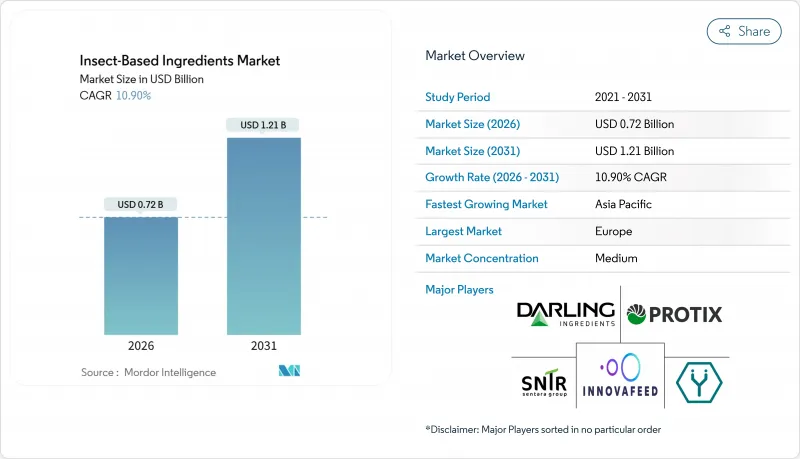
This report is Segmented by Ingredient Type (Protein Powders, Oils and Lipids, Defatted Meals, and More), by Application (Animal Feed and Agriculture Fertilizers), by Insect Species (Black Soldier Fly, Mealworms, and More), by Form (Dry, Liquid, and Paste), and by Geography (North America, South America, Europe, Asia-Pacific, and More). The Market Forecasts are Provided in Terms of Value (USD).
Global Insect-Based Ingredients Market Trends and Insights
Rising Regulatory Acceptance of Insect Protein in Aquaculture and Livestock Feed
Positive scientific opinions from the European Food Safety Authority in 2024 approved Black Soldier Fly protein for salmonids and poultry, broadening earlier aquaculture-only authorizations. In parallel, the United States Food and Drug Administration streamlined data requirements, cutting the review cycle for well-documented dossiers to 18 months, while the Canadian Food Inspection Agency aligned inclusion thresholds for insect meal in aquafeed with European norms . These harmonized rules have triggered multi-year offtake contracts between major feed blenders and insect producers, reducing commercial risk. Clearer guidelines also enable producers to develop multi-species product portfolios instead of pursuing case-by-case exemptions. The regulatory certainty lowers compliance costs, supports facility financing, and accelerates geographic scaling. Consequently, the insect-based ingredients market is moving quickly from pilot to industrial deployment across continents.
Cost-Competitive Alternative to Fishmeal and Soy Protein
Black Soldier Fly meal averaged USD 1.30 per kilogram in European spot trade during 2025, undercutting fishmeal, which fluctuated between USD 1.50 and USD 2.20 per kilogram on Peru anchovy quota swings. Although soybean meal costs less per kilogram, its lower protein content forces higher inclusion rates, eroding cost parity. Peer-reviewed tilapia trials replacing 30% fishmeal with insect meal maintained growth rates and trimmed total feed costs by 12%. Aquaculture clusters in Vietnam and Thailand lifted insect meal use by double-digit percentages in 2025 as operators sought price stability and closer supply chains. Growing economies of scale at plants larger than 10,000-metric-ton capacity are further narrowing unit costs. Taken together, insect protein is transitioning from niche supplement to structural component in commercial feed recipes.
Limited Industrial-Scale Capacity Below 300,000 Metric Tons
Worldwide nameplate capacity reached only 250,000 metric tons in 2025, a fraction of the 1.5 million metric tons of fishmeal consumed annually by aquaculture. Innovafeed's flagship plant yields 15,000 metric tons of protein meal, and Protix's Dutch site adds another 15,000 metric tons, leaving formulators supply-constrained. Most aquafeed mills cap insect inclusion at 5% to secure continuity, muting volume growth. New plants take 24 to 36 months from ground-breaking to steady-state output. Capacity scarcity is most acute in Asia-Pacific, where aquaculture exceeds 70 million metric tons but local insect facilities supply less than 50,000 metric tons, forcing reliance on pricier imports.
Other drivers and restraints analyzed in the detailed report include:
- Sustainability Commitments by Global Feed Producers
- Valorization of Insect Frass as Certified Organic Fertilizer
- High Capital Expenditure Per Metric Ton for Automated Vertical Farms
For complete list of drivers and restraints, kindly check the Table Of Contents.
Segment Analysis
The insect-based ingredients market size for protein powders accounted for 44.0% of total value in 2025, underlining their role as direct fishmeal substitutes. Oils and lipids, although smaller, are forecast to be the fastest-growing slice at an 11.5% CAGR, outpacing defatted meals and frass. Platform producers are optimizing larvae to raise lauric acid content and bundling oil with data on gut health gains to justify premium list prices. Frass emerged as a credible organic fertilizer, particularly in high-value horticulture, raising blended revenue per ton of larvae processed.
Functional differentiation is steering buyers toward insect oils that deliver measurable feed conversion and pathogen control benefits. A broiler trial showing a 5% improvement in feed efficiency catalyzed new demand from European integrators. The insect-based ingredients market share for oils is anticipated to climb as precision livestock farming scales. In contrast, defatted meal finds niche demand in organic poultry operations needing lower fat to curb storage rancidity.
Aquaculture absorbed 47% of 2025 demand, driven by shrimp, tilapia, and salmon producers replacing volatile fishmeal supplies. This channel is set to expand at an 11.8% CAGR, the strongest within applications, as inclusion caps ease. Poultry feed adoption grows in Europe and Canada, where regulators allow up to 15% Black Soldier Fly meal in broiler rations. Pet food occupies a smaller tonnage yet commands two to three times the price of aquafeed.
The insect-based ingredients market size for aquaculture protein is projected to exceed USD 0.60 billion by 2031, while pet food's premium positioning supports high margins. Organic certified frass fertilizers sell for 25% above compost, widening producer revenue streams and improving project bankability. Sustainability labeling and consumer preference for novel proteins underpin price resilience in companion animal channels.
Complete Report Scope:
- By Ingredient Type
- Protein Powders
- Oils and Lipids
- Defatted Meals
- Frass (Organic Fertilizer)
- By Application
- Animal Feed
- Aquaculture Feed
- Poultry Feed
- Pet Food
- Agriculture Fertilizers
- Animal Feed
- By Insect Species
- Black Soldier Fly
- Mealworms
- Crickets
- Others
- By Form
- Dry
- Liquid
- Paste
- By Geography
- North America
- United States
- Canada
- Mexico
- Rest of North America
- South America
- Brazil
- Argentina
- Rest of South America
- Europe
- Germany
- France
- United Kingdom
- Italy
- Spain
- Russia
- Rest of Europe
- Asia-Pacific
- China
- Japan
- India
- South Korea
- Australia
- Rest of Asia-Pacific
- Middle East
- Saudi Arabia
- United Arab Emirates
- Rest of Middle East
- Africa
- South Africa
- Nigeria
- Rest of Africa
- North America
Geography Analysis
Europe led with 32% revenue share in 2025, anchored by clear feed regulations and density of co-located facilities in France and the Netherlands. Positive European Food Safety Authority opinions in 2024 expanded species approvals for salmonids and poultry, locking in steady demand. France hosts both Innovafeed's 55,000-square-meter Black Soldier Fly site and Ynsect's mealworm plant, while Dutch incentives have fostered research and commercialization clusters. Regulatory maturity supports growth through 2031, slower than emerging regions but off a higher base.
The Asia-Pacific region is forecast to record the fastest growth at 11.0% CAGR, driven by Vietnam, Thailand, and Indonesia, where shrimp and tilapia producers are integrating insect meal to meet eco-label requirements for exports to Europe and North America. Thailand's growing production and rapidly scaling Entobel plant underscore regional momentum. China and India lag due to the absence of comprehensive guidelines, although local research pilots are underway. A capacity shortfall means that Asia-Pacific countries still import from Europe, adding freight premiums of USD 0.15 to USD 0.20 per kilogram.
North America, though smaller today, is set to grow on the back of the planned Innovafeed and Archer Daniels Midland facility in Illinois and EnviroFlight's operational Kentucky plant. Canada aligned feed rules with Europe in 2024, facilitating cross-border trade. Mexico and Brazil are consulting on approvals, and South American growth is anticipated as poultry exporters pilot insect meal to hedge soybean price swings. Middle East and African uptake hinges on faster regulatory clarity and financing for local plants.
List of Companies Covered in this Report:
- Ynsect
- Innovafeed
- Protix
- EnviroFlight (Darling Ingredients)
- Sentara Group
- Entobel
- HiProMine
- Nasekomo
- Beta Hatch
- Hexafly
- BioflyTech
- nextProtein
- FlyFeed
- Aspire Food Group
- Insect Technology Group (formerly AgriProtein)
Additional Benefits:
- The market estimate (ME) sheet in Excel format
- 3 months of analyst support
TABLE OF CONTENTS
1 Introduction
- 1.1 Study Assumptions and Market Definition
- 1.2 Scope of the Study
2 Research Methodology
3 Executive Summary
4 Market Landscape
- 4.1 Market Overview
- 4.2 Market Drivers
- 4.2.1 Rising regulatory acceptance of insect protein in aquaculture and livestock feed
- 4.2.2 Cost-competitive alternative to fishmeal and soy protein
- 4.2.3 Sustainability commitments by global feed producers
- 4.2.4 Valorization of insect frass as certified organic fertilizer
- 4.2.5 Growth of precision livestock farming needing functional lipids for gut health
- 4.2.6 Circular-economy partnerships with agri-food by-product generators
- 4.3 Market Restraints
- 4.3.1 Limited industrial-scale capacity below 300,000 metric tons
- 4.3.2 High capital expenditure per metric ton for automated vertical farms
- 4.3.3 Regulatory harmonization lag outside Europe and North America
- 4.3.4 Risk of allergen cross-reactivity with crustaceans
- 4.4 Regulatory Landscape
- 4.5 Technological Outlook
- 4.6 Porter's Five Forces
- 4.6.1 Bargaining Power of Suppliers
- 4.6.2 Bargaining Power of Buyers
- 4.6.3 Threat of New Entrants
- 4.6.4 Threat of Substitutes
- 4.6.5 Competitive Rivalry
5 Market Size and Growth Forecasts (Value)
- 5.1 By Ingredient Type
- 5.1.1 Protein Powders
- 5.1.2 Oils and Lipids
- 5.1.3 Defatted Meals
- 5.1.4 Frass (Organic Fertilizer)
- 5.2 By Application
- 5.2.1 Animal Feed
- 5.2.1.1 Aquaculture Feed
- 5.2.1.2 Poultry Feed
- 5.2.1.3 Pet Food
- 5.2.2 Agriculture Fertilizers
- 5.2.1 Animal Feed
- 5.3 By Insect Species
- 5.3.1 Black Soldier Fly
- 5.3.2 Mealworms
- 5.3.3 Crickets
- 5.3.4 Others
- 5.4 By Form
- 5.4.1 Dry
- 5.4.2 Liquid
- 5.4.3 Paste
- 5.5 By Geography
- 5.5.1 North America
- 5.5.1.1 United States
- 5.5.1.2 Canada
- 5.5.1.3 Mexico
- 5.5.1.4 Rest of North America
- 5.5.2 South America
- 5.5.2.1 Brazil
- 5.5.2.2 Argentina
- 5.5.2.3 Rest of South America
- 5.5.3 Europe
- 5.5.3.1 Germany
- 5.5.3.2 France
- 5.5.3.3 United Kingdom
- 5.5.3.4 Italy
- 5.5.3.5 Spain
- 5.5.3.6 Russia
- 5.5.3.7 Rest of Europe
- 5.5.4 Asia-Pacific
- 5.5.4.1 China
- 5.5.4.2 Japan
- 5.5.4.3 India
- 5.5.4.4 South Korea
- 5.5.4.5 Australia
- 5.5.4.6 Rest of Asia-Pacific
- 5.5.5 Middle East
- 5.5.5.1 Saudi Arabia
- 5.5.5.2 United Arab Emirates
- 5.5.5.3 Rest of Middle East
- 5.5.6 Africa
- 5.5.6.1 South Africa
- 5.5.6.2 Nigeria
- 5.5.6.3 Rest of Africa
- 5.5.1 North America
6 Competitive Landscape
- 6.1 Market Concentration
- 6.2 Strategic Moves
- 6.3 Market Share Analysis
- 6.4 Company Profiles (includes Global Level Overview, Market Level Overview, Core Segments, Financials as Available, Strategic Information, Market Rank/Share for Key Companies, Products and Services, and Recent Developments)
- 6.4.1 Ynsect
- 6.4.2 Innovafeed
- 6.4.3 Protix
- 6.4.4 EnviroFlight (Darling Ingredients)
- 6.4.5 Sentara Group
- 6.4.6 Entobel
- 6.4.7 HiProMine
- 6.4.8 Nasekomo
- 6.4.9 Beta Hatch
- 6.4.10 Hexafly
- 6.4.11 BioflyTech
- 6.4.12 nextProtein
- 6.4.13 FlyFeed
- 6.4.14 Aspire Food Group
- 6.4.15 Insect Technology Group (formerly AgriProtein)
7 Market Opportunities and Future Outlook

