PUBLISHER: Mordor Intelligence | PRODUCT CODE: 2113233

PUBLISHER: Mordor Intelligence | PRODUCT CODE: 2113233
Asia Pacific Collagen - Market Share Analysis, Industry Trends & Statistics, Growth Forecasts (2026 - 2031)
According to Mordor Intelligence, the Asia Pacific collagen market size was valued at USD 3.41 billion in 2025 and estimated to grow from USD 3.75 billion in 2026 to reach USD 6.02 billion by 2031, at a CAGR of 9.93% during the forecast period (2026-2031).
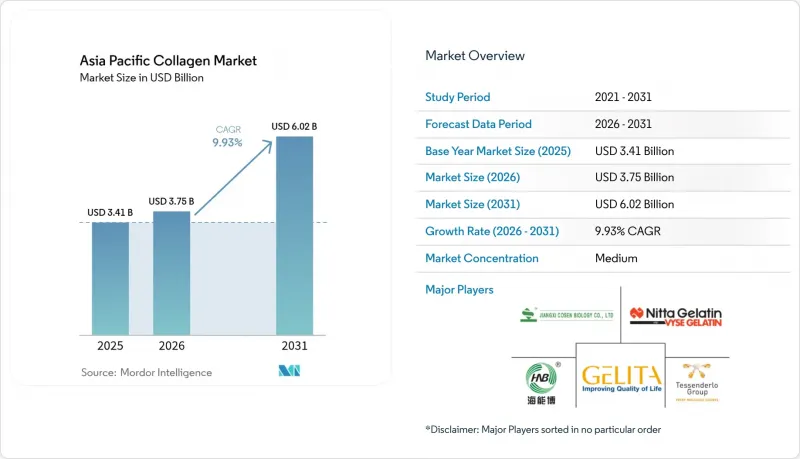
This report is Segmented by Source (Animal-Based, Marine-Based), End User/Application (Food & Beverages, Dietary Supplements, Personal Care & Cosmetics, Pharmaceuticals, Animal Nutrition), and Geography (Japan, China, India, Australia, Rest of Asia Pacific). The Market Forecasts are Provided in Terms of Value (USD).
Asia Pacific Collagen Market Trends and Insights
Increasing Consumer Demand for Health and Wellness Products
As the wellness economy continues to expand across the Asia Pacific region, collagen is increasingly being utilized in functional nutrition, extending its applications beyond traditional beauty-related uses. Furthermore, per capita income in the region is expected to grow significantly, rising from USD 17,440 in 2024 to a projected USD 23,260 by 2029. This economic growth is driving a shift toward preventive health investments, creating a strong foundation for the adoption of premium collagen products. These products are specifically designed to address key health concerns such as joint health, skin elasticity, and bone density maintenance. Consumers are demonstrating a growing willingness to pay higher prices for collagen formulations that are supported by robust scientific evidence. This trend offers substantial margin expansion opportunities for suppliers who can effectively demonstrate the clinical efficacy of their products through peer-reviewed research and ensure compliance with regulatory health claims.
Ageing Population Seeking Joint-Care Solutions
As developed APAC markets experience significant demographic shifts, the demand for joint-care collagen applications continues to grow steadily. According to the World Bank data from 2024, 30% of people in Japan were above the age of 65. Japan, characterized by its advanced aging society, serves as a pivotal market for testing and developing innovative solutions. For instance, Rohto Pharmaceutical's MOCOLA brand has introduced a unique combination of 20ml collagen drinks and vitamin tablets, effectively addressing the consumption preferences of elderly consumers. This approach highlights the importance of format innovation in catering to the aging population. Beyond Japan, similar trends are emerging in China and South Korea, where aging baby boomers are becoming key drivers of market growth. These consumers, equipped with substantial accumulated wealth and a strong focus on health and wellness, are fostering the development of premium market segments. The demand for clinically-validated joint health formulations in these regions underscores the growing importance of addressing the specific needs of this demographic group.
Competition from Alternative Proteins
Companies like Rawga are driving significant innovation in collagen sourcing by developing VC-H1, a vegetable collagen derived from plant cell wall extensin. This product is specifically designed to replicate the tripeptide structure and molecular weight of animal collagen, offering a plant-based alternative that closely mimics its natural counterpart. At the same time, Evonik is making strides in precision fermentation through substantial investments and advancements in biotechnology. These efforts are creating scalable and sustainable alternatives to traditional collagen, addressing growing concerns about environmental impact and dietary restrictions. Additionally, these technologies hold the potential to reduce production costs when implemented at scale, making them economically viable. Consequently, traditional collagen suppliers are facing mounting pressure to adapt. They are focusing on differentiating their offerings by emphasizing superior bioavailability, securing clinical validation, and targeting specialized applications. These areas highlight the unique advantages of natural collagen, particularly its complex matrix properties, which synthetic alternatives have yet to fully replicate.
Other drivers and restraints analyzed in the detailed report include:
- Rising Applications in Anti-Aging Creams and Other Beauty Products
- Technological Advancements in Extraction, Processing, and Formulation
- Stringent Regulatory Compliance and Certification Requirements
For complete list of drivers and restraints, kindly check the Table Of Contents.
Segment Analysis
Marine-based collagen accelerates at a 10.28% CAGR through 2031, outpacing the animal-based segment's market-leading 62.55% share in 2025, reflecting consumer preference shifts toward sustainable and hypoallergenic alternatives. Thai Union's marine collagen investments and circular economy initiatives demonstrate how fishing industry byproducts create value-added revenue streams while addressing sustainability concerns, according to the University of Florida IFAS EDIS. Animal-based collagen maintains dominance through established supply chains and cost advantages, particularly in price-sensitive market segments where functional benefits outweigh sustainability premiums.
The marine collagen segment benefits from technological advances in fish skin processing and decellularization techniques that enhance bioavailability while reducing allergenicity risks compared to bovine and porcine alternatives. Regulatory frameworks increasingly favor marine sources due to lower disease transmission risks and reduced religious dietary restrictions, particularly in Muslim-majority markets like Indonesia and Malaysia. However, marine collagen faces supply chain constraints from fishing industry regulations and seasonal availability, creating price volatility that limits mass-market penetration compared to consistently available animal-based alternatives.
Complete Report Scope:
- By Source
- Animal-based
- Marine-based
- By End User / Application
- Food & Beverages
- Dietary Supplements
- Personal Care & Cosmetics
- Pharmaceuticals
- Animal Nutrition
- By Geography
- Japan
- China
- India
- Australia
- Rest of Asia Pacific
List of Companies Covered in this Report:
- Gelita AG
- Rousselot / Peptan
- Nitta Gelatin Inc.
- Darling Ingredients
- Thai Union Ingredients
- Nestle Health Science (Vital Proteins)
- TCI Co. Ltd.
- Titan Biotech Ltd.
- Hangzhou Nutrition Biotechnology
- Shiseido Co. Ltd.
- AmorePacific Corp.
- Weishardt Group
- Cargill - Beauty & Health Solutions
- Ori Bionature (Malaysia)
- Nature's Bounty (Co. of The Bountiful Co.)
- Optimum Nutrition (Glambia)
- GNC Holdings
- The Clorox Company (NeoCell)
- Verisol / Gelita brand
- Collagen Solutions plc
Additional Benefits:
- The market estimate (ME) sheet in Excel format
- 3 months of analyst support
TABLE OF CONTENTS
1 INTRODUCTION
- 1.1 Study Assumptions & Market Definition
- 1.2 Scope of the Study
2 RESEARCH METHODOLOGY
3 EXECUTIVE SUMMARY
4 MARKET LANDSCAPE
- 4.1 Market Overview
- 4.2 Market Drivers
- 4.2.1 Increasing consumer demand for health and wellness products,
- 4.2.2 Ageing population seeking joint-care solutions
- 4.2.3 Rising Applications in Anti-Aging Creams and Other Beauty Products
- 4.2.4 Technological advancements in extraction, processing, and formulation
- 4.2.5 Shift toward sustainable marine collagen sources
- 4.2.6 Rising Innovation in research and production
- 4.3 Market Restraints
- 4.3.1 Competition from alternative proteins
- 4.3.2 Stringent regulatory compliance and certification requirements
- 4.3.3 Concerns over allergenicity and religious dietary restrictions
- 4.3.4 High costs of sourcing and processing high-quality collagen raw materials
- 4.4 Supply Chain Analysis
- 4.5 Regulatory Outlook
- 4.6 Porter's Five Forces
- 4.6.1 Threat of New Entrants
- 4.6.2 Bargaining Power of Buyers/Consumers
- 4.6.3 Bargaining Power of Suppliers
- 4.6.4 Threat of Substitute Products
- 4.6.5 Intensity of Competitive Rivalry
5 MARKET SIZE AND GROWTH FORECAST
- 5.1 By Source
- 5.1.1 Animal-based
- 5.1.2 Marine-based
- 5.2 By End User / Application
- 5.2.1 Food & Beverages
- 5.2.2 Dietary Supplements
- 5.2.3 Personal Care & Cosmetics
- 5.2.4 Pharmaceuticals
- 5.2.5 Animal Nutrition
- 5.3 By Geography
- 5.3.1 Japan
- 5.3.2 China
- 5.3.3 India
- 5.3.4 Australia
- 5.3.5 Rest of Asia Pacific
6 COMPETITIVE LANDSCAPE
- 6.1 Market Concentration
- 6.2 Strategic Moves
- 6.3 Market Ranking Analysis
- 6.4 Company Profiles (includes Global-level Overview, Market-level Overview, Core Segments, Financials (if available), Strategic Information, Market Rank/Share, Products & Services, Recent Developments)
- 6.4.1 Gelita AG
- 6.4.2 Rousselot / Peptan
- 6.4.3 Nitta Gelatin Inc.
- 6.4.4 Darling Ingredients
- 6.4.5 Thai Union Ingredients
- 6.4.6 Nestle Health Science (Vital Proteins)
- 6.4.7 TCI Co. Ltd.
- 6.4.8 Titan Biotech Ltd.
- 6.4.9 Hangzhou Nutrition Biotechnology
- 6.4.10 Shiseido Co. Ltd.
- 6.4.11 AmorePacific Corp.
- 6.4.12 Weishardt Group
- 6.4.13 Cargill - Beauty & Health Solutions
- 6.4.14 Ori Bionature (Malaysia)
- 6.4.15 Nature's Bounty (Co. of The Bountiful Co.)
- 6.4.16 Optimum Nutrition (Glambia)
- 6.4.17 GNC Holdings
- 6.4.18 The Clorox Company (NeoCell)
- 6.4.19 Verisol / Gelita brand
- 6.4.20 Collagen Solutions plc
7 MARKET OPPORTUNITIES AND FUTURE OUTLOOK

