PUBLISHER: Mordor Intelligence | PRODUCT CODE: 2113685

PUBLISHER: Mordor Intelligence | PRODUCT CODE: 2113685
South America Collagen - Market Share Analysis, Industry Trends & Statistics, Growth Forecasts (2026 - 2031)
According to Mordor Intelligence, South America collagen market size is valued at USD 118.38 million in 2026, growing from the 2025 value of USD 115.25 million, and is forecast to reach USD 160.53 billion by 2031, at a 5.49% CAGR over 2026-2031.
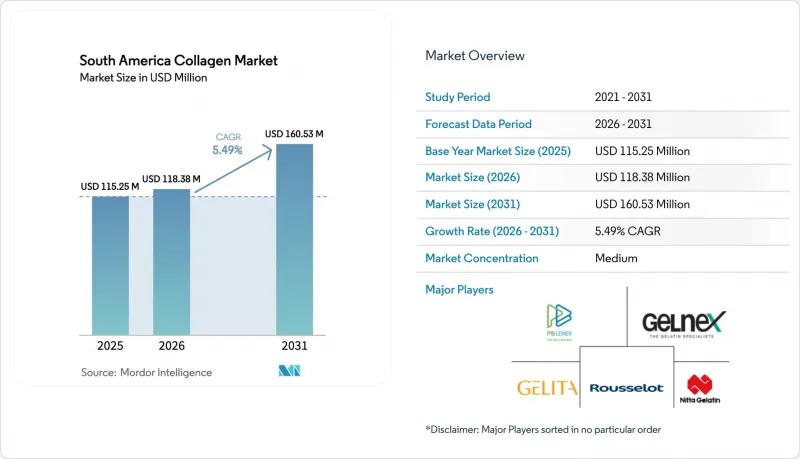
This report is Segmented by Source (Animal-Based and Marine-Based), Form (Powder and Liquid), Application (Food and Beverages, Dietary Supplements, Personal Care and Cosmetics, Pharmaceuticals, and Animal Nutrition), and Geography (Brazil, Argentina, and the Rest of South America). The Market Forecasts are Provided in Terms of Value (USD).
South America Collagen Market Trends and Insights
Growing Demand for Protein-Rich Functional Foods and Beverages
Urban consumers in Sao Paulo and Buenos Aires are increasingly identifying collagen as a convenient protein source that provides both macronutrient density and functional benefits, such as joint support and skin hydration. This trend aligns with the broader Latin American shift toward on-the-go nutrition. In Brazil, the functional beverage segment has achieved double-digit growth, driven by manufacturers incorporating hydrolyzed collagen peptides into ready-to-drink formats that cater to busy professionals. GELITA offers products like RTE-JELLY and RTE-DRINK, which dissolve rapidly in cold liquids. This innovation enables brands to enhance juices, smoothies, and sports drinks without compromising their sensory qualities. Beyond beverages, bakery items, and snack bars present a growing opportunity. Collagen peptides in these products not only improve texture and moisture retention but also contribute to meeting daily protein requirements. Rousselot's Peptan brand, produced at its Brazilian facility, emphasizes the ingredient's bioavailability. Approximately 57% of consumed collagen peptides convert into free amino acids, while 43% transform into di- and tri-peptides within hours. This positions collagen as a highly efficient protein source, particularly for sports nutrition and meal-replacement products. Collagen's dual functionality, combining macronutrient and bioactive properties, sets it apart from standard whey or soy proteins, supporting its premium pricing in the functional food market.
Rising Adoption of Collagen-Based Nutraceutical Supplements
Consumers in Brazil and Argentina are increasingly purchasing collagen supplements through pharmacies and e-commerce platforms. This growth is primarily driven by awareness campaigns emphasizing collagen's benefits, such as improved skin elasticity, stronger nails, and enhanced joint comfort. Eurofarma launched its Fortice supplement in 2021, targeting over 400,000 doctors monthly. The company markets the over-the-counter product as a prescription-like solution for arthritis and chondromalacia. Eurofarma aims to generate BRL 45 million (USD 9 million) in revenue within three years, establishing a niche in Brazil's domestic market, which is valued at approximately BRL 240 million annually. In February 2024, Brazilian producer GelcoPEP demonstrated the effectiveness of hydrolyzed collagen (types I and III) in a randomized, single-blind, placebo-controlled trial. Participants who consumed 10 grams daily for 180 days reported an 88% improvement in nail resistance and a 78% reduction in hair loss, compared to 47% for both outcomes in the placebo group. This clinical evidence not only supports marketing claims but also aids reimbursement discussions with private health insurers, potentially accelerating adoption among middle-income consumers. In a key regulatory development, Argentina's Resolution 2/2024, effective August 2024, officially approved collagen and hydrolyzed collagen as permissible ingredients in dietary supplements under the Codigo Alimentario Argentino. This decision resolves previous regulatory ambiguities that had limited product launches.
Stringent Regulatory Approvals for Medical and Food-Grade Collagen
In March 2023, ANVISA's RDC 751/2022 established a tiered risk classification system for collagen-based medical devices. Implantable or systemically absorbed products are classified as Class III or IV, requiring marketing authorization, detailed technical dossiers, biocompatibility testing, and Good Manufacturing Practices certification, which must be verified through on-site audits. Approvals for Class III and IV devices remain valid for 10 years but must be renewed with updated clinical evidence, resulting in recurring costs for manufacturers. Foreign manufacturers without a legal entity in Brazil are required to appoint a Brazil Registration Holder. This entity handles technical file management, ensures labeling in Portuguese, and oversees post-market surveillance, increasing administrative responsibilities. In 2024, Argentina's ANMAT simplified import procedures for Class I and II medical devices. However, higher-risk collagen products still face lengthy review timelines of several months. In November 2025, Senasa's Resolution 859/2025 revised the definitions of collagen and gelatin to align with European Pharmacopoeia and USP standards. While this change facilitates export certification, it also requires domestic producers to reformulate or re-label their products to meet the updated specifications. As a result, medical-grade collagen now faces a 12-to-24-month delay from development to market entry, discouraging smaller firms from pursuing pharmaceutical or regenerative medicine applications.
Other drivers and restraints analyzed in the detailed report include:
- Expanding Cosmetics and Personal-Care Focus on Anti-Aging Actives
- Emerging Use of Injectable Collagen in Regenerative Medicine
- High Costs of Sourcing and Processing High-Quality Collagen Raw Materials
For complete list of drivers and restraints, kindly check the Table Of Contents.
Segment Analysis
In 2025, animal-based collagen led South America's market, accounting for 65.21% of the revenue, highlighting the region's strong integration into global beef and pork supply chains. In 2024, Brazil and Argentina together processed over 3.2 million tonnes of beef, generating by-products such as hides, bones, and connective tissues essential for gelatin and collagen extraction. However, marine collagen is growing rapidly, with a 7.89% CAGR, as aquaculture skins appeal to consumers seeking "cleaner" peptides. Tambatinga fish gelatin, with an impressive 263 Bloom strength, has proven its viability for gummies and capsules. The increasing popularity of sustainability labels and pescatarian diets is driving premium spending on marine products, signaling a positive outlook for South America's collagen market.
Porcine collagen occupies a niche within the animal-based segment, limited by religious dietary restrictions in certain consumer groups. Nevertheless, its valued amino acid profile and gel strength make it a preferred option for pharmaceutical capsules. In March 2024, the UK approved imports of Brazilian porcine gelatin and collagen, joining El Salvador and the US, which had granted approvals earlier that year. This development could shift supplies toward higher-value international markets, potentially reducing domestic availability. Argentina's Instituto Nacional de Tecnologia Agropecuaria (INTA) has advanced a bioactive peptides project to extract collagen from meat by-products. By 2025, the project reached a technology readiness level of 4-5, reflecting public-sector efforts to upgrade commodity by-products into functional ingredients. Although marine collagen's premium pricing-often 200-300% higher than bovine alternatives-limits its reach in price-sensitive segments, it serves as a differentiation tool for brands targeting affluent urban consumers who are willing to pay for perceived purity and sustainability.
Complete Report Scope:
- By Source
- Animal-based
- Marine-based
- By Form
- Powder
- Liquid
- By Application
- Food and Beverages
- Dietary Supplements
- Personal Care and Cosmetics
- Pharmaceuticals
- Animal Nutrition
- By Geography
- Brazil
- Argentina
- Rest of South America
List of Companies Covered in this Report:
- Rousselot (Darling Ingredients)
- Gelita AG
- PB Leiner (Tessenderlo Group)
- Nitta Gelatin Inc.
- Gelnex
- JBS S.A. (Novaprom)
- Weishardt Group
- Nippi Inc.
- Collagen Solutions Plc
- Amicogen Inc.
- Giant Nutrition S.A.
- Connoils LLC
- Nutripeptin SA
- GelcoPEP
- BioCell Technology LLC
- Taia Gelatina SAS
- Italgel S.r.l.
- Lapi Gelatine S.p.A.
- Titan Biotech Ltd.
- Lonza Group AG
Additional Benefits:
- The market estimate (ME) sheet in Excel format
- 3 months of analyst support
TABLE OF CONTENTS
1 INTRODUCTION
- 1.1 Study Assumptions and Market Definition
- 1.2 Scope of the Study
2 RESEARCH METHODOLOGY
3 EXECUTIVE SUMMARY
4 MARKET LANDSCAPE
- 4.1 Market Overview
- 4.2 Market Drivers
- 4.2.1 Growing Demand for Protein-Rich Functional Foods and Beverages
- 4.2.2 Rising Adoption of Collagen-Based Nutraceutical Supplements
- 4.2.3 Expanding Cosmetics and Personal-Care Focus on Anti-Aging Actives
- 4.2.4 Abundant Bovine and Fish By-Products Lowering Raw-Material Costs
- 4.2.5 Emerging Use of Injectable Collagen in Regenerative Medicine
- 4.2.6 Bio-Economy Incentives for Valorising Agro-Industrial Waste
- 4.3 Market Restraints
- 4.3.1 Stringent Regulatory Approvals for Medical and Food-Grade Collagen
- 4.3.2 Heavy Reliance on Imports for Advanced Collagen
- 4.3.3 Price Sensitivity Among Lower-Income Groups
- 4.3.4 High Costs of Sourcing and Processing High-Quality Collagen Raw Materials
- 4.4 Supply Chain Analysis
- 4.5 Regulatory Outlook
- 4.6 Porter's Five Forces
- 4.6.1 Threat of New Entrants
- 4.6.2 Bargaining Power of Buyers/Consumers
- 4.6.3 Bargaining Power of Suppliers
- 4.6.4 Threat of Substitute Products
- 4.6.5 Intensity of Competitive Rivalry
5 MARKET SIZE AND GROWTH FORECAST (VALUE)
- 5.1 By Source
- 5.1.1 Animal-based
- 5.1.2 Marine-based
- 5.2 By Form
- 5.2.1 Powder
- 5.2.2 Liquid
- 5.3 By Application
- 5.3.1 Food and Beverages
- 5.3.2 Dietary Supplements
- 5.3.3 Personal Care and Cosmetics
- 5.3.4 Pharmaceuticals
- 5.3.5 Animal Nutrition
- 5.4 By Geography
- 5.4.1 Brazil
- 5.4.2 Argentina
- 5.4.3 Rest of South America
6 COMPETITIVE LANDSCAPE
- 6.1 Market Concentration
- 6.2 Strategic Moves
- 6.3 Market Ranking Analysis
- 6.4 Company Profiles (includes Global-level Overview, Market-level Overview, Core Segments, Financials (if available), Strategic Information, Market Rank/Share, Products and Services, Recent Developments)
- 6.4.1 Rousselot (Darling Ingredients)
- 6.4.2 Gelita AG
- 6.4.3 PB Leiner (Tessenderlo Group)
- 6.4.4 Nitta Gelatin Inc.
- 6.4.5 Gelnex
- 6.4.6 JBS S.A. (Novaprom)
- 6.4.7 Weishardt Group
- 6.4.8 Nippi Inc.
- 6.4.9 Collagen Solutions Plc
- 6.4.10 Amicogen Inc.
- 6.4.11 Giant Nutrition S.A.
- 6.4.12 Connoils LLC
- 6.4.13 Nutripeptin SA
- 6.4.14 GelcoPEP
- 6.4.15 BioCell Technology LLC
- 6.4.16 Taia Gelatina SAS
- 6.4.17 Italgel S.r.l.
- 6.4.18 Lapi Gelatine S.p.A.
- 6.4.19 Titan Biotech Ltd.
- 6.4.20 Lonza Group AG
7 MARKET OPPORTUNITIES AND FUTURE OUTLOOK

