PUBLISHER: Mordor Intelligence | PRODUCT CODE: 2113270

PUBLISHER: Mordor Intelligence | PRODUCT CODE: 2113270
Large Power Transformer - Market Share Analysis, Industry Trends & Statistics, Growth Forecasts (2026 - 2031)
According to Mordor Intelligence, the large power transformer market size was valued at USD 5.67 billion in 2025 and estimated to grow from USD 6.06 billion in 2026 to reach USD 8.48 billion by 2031, at a CAGR of 6.93% during the forecast period (2026-2031).
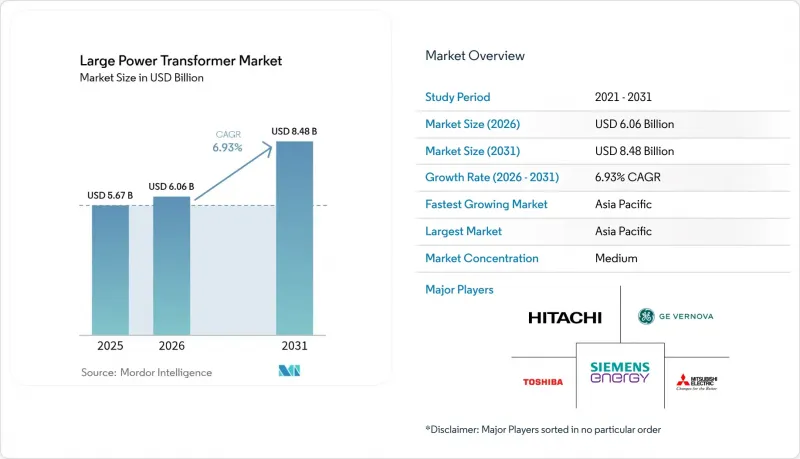
This report is Segmented by Cooling Type (Air-Cooled and Oil-Cooled), Phase (Single-Phase and Three-Phase), End-User (Power Utilities, Industrial, Commercial, and Residential), and Geography (North America, Europe, Asia-Pacific, South America, and Middle East and Africa). The Market Sizes and Forecasts are Provided in Terms of Value (USD).
Global Large Power Transformer Market Trends and Insights
Rapid Grid-Expansion Programs in Emerging Economies
Governments across the Asia-Pacific have embarked on the most ambitious transmission build-outs in modern history. China is spending USD 70 billion annually on approximately 800 kV ultra-high-voltage corridors, such as the 2,370-kilometer Gansu-Zhejiang link, which transports 36 TWh of renewable electricity each year. India's USD 109 billion plan aims to achieve 500 GW of new renewable capacity by 2030, while the ASEAN Power Grid plans to allocate USD 100 billion for cross-border interconnections that will serve more than 670 million residents. Similar mega-projects are also emerging in Africa; for instance, the Ethiopia-Kenya electricity highway now delivers electricity equivalent to 10% of Kenya's peak demand through a single 1,045-kilometre intertie. These undertakings are transforming ordering patterns: utilities now purchase multi-year blocks of identical three-phase units to accelerate construction schedules and secure volume discounts.
Accelerated Integration of Large-Scale Renewables
The International Energy Agency calculates that global grids must add more than 80 million kilometres of new lines by 2040 to accommodate the deployment of renewable energy, driving USD 140 billion in transmission spending in 2024 alone. HVDC has emerged as the preferred architecture for transmitting bulk renewable power over long distances, as demonstrated by projects such as the 885-kilometre SunZia line, which will export 3,500 MW of New Mexico wind energy to Arizona. Europe's SuedOstLink and SuedLink corridors rely on 525 kV converter transformers able to operate at sea-cable temperatures and variable load profiles. Sub-Saharan and North African exporters plan to send up to 24 GW of clean power to Europe via subsea cables, further expanding the customer base for high-capacity units. Digital-twinned transformers equipped with dynamic ratings unlock 20-40% incremental throughput on existing lines, creating a secondary revenue pool for sensor-enabled retrofits.
Volatile Copper & Electrical-Steel Prices
BHP expects global copper demand to rise by 70% to more than 50 million tonnes annually by 2050, driven primarily by electrification megatrends. Transformers are uniquely copper-intensive: a 400 MVA unit may contain up to 25 t of conductor, so a 10% price swing can shift unit economics by millions of dollars. Complicating matters, grain-oriented electrical steel-essential for achieving high efficiency-remains in chronic short supply because only a handful of mills worldwide produce the requisite texture. Qualifying a new mill can take three years due to stringent core-loss tests, leaving original-equipment manufacturers to hedge with financial derivatives or negotiate price-escalation clauses with utility buyers. The result is contract structures that reset prices quarterly rather than the traditional yearly cadence, a change that many public procurement rules still struggle to accommodate.
Other drivers and restraints analyzed in the detailed report include:
- Replacement Cycle for Ageing Above 40-Year Transformer Fleet
- HV Transformers for Green-Hydrogen Electrolyser Clusters
- 18-24-Month Manufacturing Lead-Times vs Project Delays
For complete list of drivers and restraints, kindly check the Table Of Contents.
Segment Analysis
Oil-immersed designs accounted for 76.12% of 2025 revenue, reflecting proven thermal capacity and long service life. That share is expected to hold even as air-cooled units record the fastest 7.95% CAGR. Utilities often select air-cooled styles when land values, fire safety rules, or maintenance access make liquid containment difficult. Research on nano-enhanced cellulose insulation has reduced hotspot temperatures by 5-10 °C, thereby extending the mean time to failure for both cooling systems.
Air-cooled adoption is most visible in rooftop solar inverters, metro rail traction substations, and data-center campuses that favor sealed designs. Meanwhile, ester-fluid hybrids offer a compromise: they match the heat-transfer capacity of oil yet provide higher fire points and biodegradability. The U.S. grid-modernization program now ties investment tax credits to the use of less-flammable fluids, accelerating a shift toward natural esters.
Complete Report Scope:
- By Cooling Type
- Air-cooled
- Oil-cooled
- By Phase
- Single-Phase
- Three-Phase
- By End-User
- Power Utilities (includes, Renewables, Non-renewables, and T&D)
- Industrial
- Commercial
- Residential
- By Geography
- North America
- United States
- Canada
- Mexico
- Europe
- Germany
- United Kingdom
- France
- Italy
- Spain
- Russia
- Rest of Europe
- Asia-Pacific
- China
- India
- Japan
- South Korea
- ASEAN Countries
- Australia and New Zealand
- Rest of Asia-Pacific
- South America
- Brazil
- Argentina
- Chile
- Rest of South America
- Middle East and Africa
- Saudi Arabia
- United Arab Emirates
- South Africa
- Egypt
- Rest of Middle East and Africa
- North America
Geography Analysis
Asia-Pacific produced 42.75% of 2025 revenue and carries the fastest 7.45% regional CAGR outlook. China alone channels USD 70 billion per year into ultra-high-voltage construction, exemplified by the 1,901-kilometer Gansu-Zhejiang +-800 kV corridor that transports wind and solar power from the northwest to the coastal east. India's USD 109 billion transmission master plan and the ASEAN Power Grid's USD 100 billion budget further expand the addressable base, while Japan's validated 3,000 MVA designs showcase regional leadership at the technical frontier. Australia adds momentum with projects such as CopperString 2032, which will build a 1,100-kilometre backbone to integrate Queensland renewables. Consequently, suppliers operating in the region enjoy order visibility well into the next decade.
The growth in the Middle East & Africa region is powered by megaprojects aimed at exporting renewable electricity to Europe and deepening intra-African trade. Morocco's 11.5 GW Xlinks initiative will install 4,000 kilometres of submarine cable and require multiple 525 kV converter stations. In parallel, Gulf utilities leverage petrodollar surpluses to build redundant inter-emirate links and to pilot green-hydrogen corridors. Sub-Saharan Africa witnesses incremental yet symbolic milestones, such as the Ethiopia-Kenya intertie, which has already displaced diesel generation equal to 10% of Kenyan peak load. Financing hurdles persist, but multilateral lenders are increasingly underwriting currency hedging to unlock private-sector participation and expedite transformer procurement.
North America and Europe are pursuing steady, replacement-driven demand trajectories, coupled with obligations to integrate renewables. U.S. supply constraints have pushed lead times for specialized units into the 18-24 month window, triggering Department of Energy programs that incentivize domestic production. European network operators must juggle ageing asset fleets with the Tier 3 eco-design rule, which is expected to be implemented by 2027, under which efficiency penalties for low-grade core steel will tighten further. Germany's SuedLink HVDC corridor and the UK's proposed Morocco interconnector together exemplify how Europe leverages large-scale imports to meet net-zero targets. South America, although still a smaller market, is showing increasing depth: Brazil's 2024 transmission auctions attracted a record level of interest, and the Ecuador-Peru 500 kV interconnection is slated for contract award in 2025.
- Hitachi Energy Ltd
- Siemens Energy AG
- General Electric (GE Vernova)
- Mitsubishi Electric Corporation
- Toshiba Energy Systems & Solutions
- Hyundai Heavy Industries Co. Ltd
- Hyosung Heavy Industries
- CG Power & Industrial Solutions Ltd
- SGB-SMIT GmbH
- SPX Transformer Solutions
- TBEA Co. Ltd
- China XD Group
- Bharat Heavy Electricals Ltd (BHEL)
- Schneider Electric SE
- WEG SA
- Fuji Electric Co. Ltd
- LS Electric Co. Ltd
- Wilson Transformer Company
- JiangSu HuaPeng Transformer Co. Ltd
- Bharat Bijlee Ltd
Additional Benefits:
- The market estimate (ME) sheet in Excel format
- 3 months of analyst support
TABLE OF CONTENTS
1 Introduction
- 1.1 Study Assumptions & Market Definition
- 1.2 Scope of the Study
2 Research Methodology
3 Executive Summary
4 Market Landscape
- 4.1 Market Overview
- 4.2 Market Drivers
- 4.2.1 Rapid grid?expansion programs in emerging economies
- 4.2.2 Accelerated integration of large-scale renewables
- 4.2.3 Replacement cycle for ageing over 40-yr transformer fleet
- 4.2.4 HV transformers for green-hydrogen electrolyser clusters
- 4.2.5 Inter-regional HVDC corridors for hyperscale data-centres
- 4.2.6 Climate-resilience mandates for substation assets
- 4.3 Market Restraints
- 4.3.1 Volatile copper & electrical-steel prices
- 4.3.2 18-24-month manufacturing lead-times vs project delays
- 4.3.3 Community opposition to new transmission corridors
- 4.3.4 Skilled coil-winding labour shortages
- 4.4 Supply-Chain Analysis
- 4.5 Regulatory Landscape
- 4.6 Technological Outlook (digital monitoring, ester fluids, HVDC)
- 4.7 Porter's Five Forces
- 4.7.1 Bargaining Power of Suppliers
- 4.7.2 Bargaining Power of Buyers
- 4.7.3 Threat of New Entrants
- 4.7.4 Threat of Substitutes
- 4.7.5 Competitive Rivalry
5 Market Size & Growth Forecasts
- 5.1 By Cooling Type
- 5.1.1 Air-cooled
- 5.1.2 Oil-cooled
- 5.2 By Phase
- 5.2.1 Single-Phase
- 5.2.2 Three-Phase
- 5.3 By End-User
- 5.3.1 Power Utilities (includes, Renewables, Non-renewables, and T&D)
- 5.3.2 Industrial
- 5.3.3 Commercial
- 5.3.4 Residential
- 5.4 By Geography
- 5.4.1 North America
- 5.4.1.1 United States
- 5.4.1.2 Canada
- 5.4.1.3 Mexico
- 5.4.2 Europe
- 5.4.2.1 Germany
- 5.4.2.2 United Kingdom
- 5.4.2.3 France
- 5.4.2.4 Italy
- 5.4.2.5 Spain
- 5.4.2.6 Russia
- 5.4.2.7 Rest of Europe
- 5.4.3 Asia-Pacific
- 5.4.3.1 China
- 5.4.3.2 India
- 5.4.3.3 Japan
- 5.4.3.4 South Korea
- 5.4.3.5 ASEAN Countries
- 5.4.3.6 Australia and New Zealand
- 5.4.3.7 Rest of Asia-Pacific
- 5.4.4 South America
- 5.4.4.1 Brazil
- 5.4.4.2 Argentina
- 5.4.4.3 Chile
- 5.4.4.4 Rest of South America
- 5.4.5 Middle East and Africa
- 5.4.5.1 Saudi Arabia
- 5.4.5.2 United Arab Emirates
- 5.4.5.3 South Africa
- 5.4.5.4 Egypt
- 5.4.5.5 Rest of Middle East and Africa
- 5.4.1 North America
6 Competitive Landscape
- 6.1 Market Concentration
- 6.2 Strategic Moves (M&A, Partnerships, PPAs)
- 6.3 Market Share Analysis (Market Rank/Share for key companies)
- 6.4 Company Profiles (includes Global level Overview, Market level overview, Core Segments, Financials as available, Strategic Information, Products & Services, and Recent Developments)
- 6.4.1 Hitachi Energy Ltd
- 6.4.2 Siemens Energy AG
- 6.4.3 General Electric (GE Vernova)
- 6.4.4 Mitsubishi Electric Corporation
- 6.4.5 Toshiba Energy Systems & Solutions
- 6.4.6 Hyundai Heavy Industries Co. Ltd
- 6.4.7 Hyosung Heavy Industries
- 6.4.8 CG Power & Industrial Solutions Ltd
- 6.4.9 SGB-SMIT GmbH
- 6.4.10 SPX Transformer Solutions
- 6.4.11 TBEA Co. Ltd
- 6.4.12 China XD Group
- 6.4.13 Bharat Heavy Electricals Ltd (BHEL)
- 6.4.14 Schneider Electric SE
- 6.4.15 WEG SA
- 6.4.16 Fuji Electric Co. Ltd
- 6.4.17 LS Electric Co. Ltd
- 6.4.18 Wilson Transformer Company
- 6.4.19 JiangSu HuaPeng Transformer Co. Ltd
- 6.4.20 Bharat Bijlee Ltd
7 Market Opportunities & Future Outlook
- 7.1 White-Space & Unmet-Need Assessment

