PUBLISHER: Mordor Intelligence | PRODUCT CODE: 2116765

PUBLISHER: Mordor Intelligence | PRODUCT CODE: 2116765
United States Large Power Transformer - Market Share Analysis, Industry Trends & Statistics, Growth Forecasts (2026 - 2031)
According to Mordor Intelligence, the United States large power transformer market size is expected to grow from USD 1.10 billion in 2025 to USD 1.16 billion in 2026 and is forecast to reach USD 1.48 billion by 2031 at 5.07% CAGR over 2026-2031.
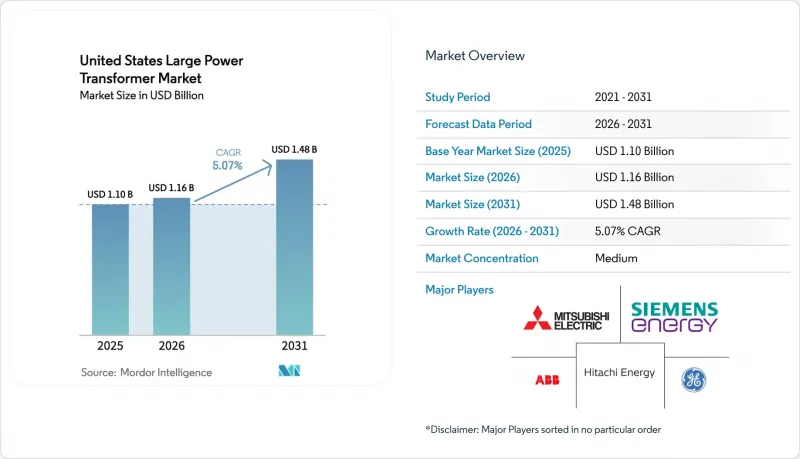
This report is Segmented by Cooling Type (Air-Cooled and Oil-Cooled), Phase (Single-Phase and Three-Phase), and End-User (Power Utilities, Industrial, Commercial, and Residential). The Market Sizes and Forecasts are Provided in Terms of Value (USD).
United States Large Power Transformer Market Trends and Insights
Government Grid-Modernization Funding Surges
Federal programs such as GRIP's USD 10.5 billion allocation in 2024 and the Transmission Facilitation Program's USD 2.5 billion credit facility are compressing utility upgrade timelines. The Infrastructure Investment and Jobs Act injects an additional USD 65 billion, incentivizing advanced transformer purchases that meet newer DOE 10 CFR 431 efficiency thresholds. Texas ERCOT's USD 18 billion, six-year roadmap and California's USD 7.3 billion transmission strategy stack further funding atop federal dollars, magnifying procurement volume. Utilities now accelerate retirements for assets beyond 30 years of service, a cohort representing roughly 70% of installed U.S. capacity. Higher-efficiency cores and digital sensors lift upfront material costs but trim lifetime no-load losses, sharpening the total-cost-of-ownership argument. Collectively, these initiatives deepen order visibility for the United States' large power transformer market and put pressure on constrained domestic capacity.
Utility-Scale Renewable Build-Outs Escalating Inter-Tie Demand
The National Transmission Needs Study forecasts a 64% increase in line-carrying capacity by 2040, primarily to transport solar and wind power from resource-rich regions to major load centers. Projects in the Great Plains and Southwest require extra-high-voltage units and high-voltage DC converter transformers that can manage variable power flows. Offshore wind ventures, typified by forthcoming 1.25 GW Lake Michigan arrays, demand corrosion-resistant designs and integrated submarine-cable terminations. Grid architects specify dynamic ratings, on-load tap changers, and advanced cooling schemes to accommodate harmonic-heavy inverter output. Co-located battery storage compounds loading volatility, heightening the need for broader thermal margins. These technical shifts reinforce a premium subsegment within the United States' large power transformer market, favoring suppliers that offer application-specific engineering.
CRGO Steel Supply-Chain Constraints
The United States houses a single producer of grain-oriented electrical steel, leaving 85% of demand filled by imports from South Korea, Japan, and Germany. Parallel EV motor demand has tightened coil allocations, pushing GOES prices to multi-decade highs and lengthening mill lead times to nine months or more. Alternative amorphous alloys deliver up to 30% lower core losses but cost roughly 1.5 times standard M3 steel and have only one domestic source, limiting near-term substitution. Industry groups are lobbying for Defense Production Act prioritization and direct federal incentives to underwrite the construction of new annealing furnaces, but any capacity build will require three years or more. In the interim, manufacturers ration sheet width to top clients, forcing smaller buyers to accept mixed grades that complicate loss-calculation guarantees. This material bottleneck constrains output, capping the upside for the United States' large power transformer market even as demand climbs.
Other drivers and restraints analyzed in the detailed report include:
- Aging U.S. Transformer Fleet Replacement Cycle Accelerates
- Hyperscale Data-Center Clusters Requiring High-MVA LPTs
- Domestic LPT Manufacturing Capacity Limits
For complete list of drivers and restraints, kindly check the Table Of Contents.
Segment Analysis
Oil-cooled designs generated 83.05% of 2025 revenue, cementing their role as the default solution for bulk-power applications where thermal performance per MVA remains paramount and where compact footprints reduce substation real-estate costs. Their mature supply chain, wide performance envelope, and straightforward maintenance routines reinforce preference among utilities managing aging fleets. However, recent fires at densely populated urban substations fueled regulatory scrutiny, propelling air-cooled and ester-fluid units into pilot deployments. The latter's flash point of over 330 °C satisfies stringent NFPA urban fire codes, but its higher viscosity requires larger core-window dimensions, which in turn increase copper usage and cost.
Energy transition policies are expected to accelerate air-cooled orders by 6.46% per year through 2031, albeit from a relatively small base. Utilities balancing cost and risk are experimenting with hybrid cooling, integrating directed-oil channels alongside forced-air radiators to lower hot-spot temperature by 10 °C under cyclic loads. In the process, advanced computational fluid dynamics tools enable optimized fin spacing and radiator geometry, offsetting some of the efficiency penalties. Market entrants emphasizing modular radiator designs aim to shave eight weeks from fabrication schedules, a differentiator while lead-time anxiety persists. These developments collectively broaden supplier opportunities without displacing entrenched oil-cooled incumbents in the United States' large power transformer market.
Complete Report Scope:
- By Cooling Type
- Air-cooled
- Oil-cooled
- By Phase
- Single-Phase
- Three-Phase
- By End-User
- Power Utilities (includes, Renewables, Non-renewables, and T&D)
- Industrial
- Commercial
- Residential
List of Companies Covered in this Report:
- Siemens Energy AG
- General Electric Company
- Hitachi Energy Ltd.
- Mitsubishi Electric Corporation
- ABB Ltd.
- Toshiba Energy Systems & Solutions Corp.
- Hyundai Electric & Energy Systems Co., Ltd.
- SPX Transformer Solutions, Inc.
- Virginia Transformer Corp.
- Howard Industries, Inc.
- Delta Star, Inc.
- CG Power & Industrial Solutions Ltd.
- SGB-SMIT Group
- Eaton Corporation
- Schneider Electric SE
- Hyosung Heavy Industries Corp.
- ERMCO (Electric Research & Manufacturing Cooperative)
- TBEA USA Corp.
- Weg SA
- Jiangsu Huapeng Transformer Co., Ltd.
Additional Benefits:
- The market estimate (ME) sheet in Excel format
- 3 months of analyst support
TABLE OF CONTENTS
1 Introduction
- 1.1 Study Assumptions & Market Definition
- 1.2 Scope of the Study
2 Research Methodology
3 Executive Summary
4 Market Landscape
- 4.1 Market Overview
- 4.2 Market Drivers
- 4.2.1 Government grid-modernization funding surges
- 4.2.2 Utility-scale renewable build-outs (wind/solar) escalating inter-tie demand
- 4.2.3 Aging U.S. transformer fleet replacement cycle accelerates
- 4.2.4 Hyperscale data-center clusters requiring high-MVA LPTs
- 4.2.5 Rail-corridor electrification projects (freight & high-speed)
- 4.3 Market Restraints
- 4.3.1 CRGO steel supply-chain constraints
- 4.3.2 Domestic LPT manufacturing capacity limits
- 4.3.3 Cyber-security certification delays for digital monitoring
- 4.3.4 Rising insurance & financing premiums post-failure events
- 4.4 Supply-Chain Analysis
- 4.5 Regulatory Landscape
- 4.6 Technological Outlook (HVDC, digital twins)
- 4.7 Porter's Five Forces
- 4.7.1 Bargaining Power of Suppliers
- 4.7.2 Bargaining Power of Buyers
- 4.7.3 Threat of New Entrants
- 4.7.4 Threat of Substitutes
- 4.7.5 Competitive Rivalry
- 4.8 PESTLE Analysis
5 Market Size & Growth Forecasts
- 5.1 By Cooling Type
- 5.1.1 Air-cooled
- 5.1.2 Oil-cooled
- 5.2 By Phase
- 5.2.1 Single-Phase
- 5.2.2 Three-Phase
- 5.3 By End-User
- 5.3.1 Power Utilities (includes, Renewables, Non-renewables, and T&D)
- 5.3.2 Industrial
- 5.3.3 Commercial
- 5.3.4 Residential
6 Competitive Landscape
- 6.1 Market Concentration
- 6.2 Strategic Moves (M&A, Partnerships, PPAs)
- 6.3 Market Share Analysis (Market Rank/Share for key companies)
- 6.4 Company Profiles (includes Global level Overview, Market level overview, Core Segments, Financials as available, Strategic Information, Products & Services, and Recent Developments)
- 6.4.1 Siemens Energy AG
- 6.4.2 General Electric Company
- 6.4.3 Hitachi Energy Ltd.
- 6.4.4 Mitsubishi Electric Corporation
- 6.4.5 ABB Ltd.
- 6.4.6 Toshiba Energy Systems & Solutions Corp.
- 6.4.7 Hyundai Electric & Energy Systems Co., Ltd.
- 6.4.8 SPX Transformer Solutions, Inc.
- 6.4.9 Virginia Transformer Corp.
- 6.4.10 Howard Industries, Inc.
- 6.4.11 Delta Star, Inc.
- 6.4.12 CG Power & Industrial Solutions Ltd.
- 6.4.13 SGB-SMIT Group
- 6.4.14 Eaton Corporation
- 6.4.15 Schneider Electric SE
- 6.4.16 Hyosung Heavy Industries Corp.
- 6.4.17 ERMCO (Electric Research & Manufacturing Cooperative)
- 6.4.18 TBEA USA Corp.
- 6.4.19 Weg SA
- 6.4.20 Jiangsu Huapeng Transformer Co., Ltd.
7 Market Opportunities & Future Outlook
- 7.1 White-space & Unmet-need Assessment

