PUBLISHER: Mordor Intelligence | PRODUCT CODE: 2116024

PUBLISHER: Mordor Intelligence | PRODUCT CODE: 2116024
United States Power Transformer - Market Share Analysis, Industry Trends & Statistics, Growth Forecasts (2026 - 2031)
According to Mordor Intelligence, the United States power transformer market size was valued at USD 4.49 billion in 2025 and estimated to grow from USD 4.76 billion in 2026 to reach USD 6.39 billion by 2031, at a CAGR of 6.08% during the forecast period (2026-2031).
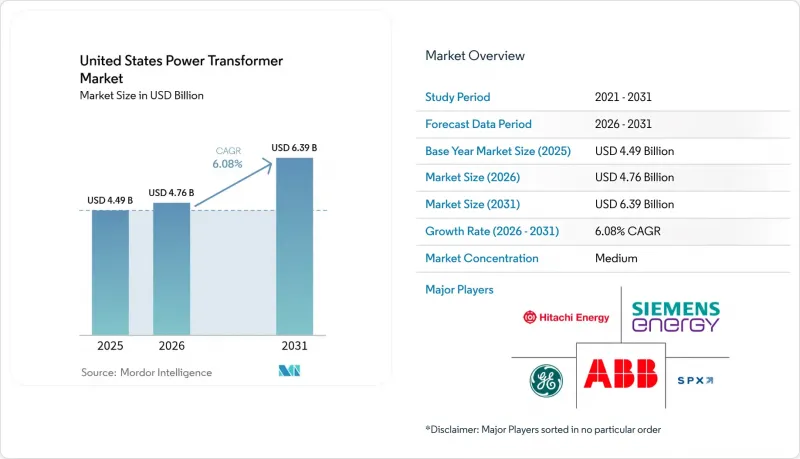
This report is Segmented by Power Rating (Large, Medium, and Small), Cooling Type (Air-Cooled and Oil-Cooled), Phase (Single-Phase and Three-Phase), and End-User (Power Utilities, Industrial, Commercial, and Residential). The Market Sizes and Forecasts are Provided in Terms of Value (USD).
United States Power Transformer Market Trends and Insights
Accelerated Replacement of Aging Grid Assets
Four-decade-old transformers now dominate many regional networks, creating a reliability gap as failure rates approach 0.5% of the installed base annually. DOE data indicate that 55% of distribution-class units surpass 33 years of age, while transmission-class averages reach 40 years. New efficiency standards effective in 2027 classify many legacy designs as non-compliant, compelling utilities to adopt fleet-wide swap-out programs rather than one-off repairs. Rising electric-load intensity from AI-driven data centers and electric-vehicle charging elevates operational stress on aging machines, compressing the replacement timetable. Consequently, the United States power transformer market gains a predictable floor of baseline demand that cushions against macroeconomic swings.
Surge in Renewable-Energy Interconnections
Utility-scale wind and solar plants require collector transformers that can handle bidirectional power flow, harmonic distortion, and fluctuating load cycling. California ISO's twenty-year transmission outlook highlights USD 30 billion of projects with advanced monitoring and tap-changing requirements. ERCOT expects 40 GW of incremental load by 2030, largely tied to renewable interconnections that rely on bespoke step-up transformers. Such technical needs reshape specification sheets, allowing suppliers to embed smart-sensor packages and command premium margins inside the United States power transformer market.
Copper & Electrical-Steel Price Volatility
Copper price bands widened 40% year-on-year in 2024, and grain-oriented electrical steel (GOES) quotes have doubled since 2020. Cleveland-Cliffs remains the only domestic GOES smelter, creating a single-supplier pinch point. Price swings complicate bid validity and inflate inventory carrying costs, forcing utilities to pre-purchase or escrow contracts, moves that erode capital budgets earmarked for modernization.
Other drivers and restraints analyzed in the detailed report include:
- Federal Grid-Modernization Funding (IIJA)
- Hyperscale Data-Center Build-Out
- Stricter Mineral-Oil Spill Regulations
For complete list of drivers and restraints, kindly check the Table Of Contents.
Segment Analysis
Medium-capacity units (10-100 MVA) captured 61.85% of the United States power transformer market in 2025. Utilities prefer this range because it strikes a balance between factory throughput, shipping weight, and substation footprint. The segment also records the briskest 6.95% CAGR as transmission owners deploy modular substations that can scale capacity by adding identical bays rather than installing single large monoliths. Up-rating feeders from 138 kV to 230 kV often lands in the mid-capacity sweet spot, ensuring repeat orders. Large-capacity machines (over 100 MVA) service 765 kV corridors and hyperscale data center campuses. Demand spikes in Texas, where regulators have just green-lit the state's inaugural 765 kV lines, stretch the domestic build queue for units exceeding 500 MVA. Small transformers (<10 MVA) hold niche relevance in distributed generation, microgrids, and EV fast-charging plazas. Although volume is high, revenue share remains modest due to lower unit pricing. The United States power transformer market size for mid-capacity equipment is forecast to rise steadily, supported by a fleet-average replacement strategy that favors uniform ratings for easier inventory management.
Oil-cooled designs held 76.55% share of the United States power transformer market in 2025, underpinned by proven thermal performance at high nameplate ratings and comparatively low upfront cost. Mineral-oil systems remain the default for bulk-power interconnection and petrochemical complexes where land is plentiful and spill-containment basins are standard practice. Yet, city-center substations, data-center halls, and offshore wind platforms face stringent fire and environmental rules that benefit air-cooled and natural-ester variants. Air-cooled models log a 6.62% CAGR as utility planners trade off lower power density for simplified permitting. National Electrical Code updates now recognize less-flammable liquids, allowing hybrid solutions that marry forced-oil cooling with fire-inhibited esters. This design innovation bridges the performance gap while maintaining compliance, thereby widening the addressable use cases for non-mineral-oil alternatives. Over the forecast period, the United States power transformer market is expected to see a gradual shift in share toward air-cooled and ester-filled products, particularly in jurisdictions with stringent spill-prevention enforcement.
Complete Report Scope:
- By Power Rating
- Large (Above 100 MVA)
- Medium (10 to 100 MVA)
- Small (Up to 10 MVA)
- By Insulation Type
- Air-cooled
- Oil-cooled
- By Phase
- Single Phase
- Three Phase
- By End-User
- Power Utilities (includes, Renewables, Non-renewables, and T&D)
- Industrial
- Commercial
- Residential
List of Companies Covered in this Report:
- ABB Ltd.
- Siemens Energy AG
- General Electric Company
- Eaton Corporation plc
- Schneider Electric SE
- Hitachi Energy Ltd.
- Mitsubishi Electric Corp.
- SPX Transformer Solutions Inc.
- Howard Industries Inc.
- Virginia Transformer Corp.
- WEG Electric Corp.
- CG Power Systems USA Inc.
- Hyundai Electric & Energy Systems Co.
- Toshiba Energy Systems & Solutions Corp.
- SGB-SMIT Group
- Kirloskar Electric Co. Ltd.
- MGM Transformer Company
- Pennsylvania Transformer Technology Inc.
- Triad Magnetics
- ERMCO
Additional Benefits:
- The market estimate (ME) sheet in Excel format
- 3 months of analyst support
TABLE OF CONTENTS
1 Introduction
- 1.1 Study Assumptions & Market Definition
- 1.2 Scope of the Study
2 Research Methodology
3 Executive Summary
4 Market Landscape
- 4.1 Market Overview
- 4.2 Market Drivers
- 4.2.1 Accelerated replacement of aging grid assets
- 4.2.2 Surge in renewable energy interconnections
- 4.2.3 Federal grid-modernization funding (IIJA)
- 4.2.4 Hyperscale data-center build-out
- 4.2.5 Heavy-transport electrification projects
- 4.2.6 Domestic-content incentives under IRA
- 4.3 Market Restraints
- 4.3.1 Copper & electrical-steel price volatility
- 4.3.2 Global core-steel supply-chain bottlenecks
- 4.3.3 Stricter mineral-oil spill regulations
- 4.3.4 Emerging solid-state transformer pilots
- 4.4 Supply-Chain Analysis
- 4.5 Regulatory Landscape
- 4.6 Technological Outlook
- 4.7 Porter's Five Forces
- 4.7.1 Threat of New Entrants
- 4.7.2 Bargaining Power of Suppliers
- 4.7.3 Bargaining Power of Buyers
- 4.7.4 Threat of Substitutes
- 4.7.5 Competitive Rivalry
- 4.8 PESTLE Analysis
5 Market Size & Growth Forecasts
- 5.1 By Power Rating
- 5.1.1 Large (Above 100 MVA)
- 5.1.2 Medium (10 to 100 MVA)
- 5.1.3 Small (Up to 10 MVA)
- 5.2 By Insulation Type
- 5.2.1 Air-cooled
- 5.2.2 Oil-cooled
- 5.3 By Phase
- 5.3.1 Single Phase
- 5.3.2 Three Phase
- 5.4 By End-User
- 5.4.1 Power Utilities (includes, Renewables, Non-renewables, and T&D)
- 5.4.2 Industrial
- 5.4.3 Commercial
- 5.4.4 Residential
6 Competitive Landscape
- 6.1 Market Concentration
- 6.2 Strategic Moves (M&A, Partnerships, PPAs)
- 6.3 Market Share Analysis (Market Rank/Share for key companies)
- 6.4 Company Profiles (includes Global level Overview, Market level overview, Core Segments, Financials as available, Strategic Information, Products & Services, and Recent Developments)
- 6.4.1 ABB Ltd.
- 6.4.2 Siemens Energy AG
- 6.4.3 General Electric Company
- 6.4.4 Eaton Corporation plc
- 6.4.5 Schneider Electric SE
- 6.4.6 Hitachi Energy Ltd.
- 6.4.7 Mitsubishi Electric Corp.
- 6.4.8 SPX Transformer Solutions Inc.
- 6.4.9 Howard Industries Inc.
- 6.4.10 Virginia Transformer Corp.
- 6.4.11 WEG Electric Corp.
- 6.4.12 CG Power Systems USA Inc.
- 6.4.13 Hyundai Electric & Energy Systems Co.
- 6.4.14 Toshiba Energy Systems & Solutions Corp.
- 6.4.15 SGB-SMIT Group
- 6.4.16 Kirloskar Electric Co. Ltd.
- 6.4.17 MGM Transformer Company
- 6.4.18 Pennsylvania Transformer Technology Inc.
- 6.4.19 Triad Magnetics
- 6.4.20 ERMCO
7 Market Opportunities & Future Outlook
- 7.1 White-space & Unmet-Need Assessment

