PUBLISHER: Mordor Intelligence | PRODUCT CODE: 2113305

PUBLISHER: Mordor Intelligence | PRODUCT CODE: 2113305
South America Rice - Market Share Analysis, Industry Trends & Statistics, Growth Forecasts (2026 - 2031)
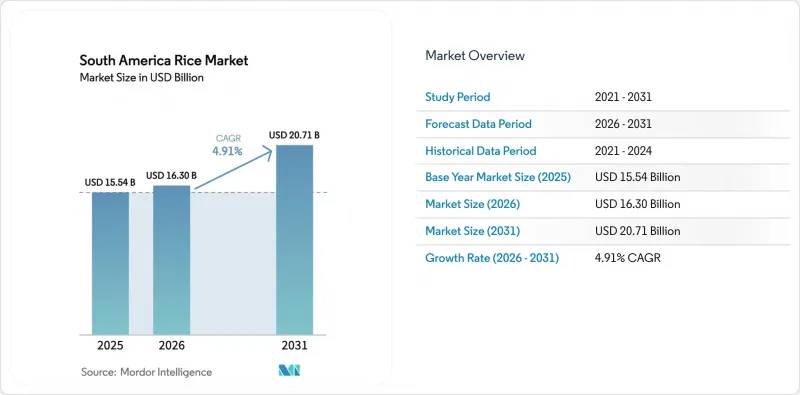
According to Mordor Intelligence, the South America rice market size is projected to expand from USD 15.54 billion in 2025 and USD 16.30 billion in 2026 to USD 20.71 billion by 2031, registering a CAGR of 4.91% between 2026 to 2031.
This report is Segmented by Geography (Brazil, Argentina, Chile, Peru, Uruguay, and More). The Report Includes Production Analysis (Volume), Consumption Analysis (Value and Volume), Import Analysis (Value and Volume), Export Analysis (Value and Volume), Wholesale Price Trend Analysis, List of Key Players, and More. The Market Forecasts are Provided in Terms of Value (USD) and Volume (Metric Tons).
South America Rice Market Trends and Insights
Rising Rice Productivity Through Hybrid-Seed Adoption
Hybrid varieties deliver 15%-20% higher yields but cost more than inbred lines, which slows their uptake outside pilot programs. Embrapa commercialized two hybrids for southern Brazil in 2024, targeting farmers who accept a 30% seed premium for shorter maturity and improved lodging resistance. Argentina's National Institute of Agricultural Technology (INTA) is field-testing private-sector hybrids in Entre Rios and Corrientes, with releases projected by 2026. Peru subsidized certified hybrid seed for 5,000 coastal smallholders in 2025, narrowing the yield gap between irrigated and rain-fed districts. The resulting output stability supports export commitments, even when land is shifted to soy or corn.
Mechanization Upgrades on Medium and Large Farms
Farm consolidation enables the use of capital-intensive machinery, which cuts input costs by 8%-12%. Combine-harvester deliveries to Rio Grande do Sul climbed 12% in 2024, financed by Banco do Brasil credit lines. GPS-guided planters in Argentina's Litoral region reduced seed waste by 18% the same year. Ecuador's Rice Cluster, backed by the Inter-American Development Bank, laser-leveled 280,000 hectares in 2024-2025, lowering water use by 20% . Profitability at mechanized farms remains positive even when prices dip below USD 400 per metric ton.
El Nino-Driven Flood and Drought Cycles
The 2023-2024 El Nino slashed Rio Grande do Sul's harvest by 15% and prompted Argentina's first rice imports in a decade. La Nina rainfall in early 2025 then delayed planting in Uruguay's Treinta y Tres district. International Monetary Fund (IMF) analysis indicates that a 10% deviation in rainfall leads to a 6%-8% change in rice yields, compared to 3%-5% for soybeans . Higher yield risk inflates insurance costs, deterring capital outlays for irrigation. The Food and Agriculture Organization of the United Nations (FAO) deployed anticipatory action plans in Bolivia, Ecuador, and Peru in 2024 to support smallholders.
Other drivers and restraints analyzed in the detailed report include:
- Expansion of Irrigated Acreage Along La Plata Basin
- Government Export-Revenue Incentives
- Competition from Soy and Corn for Prime Farmland
For complete list of drivers and restraints, kindly check the Table Of Contents.
Complete Report Scope:
- By Geography
- Brazil
- Production Analysis (Area Harvested, Yield, and Production Volume)
- Consumption Analysis (Consumption Value and Volume)
- Import Market Analysis (Import Value, Volume, and Key Supplying Markets)
- Export Market Analysis (Export Value, Volume, and Key Destination Markets)
- Wholesale Price Trend Analysis and Forecast
- Regulatory Framework
- List of Key Players
- Logistics and Infrastructure
- Seasonality Analysis
- Argentina
- Production Analysis (Area Harvested, Yield, and Production Volume)
- Consumption Analysis (Consumption Value and Volume)
- Import Market Analysis (Import Value, Volume, and Key Supplying Markets)
- Export Market Analysis (Export Value, Volume, and Key Destination Markets)
- Wholesale Price Trend Analysis and Forecast
- Regulatory Framework
- List of Key Players
- Logistics and Infrastructure
- Seasonality Analysis
- Chile
- Production Analysis (Area Harvested, Yield, and Production Volume)
- Consumption Analysis (Consumption Value and Volume)
- Import Market Analysis (Import Value, Volume, and Key Supplying Markets)
- Export Market Analysis (Export Value, Volume, and Key Destination Markets)
- Wholesale Price Trend Analysis and Forecast
- Regulatory Framework
- List of Key Players
- Logistics and Infrastructure
- Seasonality Analysis
- Peru
- Production Analysis (Area Harvested, Yield, and Production Volume)
- Consumption Analysis (Consumption Value and Volume)
- Import Market Analysis (Import Value, Volume, and Key Supplying Markets)
- Export Market Analysis (Export Value, Volume, and Key Destination Markets)
- Wholesale Price Trend Analysis and Forecast
- Regulatory Framework
- List of Key Players
- Logistics and Infrastructure
- Seasonality Analysis
- Uruguay
- Production Analysis (Area Harvested, Yield, and Production Volume)
- Consumption Analysis (Consumption Value and Volume)
- Import Market Analysis (Import Value, Volume, and Key Supplying Markets)
- Export Market Analysis (Export Value, Volume, and Key Destination Markets)
- Wholesale Price Trend Analysis and Forecast
- Regulatory Framework
- List of Key Players
- Logistics and Infrastructure
- Seasonality Analysis
- Paraguay
- Production Analysis (Area Harvested, Yield, and Production Volume)
- Consumption Analysis (Consumption Value and Volume)
- Import Market Analysis (Import Value, Volume, and Key Supplying Markets)
- Export Market Analysis (Export Value, Volume, and Key Destination Markets)
- Wholesale Price Trend Analysis and Forecast
- Regulatory Framework
- List of Key Players
- Logistics and Infrastructure
- Seasonality Analysis
- Ecuador
- Production Analysis (Area Harvested, Yield, and Production Volume)
- Consumption Analysis (Consumption Value and Volume)
- Import Market Analysis (Import Value, Volume, and Key Supplying Markets)
- Export Market Analysis (Export Value, Volume, and Key Destination Markets)
- Wholesale Price Trend Analysis and Forecast
- Regulatory Framework
- List of Key Players
- Logistics and Infrastructure
- Seasonality Analysis
- Bolivia
- Production Analysis (Area Harvested, Yield, and Production Volume)
- Consumption Analysis (Consumption Value and Volume)
- Import Market Analysis (Import Value, Volume, and Key Supplying Markets)
- Export Market Analysis (Export Value, Volume, and Key Destination Markets)
- Wholesale Price Trend Analysis and Forecast
- Regulatory Framework
- List of Key Players
- Logistics and Infrastructure
- Seasonality Analysis
- Brazil
Additional Benefits:
- The market estimate (ME) sheet in Excel format
- 3 months of analyst support
TABLE OF CONTENTS
1 Introduction
- 1.1 Study Assumptions and Market Definition
- 1.2 Scope of the Study
2 Research Methodology
3 Executive Summary
4 Market Landscape
- 4.1 Market Overview
- 4.2 Market Drivers
- 4.2.1 Rising rice productivity through hybrid-seed adoption
- 4.2.2 Mechanization upgrades on medium and large farms
- 4.2.3 Expansion of irrigated acreage along the La Plata Basin
- 4.2.4 Government export-revenue incentives
- 4.2.5 Growing intra-regional demand from food processors
- 4.2.6 Blockchain-based traceability premiums
- 4.3 Market Restraints
- 4.3.1 El Nino driven flood and drought cycles
- 4.3.2 Competition from soy and corn for prime farmland
- 4.3.3 Low farm-gate prices in oversupply years
- 4.3.4 Logistics bottlenecks at inland waterways
- 4.4 Opportunities
- 4.5 Challenges
- 4.6 Value Chain Analysis
- 4.7 Technologies and usage of AI in the Industry
- 4.8 Input Market Analysis
- 4.8.1 Seeds
- 4.8.2 Fertilizers
- 4.8.3 Crop Protection Chemicals
- 4.9 Distribution Channel Analysis
- 4.10 Market Sentiment Analysis
- 4.11 PESTLE Analysis
5 Market Size and Growth Forecasts (Value and Volume)
- 5.1 By Geography
- 5.1.1 Brazil
- 5.1.1.1 Production Analysis (Area Harvested, Yield, and Production Volume)
- 5.1.1.2 Consumption Analysis (Consumption Value and Volume)
- 5.1.1.3 Import Market Analysis (Import Value, Volume, and Key Supplying Markets)
- 5.1.1.4 Export Market Analysis (Export Value, Volume, and Key Destination Markets)
- 5.1.1.5 Wholesale Price Trend Analysis and Forecast
- 5.1.1.6 Regulatory Framework
- 5.1.1.7 List of Key Players
- 5.1.1.8 Logistics and Infrastructure
- 5.1.1.9 Seasonality Analysis
- 5.1.2 Argentina
- 5.1.2.1 Production Analysis (Area Harvested, Yield, and Production Volume)
- 5.1.2.2 Consumption Analysis (Consumption Value and Volume)
- 5.1.2.3 Import Market Analysis (Import Value, Volume, and Key Supplying Markets)
- 5.1.2.4 Export Market Analysis (Export Value, Volume, and Key Destination Markets)
- 5.1.2.5 Wholesale Price Trend Analysis and Forecast
- 5.1.2.6 Regulatory Framework
- 5.1.2.7 List of Key Players
- 5.1.2.8 Logistics and Infrastructure
- 5.1.2.9 Seasonality Analysis
- 5.1.3 Chile
- 5.1.3.1 Production Analysis (Area Harvested, Yield, and Production Volume)
- 5.1.3.2 Consumption Analysis (Consumption Value and Volume)
- 5.1.3.3 Import Market Analysis (Import Value, Volume, and Key Supplying Markets)
- 5.1.3.4 Export Market Analysis (Export Value, Volume, and Key Destination Markets)
- 5.1.3.5 Wholesale Price Trend Analysis and Forecast
- 5.1.3.6 Regulatory Framework
- 5.1.3.7 List of Key Players
- 5.1.3.8 Logistics and Infrastructure
- 5.1.3.9 Seasonality Analysis
- 5.1.4 Peru
- 5.1.4.1 Production Analysis (Area Harvested, Yield, and Production Volume)
- 5.1.4.2 Consumption Analysis (Consumption Value and Volume)
- 5.1.4.3 Import Market Analysis (Import Value, Volume, and Key Supplying Markets)
- 5.1.4.4 Export Market Analysis (Export Value, Volume, and Key Destination Markets)
- 5.1.4.5 Wholesale Price Trend Analysis and Forecast
- 5.1.4.6 Regulatory Framework
- 5.1.4.7 List of Key Players
- 5.1.4.8 Logistics and Infrastructure
- 5.1.4.9 Seasonality Analysis
- 5.1.5 Uruguay
- 5.1.5.1 Production Analysis (Area Harvested, Yield, and Production Volume)
- 5.1.5.2 Consumption Analysis (Consumption Value and Volume)
- 5.1.5.3 Import Market Analysis (Import Value, Volume, and Key Supplying Markets)
- 5.1.5.4 Export Market Analysis (Export Value, Volume, and Key Destination Markets)
- 5.1.5.5 Wholesale Price Trend Analysis and Forecast
- 5.1.5.6 Regulatory Framework
- 5.1.5.7 List of Key Players
- 5.1.5.8 Logistics and Infrastructure
- 5.1.5.9 Seasonality Analysis
- 5.1.6 Paraguay
- 5.1.6.1 Production Analysis (Area Harvested, Yield, and Production Volume)
- 5.1.6.2 Consumption Analysis (Consumption Value and Volume)
- 5.1.6.3 Import Market Analysis (Import Value, Volume, and Key Supplying Markets)
- 5.1.6.4 Export Market Analysis (Export Value, Volume, and Key Destination Markets)
- 5.1.6.5 Wholesale Price Trend Analysis and Forecast
- 5.1.6.6 Regulatory Framework
- 5.1.6.7 List of Key Players
- 5.1.6.8 Logistics and Infrastructure
- 5.1.6.9 Seasonality Analysis
- 5.1.7 Ecuador
- 5.1.7.1 Production Analysis (Area Harvested, Yield, and Production Volume)
- 5.1.7.2 Consumption Analysis (Consumption Value and Volume)
- 5.1.7.3 Import Market Analysis (Import Value, Volume, and Key Supplying Markets)
- 5.1.7.4 Export Market Analysis (Export Value, Volume, and Key Destination Markets)
- 5.1.7.5 Wholesale Price Trend Analysis and Forecast
- 5.1.7.6 Regulatory Framework
- 5.1.7.7 List of Key Players
- 5.1.7.8 Logistics and Infrastructure
- 5.1.7.9 Seasonality Analysis
- 5.1.8 Bolivia
- 5.1.8.1 Production Analysis (Area Harvested, Yield, and Production Volume)
- 5.1.8.2 Consumption Analysis (Consumption Value and Volume)
- 5.1.8.3 Import Market Analysis (Import Value, Volume, and Key Supplying Markets)
- 5.1.8.4 Export Market Analysis (Export Value, Volume, and Key Destination Markets)
- 5.1.8.5 Wholesale Price Trend Analysis and Forecast
- 5.1.8.6 Regulatory Framework
- 5.1.8.7 List of Key Players
- 5.1.8.8 Logistics and Infrastructure
- 5.1.8.9 Seasonality Analysis
- 5.1.1 Brazil
6 End Use Applications and Industries
- 6.1 Primary Applications and Emerging Applications
- 6.2 Consumption Breakdown by Industries
7 Competitive Landscape
- 7.1 Overview of the Competition
- 7.2 Recent Developments
- 7.3 Market Concentration Analysis
8 Market Opportunities and Future Outlook

