PUBLISHER: Mordor Intelligence | PRODUCT CODE: 2113574

PUBLISHER: Mordor Intelligence | PRODUCT CODE: 2113574
Asia-Pacific Rice - Market Share Analysis, Industry Trends & Statistics, Growth Forecasts (2026 - 2031)
According to Mordor Intelligence, the Asia-Pacific rice market size is expected to grow from USD 376 billion in 2025 to USD 391.12 billion in 2026 and is forecast to reach USD 476.34 billion by 2031 at 4.02% CAGR over 2026-2031.
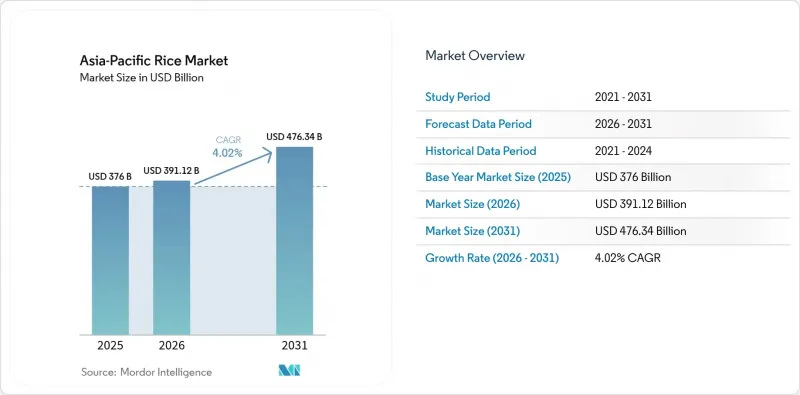
This report is Segmented by Geography (China, India, Indonesia, Bangladesh, Thailand, Vietnam, Philippines, and More). The Report Includes Production Analysis (Volume), Consumption Analysis (Value and Volume), Export Analysis (Value and Volume), Import Analysis (Value and Volume), and Price Trend Analysis. The Market Forecasts are Provided in Terms of Value (USD) and Volume (Metric Tons).
Asia-Pacific Rice Market Trends and Insights
Surging Intra-regional Demand from the Middle-income Cohort
Rising incomes among middle-class consumers in China, Indonesia, and India are reshaping rice consumption patterns. There is increasing demand for specialty, organic, and fortified rice varieties that provide enhanced nutritional value. Urban consumers prioritize grain uniformity, aroma, and branded packaging, leading processors to enhance quality control, traceability, and marketing. While overall consumption stabilizes in some regions, the transition toward premium products maintains market growth. Consumer preferences for health-conscious options and sustainable products drive demand for organic jasmine, low glycemic index varieties, and fortified grains. These consumption trends are transforming the rice value chain and promoting innovation across production, processing, and retail segments in the Asia-Pacific region.
Rapid Mechanization Narrowing the Yield Gap
Mechanization is increasing across the Asia-Pacific, particularly in regions with labor shortages and small landholdings. Farmers are adopting mini tillers, combine harvesters, and transplanting machines for small plots, which improves efficiency and reduces post-harvest losses. Increasing labor costs and rural migration have reduced manual farming viability, encouraging farmers to use machinery through rental cooperatives and government programs. This equipment helps reduce the gap between potential and actual yields, decreases production costs, and improves supply chain stability. Mechanization enables crop diversification and timely field operations, essential for climate resilience. As equipment becomes more accessible, productivity increases and the region progresses toward sustainable agricultural growth.
Land Tenure Insecurity Limiting Long-term On-farm Investment
In many parts of the Asia-Pacific region, farmers face significant challenges due to insecure land tenure. Without formal ownership or long-term rights, they are reluctant to invest in improvements such as irrigation systems, soil restoration, or perennial crops that require multi-season commitment. This uncertainty prevents capital investment and reduces productivity. In regions where governments have implemented land-use rights or formal titles, farmers have demonstrated increased adoption of sustainable practices and investment in organic inputs. Women farmers experience higher rates of tenure insecurity, which restricts their access to credit and resources. This gender disparity hampers agricultural development and impedes equitable growth. Addressing land rights remains fundamental for enabling long-term investment and building resilience in the regional rice sector.
Other drivers and restraints analyzed in the detailed report include:
- Gene-edited Drought-tolerant Varieties Moving from Trials to Scale
- Public Stockpiling Programs Cushioning Price Volatility
- Invasive Disease and Pest Outbreaks Disrupting Regional Yields
For complete list of drivers and restraints, kindly check the Table Of Contents.
Complete Report Scope:
- By Geography (Production Analysis (Volume), Consumption Analysis (Volume and Value), Import Analysis (Volume and Value), Export Analysis (Volume and Value), and Price Trend Analysis)
- China
- India
- Indonesia
- Bangladesh
- Thailand
- Vietnam
- Philippines
- Pakistan
- Japan
- Australia
Additional Benefits:
- The market estimate (ME) sheet in Excel format
- 3 months of analyst support
TABLE OF CONTENTS
1 Introduction
- 1.1 Study Assumptions and Market Definition
- 1.2 Scope of the Study
2 Research Methodology
3 Executive Summary
4 Market Landscape
- 4.1 Market Overview
- 4.2 Market Drivers
- 4.2.1 Surging Intra-regional Demand from the Middle-income Cohort
- 4.2.2 Rapid Mechanization Narrowing the Yield Gap
- 4.2.3 Gene-edited Drought-tolerant Varieties Moving from Trials to Scale
- 4.2.4 Public Stockpiling Programs Cushioning Price Volatility
- 4.2.5 Expansion of Cross-border E-procurement Platforms
- 4.2.6 Carbon-credit Premiums for Low-methane Paddy Practices
- 4.3 Market Restraints
- 4.3.1 Land Tenure Insecurity Limiting Long-term On-farm Investment
- 4.3.2 Invasive Disease and Pest Outbreaks Disrupting Regional Yields
- 4.3.3 Diesel-price Volatility Squeezing Milling Margins
- 4.3.4 Fragmented Supply Chains and Poor Infrastructure
- 4.4 Regulatory Landscape
- 4.5 Technological Outlook
- 4.6 Value / Supply-Chain Analysis
- 4.7 PESTLE Analysis
5 Market Size and Growth Forecasts (Value and Volume)
- 5.1 By Geography (Production Analysis (Volume), Consumption Analysis (Volume and Value), Import Analysis (Volume and Value), Export Analysis (Volume and Value), and Price Trend Analysis)
- 5.1.1 China
- 5.1.2 India
- 5.1.3 Indonesia
- 5.1.4 Bangladesh
- 5.1.5 Thailand
- 5.1.6 Vietnam
- 5.1.7 Philippines
- 5.1.8 Pakistan
- 5.1.9 Japan
- 5.1.10 Australia
6 Competitive Landscape
- 6.1 List of Stakeholders
- 6.1.1 Wilmar International Ltd.
- 6.1.2 China Oil and Foodstuffs Corp. (COFCO)
- 6.1.3 Charoen Pokphand Foods
- 6.1.4 Ricegrowers Limited (SunRice)
- 6.1.5 Khushi Ram Behari Lal Limited
- 6.1.6 Siam Grains Company Limited
- 6.1.7 Asia Golden Rice Co., Ltd.
- 6.1.8 SunWest Milling Co.
- 6.1.9 STC Group (Capital Rice Co., Ltd.)
- 6.1.10 Matco Foods Ltd.
- 6.1.11 Veer Overseas Ltd.
7 Market Opportunities and Future Outlook

