PUBLISHER: Mordor Intelligence | PRODUCT CODE: 2113709

PUBLISHER: Mordor Intelligence | PRODUCT CODE: 2113709
Spain Rice - Market Share Analysis, Industry Trends & Statistics, Growth Forecasts (2026 - 2031)
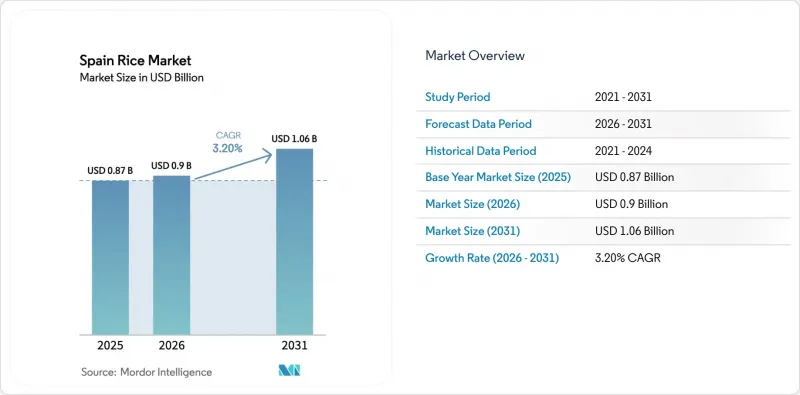
According to Mordor Intelligence, the spain rice market is projected to grow from USD 0.87 billion in 2025 to USD 0.90 billion in 2026 and is forecast to reach USD 1.06 billion by 2031 at a 3.20% CAGR over 2026-2031.
This report is Segmented by Production Analysis (Volume), Consumption Analysis (Value and Volume), Import Analysis (Value and Volume), Export Analysis (Value and Volume), Wholesale Price Trend Analysis and Forecast, Regulatory Framework, Logistics and Infrastructure, Seasonality Analysis, and List of Key Players. The Market Forecasts are Provided in Terms of Value (USD) and Volume (Metric Tons).
Spain Rice Market Trends and Insights
Growing Demand for Sustainably Produced Rice
Major retailers such as Carrefour, Mercadona, and Auchan now require certified low-carbon rice for their private-label tenders, prompting cooperative mills to secure Parcs Naturals or carbon-neutral certifications that yield 12-18% wholesale premiums. DO zones in the Ebro Delta and Valencia gain first-mover advantage because existing Parc Natural restrictions already cap synthetic inputs, aligning neatly with retailer scorecards. Guadalquivir growers, by contrast, face higher retrofit bills to replace flood-irrigation hardware and document field emissions. Urban consumers in Northern Europe display higher willingness to pay, creating a bifurcated domestic market where conventional Indica still dominates price-sensitive segments. The European Union Farm-to-Fork target to halve chemical pesticide usage by 2030 enhances certification value, though delays in Sustainable Use Regulation roll-out inject regulatory uncertainty that discourages smallholder investment. Overall, sustainability pull is solid yet uneven, rewarding vertically integrated processors with the capital and audit infrastructure to navigate evolving compliance thresholds.
Government Subsidies for Water-Efficient Irrigation
The Common Agricultural Policy (CAP) earmarks USD 14.9 million annually for Spanish rice coupled aid and offers eco-scheme top-ups of USD 63-126 per hectare for Alternate Wetting and Drying (AWD), sprinkler or precision irrigation deployments. Andalusia and Extremadura absorb a majority of disbursed funds because recurring droughts make subsidy-backed infrastructure essential. Regional co-finance packages support sensor grids and variable-rate controllers, cutting pumping costs and reducing water withdrawals by 15-30%. Still, national Alternate Wetting and Drying (AWD) penetration remains under 20%, as high up-front investment requirements deter smallholders. Trials conducted by the National Institute for Agricultural and Food Research and Technology (INIA) in Seville confirmed water savings of around 25% without yield penalties, validating the agronomic case. However, an aging farmer population and fragmented landholdings continue to slow broader adoption. The European Union's Common Agricultural Policy (CAP) 2023-2027 links future aid to verifiable emission reductions, increasing pressure on lagging producers to modernize or risk losing subsidies that can account for up to 20% of gross farm income. Overall, current subsidy structures support near-term adoption momentum, but sustained impact will depend on easing capital constraints and strengthening extension services.
Water Scarcity in the Guadalquivir Basin
Droughts cut rice allocations by up to 40% during 2022-2023, threatening large cultivation areas that contribute to Spain's highest agricultural yields. Reservoirs remain at reduced capacity, while urban centers such as Seville and Cordoba compete for water supplies, and Europe's Water Framework Directive obligations require ecological flows to the Donana wetlands. Salinity rises as growers tap groundwater exceeding 2 dS/m, compromising milling quality and driving trials of salt-tolerant Indica hybrids that lack consumer acceptance in paella markets. Climate models from the Spain State Meteorological Agency (Agencia Estatal de Meteorologia) project a 15-20% rainfall decline in southern Iberia by 2040, indicating chronic deficits. High-capex desalination and controversial Tagus transfers offer limited respite, and the Guadalquivir management plan for 2024-2027 prioritizes ecological flows over agriculture. Long-term, Andalusia risks ceding production leadership to water-secure Valencia and the Ebro Delta.
Other drivers and restraints analyzed in the detailed report include:
- Premiumization Enabled by Designation of Origin Certified Varieties
- Robust Intra-Europe Export Demand
- Stricter Pesticide-Residue Regulations
For complete list of drivers and restraints, kindly check the Table Of Contents.
Complete Report Scope:
- Production Analysis
- Production Volume
- Area Harvested and Yield
- Consumption Analysis (Value and Volume)
- Trade Analysis (Value and Volume)
- Import Market Analysis
- Import Value and Volume
- Key Supplying Markets
- Export Market Analysis
- Export Value and Volume
- Key Destinations Markets
- Import Market Analysis
- Wholesale Price Trend Analysis and Forecast
- Regulatory Framework
- Logistics and Infrastructure
- Seasonality Analysis
List of Companies Covered in this Report:
- Overview of the Competition
- Recent Developments
- Market Concentration Analysis
- List of Key Players
Additional Benefits:
- The market estimate (ME) sheet in Excel format
- 3 months of analyst support
TABLE OF CONTENTS
1 Introduction
- 1.1 Study Assumptions and Market Definition
- 1.2 Scope of the Study
2 Research Methodology
3 Executive Summary
4 Market Dynamics
- 4.1 Market Overview
- 4.2 Market Drivers
- 4.2.1 Growing demand for sustainably produced rice
- 4.2.2 Government subsidies for water-efficient irrigation
- 4.2.3 Premiumization enabled by Designation of Origin certified varieties
- 4.2.4 Robust intra-Europe export demand
- 4.2.5 Adoption of AWD irrigation cutting costs
- 4.2.6 AI-enabled disease-prediction boosting yields
- 4.3 Market Restraints
- 4.3.1 Water scarcity in the Guadalquivir basin
- 4.3.2 Stricter pesticide-residue regulations
- 4.3.3 Aging farmer demographics
- 4.3.4 Land competition from photovoltaic projects
- 4.4 Opportunities
- 4.5 Challenges
- 4.6 Value Chain Analysis
- 4.7 Technologies and Usage of AI in the Industry
- 4.8 Input Market Analysis
- 4.8.1 Seeds
- 4.8.2 Fertilizers
- 4.8.3 Crop Protection Chemicals
- 4.9 Distribution Channel Analysis
- 4.10 Market Sentiment Analysis
- 4.11 PESTLE Analysis
5 Market Size and Growth Forecast (Value and Volume)
- 5.1 Production Analysis
- 5.1.1 Production Volume
- 5.1.2 Area Harvested and Yield
- 5.2 Consumption Analysis (Value and Volume)
- 5.3 Trade Analysis (Value and Volume)
- 5.3.1 Import Market Analysis
- 5.3.1.1 Import Value and Volume
- 5.3.1.2 Key Supplying Markets
- 5.3.2 Export Market Analysis
- 5.3.2.1 Export Value and Volume
- 5.3.2.2 Key Destinations Markets
- 5.3.1 Import Market Analysis
- 5.4 Wholesale Price Trend Analysis and Forecast
- 5.5 Regulatory Framework
- 5.6 Logistics and Infrastructure
- 5.7 Seasonality Analysis
6 End Use Applications and Industries
- 6.1 Primary Applications and Emerging Applications
- 6.2 Consumption Breakdown by Industries
7 Competitive Landscape
- 7.1 Overview of the Competition
- 7.2 Recent Developments
- 7.3 Market Concentration Analysis
- 7.4 List of Key Players
- 7.4.1 Ebro Foods, S.A.
- 7.4.2 Arrossaires del Delta (Noman Foods)
- 7.4.3 Dacsa Group
- 7.4.4 BASF SE
- 7.4.5 Corteva Agriscience
- 7.4.6 Syngenta Group
- 7.4.7 Bayer AG
- 7.4.8 Limagrain Iberica S.A.
- 7.4.9 Arroz Brazal
- 7.4.10 Sivaris
- 7.4.11 Sat Muceval
- 7.4.12 Arrocerias Pons, S.A.
8 Market Opportunities and Future Trends

