PUBLISHER: Mordor Intelligence | PRODUCT CODE: 2121810

PUBLISHER: Mordor Intelligence | PRODUCT CODE: 2121810
India Rice - Market Share Analysis, Industry Trends & Statistics, Growth Forecasts (2026 - 2031)
According to Mordor Intelligence, the India rice market size in 2026 is estimated at USD 49.32 billion, growing from 2025 value of USD 47.1 billion with 2031 projections showing USD 62.09 billion, growing at 4.72% CAGR over 2026-2031.
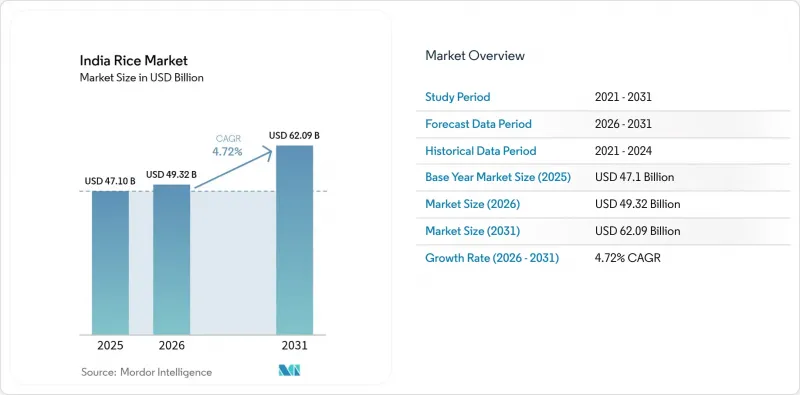
The India Rice Market Report Includes Production Analysis (Volume), Consumption Analysis (Value and Volume), Export Analysis (Value and Volume), Import Analysis (Value and Volume), and Price Trend Analysis. The Market Forecasts are Provided in Terms of Value (USD) and Volume (Metric Tons).
India Rice Market Trends and Insights
Rising Domestic Per-Capita Rice Consumption
Per-capita rice consumption is increasing in Indian metropolitan areas where changing lifestyles drive demand for convenient, nutritionally enhanced staples. Government surveys indicate growing differences in cereal preferences between rural and urban areas, leading suppliers to develop high-protein and low-glycemic index products that can command higher prices. The International Rice Research Institute has enhanced protein content to 15.99%, while the black-grained BPT 2841 variety offers increased lysine content, appealing to health-conscious consumers. KRBL's 18% increase in domestic branded sales demonstrates that premium products perform well in modern retail channels. Rice suppliers are investing in new varieties, improved packaging, and multi-channel distribution to capture urban market share. This trend has increased value realization across the supply chain, benefiting farmers who meet quality standards.
Mandatory Rice Fortification Across Public Distribution System
The government mandate for grain fortification through the Public Distribution System (PDS) has established consistent demand. The program serves more than 800 million beneficiaries, with 1,023 fortified kernel plants having a capacity of 111 lakh metric tons, which is twice the scheme's requirements. The installation of blending equipment in over 21,000 rice mills has created an additional processing network that ensures steady operations for millers. The guaranteed annual procurement of 520 lakh metric tons provides stable demand for compliant suppliers. States with high anemia rates, such as Nagaland, demonstrate the public health need that supports continued budget allocation. The fortification requirements are projected to become standard specifications, encouraging open-market participants to produce nutrient-enriched products.
Monsoon Volatility and Climate Shocks
Extreme precipitation events were observed during the 2024 monsoon, affecting agricultural fields in Gujarat, Andhra Pradesh, and Telangana. Analysis indicates that rainfall exceeding 1,621 mm negatively impacts Kharif crop yields. Climate projections indicate a potential 20% decline in irrigated crop yields in Uttar Pradesh, while rain-fed areas may experience slight improvements. Farmers are responding by adjusting planting schedules and adopting drought-resistant crop varieties, though infrastructure development for climate resilience remains inconsistent across regions.
Other drivers and restraints analyzed in the detailed report include:
- Higher Minimum Support Price (MSP) and Procurement Volumes
- Farm Mechanization and Irrigation Expansion
- Small Farm Size and High Production Cost Structure
For complete list of drivers and restraints, kindly check the Table Of Contents.
Complete Report Scope:
- India
- Production Analysis (Volume)
- Consumption Analysis (Value and Volume)
- Export Analysis (Value and Volume)
- Import Analysis (Value and Volume)
- Price Trend Analysis
Additional Benefits:
- The market estimate (ME) sheet in Excel format
- 3 months of analyst support
TABLE OF CONTENTS
1 Introduction
- 1.1 Study Assumptions and Market Definition
- 1.2 Scope of the Study
2 Research Methodology
3 Executive Summary
4 Market Landscape
- 4.1 Market Overview
- 4.2 Market Drivers
- 4.2.1 Rising Domestic Per-capita Rice Consumption
- 4.2.2 Mandatory Rice Fortification Across Public Distribution System
- 4.2.3 Higher Minimum Support Price (MSP) and Procurement Volumes
- 4.2.4 Farm mechanization and Irrigation Expansion
- 4.2.5 Hybrid, High-protein Rice Varieties Targeting Health-aware Consumers
- 4.2.6 Blockchain-based Traceability Premiums in Export Markets
- 4.3 Market Restraints
- 4.3.1 Monsoon Volatility and Climate Shocks
- 4.3.2 Small Farm Size and High Production Cost Structure
- 4.3.3 Methane-emission Compliance Pressure
- 4.3.4 Shift of Acreage to Higher-value Horticulture
- 4.4 Value / Supply-Chain Analysis
- 4.5 Regulatory Landscape
- 4.6 Technological Outlook
- 4.7 PESTLE Analysis
5 Market Size and Growth Forecasts (Value and Volume)
- 5.1 India
- 5.1.1 Production Analysis (Volume)
- 5.1.2 Consumption Analysis (Value and Volume)
- 5.1.3 Export Analysis (Value and Volume)
- 5.1.4 Import Analysis (Value and Volume)
- 5.1.5 Price Trend Analysis
6 Competitive Analysis
- 6.1 List of Stakeholders
7 Market Opportunities and Future Outlook

