PUBLISHER: Mordor Intelligence | PRODUCT CODE: 2113347

PUBLISHER: Mordor Intelligence | PRODUCT CODE: 2113347
Indonesia Infrastructure - Market Share Analysis, Industry Trends & Statistics, Growth Forecasts (2026 - 2031)
According to Mordor Intelligence, the Indonesia infrastructure market size is expected to grow from USD 101.22 billion in 2025 to USD 106.89 billion in 2026 and is forecast to reach USD 140.4 billion by 2031 at 5.6% CAGR over 2026-2031.
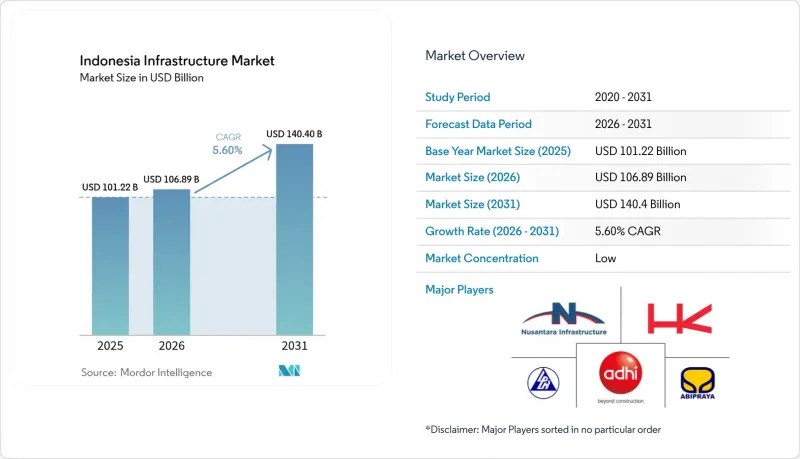
This report is Segmented by Infrastructure (Transportation Infrastructure, Utilities Infrastructure, and More), by Construction Type (New Construction and Renovation), by Investment Source (Public and Private), and by Geography (Java, Sumatra, Kalimantan, Sulawesi and the Rest of Indonesia). The Market Forecasts are Provided in Terms of Value (USD).
Indonesia Infrastructure Market Trends and Insights
National Medium-Term Development Plan (RPJMN 2025-2029)
The RPJMN commits USD 25.8 billion in 2025 for roads, mass transit, and energy transition assets, making infrastructure the policy centerpiece for escaping the middle-income trap. A pipeline of 210 strategic projects already enjoys presidential regulation backing, which reduces approval risk and standardizes PPP templates across ministries. Execution credibility is high because 153 legacy projects worth USD 67.1 billion reached completion between 2016-2023, demonstrating a functioning delivery apparatus. The plan explicitly targets logistics-cost reduction below 10% of GDP, a metric closely watched by manufacturing investors. By embedding climate resilience and digital connectivity targets, RPJMN provides visibility that encourages multidecade private capital commitments.
Relocation of the New Capital (Nusantara)
The USD 29 billion first-phase build of Nusantara turns Kalimantan into the largest construction site in Southeast Asia, sparking ancillary demand in ports, airports, and water systems. More than 61.7% of state-funded packages were physically complete by December 2024, a key confidence signal for institutional investors eyeing later-stage parcels. Design parameters call for carbon neutrality by 2045 and fully digital public services, positioning the city as a demonstration hub for smart, sustainable infrastructure. Foreign pledges reached USD 97 million by late 2024, with Russian, Chinese, and Australian participants, and are expected to accelerate once core civil works de-risk remaining phases. Spill-over effects already include road upgrades linking mineral-rich South Sulawesi to new logistics channels, underscoring the project's national multiplier.
Fiscal-Deficit-Driven Cap-Ex Ceilings
The Ministry of Public Works budget plunged 73% to USD 1.9 billion for 2025 after a presidential efficiency mandate, forcing ministries to shelve new physical projects unless co-financed via PPPs. Although the deficit rule underpins macro stability, it shifts risk-sharing toward private investors who demand higher returns, raising project-level costs. State-owned builders now prioritize return-guaranteed toll roads over socially oriented works such as irrigation channels. The Nusantara build illustrates the tension: only 12.1% of allocated funds were spent by May 2024, compelling aggressive outreach to foreign partners. In the near term, financing scarcity may delay non-strategic assets, but it also accelerates market discipline that rewards efficient, well-structured projects.
Other drivers and restraints analyzed in the detailed report include:
- Sovereign Wealth Fund (INA) Catalyzing PPP Pipelines
- Growing Urbanization and Middle-Class Expansion
- Protracted Land-Acquisition and Permitting Cycles
For complete list of drivers and restraints, kindly check the Table Of Contents.
Segment Analysis
Transportation captured 41.87% of the 2025 project value within the Indonesia infrastructure market, reflecting its centrality to cost-of-goods reduction and regional integration. New corridors such as the 1,065.5 km Trans-Java network and the Lampung-Aceh Trans-Sumatra line shorten travel times and underpin commodity supply chains. The Jakarta-Surabaya high-speed rail feasibility stage indicates future passenger rail spending once financial close is reached. Simultaneously, 25 airports have been built or upgraded since 2015, facilitating tourism and e-commerce air-cargo flows, while the maritime "Tol Laut" program enhances port-to-port reliability across 115 ports. The Indonesia infrastructure market size for transportation projects will expand at a 6.88% CAGR through 2031 as public-sector concessional loans dovetail with private toll-road equity, positioning the segment for both volume and margin growth.
Growth potential extends beyond highways. State rail operator PT Kereta Api Indonesia now bundles station commercial rights with track upgrades, creating blended revenue streams attractive to pension funds. In aviation, Dhoho Kediri, the first unsolicited airport PPP at USD 567.7 million, sets a precedent for greenfield deals, while digital air-traffic-management systems enter procurement to raise throughput. Port operators, led by Pelindo, pursue dredging and crane automation to meet 24/7 shipping standards, and investors eye bond-financed refrigerated-container yards that link fisheries to export gateways. Together, these initiatives diversify construction orders and deepen skill requirements, reinforcing transportation's role as the flagship of the Indonesia infrastructure market.
Complete Report Scope:
- By Infrastructure
- Transportation Infrastructure
- Utilities Infrastructure
- Social Infrastructure
- Extraction Infrastructure
- By Construction Type
- New Construction
- Renovation
- By Investment Source
- Public
- Private
- By Geography
- Java
- Sumatra
- Kalimantan
- Sulawesi
- Rest of Indonesia
List of Companies Covered in this Report:
- PT Nusantara Infrastructure Tbk
- PT Adhi Karya (Persero) Tbk
- PT Brantas Abipraya (Persero)
- PT Hutama Karya (Persero)
- PT Indonesia Pondasi Raya Tbk
- PT Jagat Konstruksi Adipersada
- PT Jasa Marga (Persero) Tbk
- PT Wijaya Karya (Persero) Tbk
- PT Kajima Indonesia
- PT Total Bangun Persada Tbk
- PT Waskita Karya (Persero) Tbk
- PT Pembangunan Perumahan (Persero) Tbk
- PT PP Presisi Tbk
- PT Wijaya Karya Beton Tbk
- PT Sinohydro Indonesia
- PT Cipta Kridatama
- PT Len Railway Systems
- PT Medco Power Indonesia
- PT Telkom Infra
- PT Indika Energy Infrastructure
Additional Benefits:
- The market estimate (ME) sheet in Excel format
- 3 months of analyst support
TABLE OF CONTENTS
1 Introduction
- 1.1 Study Assumptions & Market Definition
- 1.2 Scope of the Study
2 Research Methodology
3 Executive Summary
4 Market Landscape
- 4.1 Market Overview
- 4.2 Market Drivers
- 4.2.1 National Medium-Term Development Plan (RPJMN 2025-2029)
- 4.2.2 Growing urbanisation & middle-class expansion
- 4.2.3 Sovereign wealth fund (INA) catalysing PPP pipelines
- 4.2.4 Relocation of the new capital (Nusantara)
- 4.2.5 Surge in data-centre & fibre backbone build-outs
- 4.2.6 Green-bond financed renewable & climate-resilient assets
- 4.3 Market Restraints
- 4.3.1 Fiscal-deficit driven cap-ex ceilings
- 4.3.2 Protracted land-acquisition & permitting cycles
- 4.3.3 Climate-change-related cost escalations (flooding, sea-level)
- 4.3.4 Fragmented SME contractor ecosystem & low BIM adoption
- 4.4 Value / Supply-Chain Analysis
- 4.4.1 Overview
- 4.4.2 Real Estate Developers and Contractors - Key Quantitative and Qualitative Insights
- 4.4.3 Architectural and Engineering Companies - Key Quantitative and Qualitative Insights
- 4.4.4 Building Material and Equipment Companies - Key Quantitative and Qualitative Insights
- 4.5 Government Initiatives & Vision
- 4.6 Regulatory or Technological Outlook
- 4.7 Industry Attractiveness - Porter's Five Force Analysis
- 4.7.1 Threat of New Entrants
- 4.7.2 Bargaining Power of Suppliers
- 4.7.3 Bargaining Power of Buyers
- 4.7.4 Threat of Substitutes
- 4.7.5 Competitive Rivalry
- 4.8 Pricing (Construction Materials) and Construction Cost (Materials, Labour, Equipment) Analysis
- 4.9 Comparison of Key Industry Metrics of Indonesia with Other Countries
- 4.10 Key Upcoming/Ongoing Projects (with a focus on Mega Projects)
5 Market Size & Growth Forecasts (Value, In USD Billion)
- 5.1 By Infrastructure
- 5.1.1 Transportation Infrastructure
- 5.1.2 Utilities Infrastructure
- 5.1.3 Social Infrastructure
- 5.1.4 Extraction Infrastructure
- 5.2 By Construction Type
- 5.2.1 New Construction
- 5.2.2 Renovation
- 5.3 By Investment Source
- 5.3.1 Public
- 5.3.2 Private
- 5.4 By Geography
- 5.4.1 Java
- 5.4.2 Sumatra
- 5.4.3 Kalimantan
- 5.4.4 Sulawesi
- 5.4.5 Rest of Indonesia
6 Competitive Landscape
- 6.1 Market Concentration
- 6.2 Strategic Moves
- 6.3 Market Share Analysis
- 6.4 Company Profiles (includes Global level Overview, Market level overview, Core Segments, Financials as available, Strategic Information, Products & Services, and Recent Developments)
- 6.4.1 PT Nusantara Infrastructure Tbk
- 6.4.2 PT Adhi Karya (Persero) Tbk
- 6.4.3 PT Brantas Abipraya (Persero)
- 6.4.4 PT Hutama Karya (Persero)
- 6.4.5 PT Indonesia Pondasi Raya Tbk
- 6.4.6 PT Jagat Konstruksi Adipersada
- 6.4.7 PT Jasa Marga (Persero) Tbk
- 6.4.8 PT Wijaya Karya (Persero) Tbk
- 6.4.9 PT Kajima Indonesia
- 6.4.10 PT Total Bangun Persada Tbk
- 6.4.11 PT Waskita Karya (Persero) Tbk
- 6.4.12 PT Pembangunan Perumahan (Persero) Tbk
- 6.4.13 PT PP Presisi Tbk
- 6.4.14 PT Wijaya Karya Beton Tbk
- 6.4.15 PT Sinohydro Indonesia
- 6.4.16 PT Cipta Kridatama
- 6.4.17 PT Len Railway Systems
- 6.4.18 PT Medco Power Indonesia
- 6.4.19 PT Telkom Infra
- 6.4.20 PT Indika Energy Infrastructure
7 Market Opportunities & Future Outlook
- 7.1 White-space & Unmet-Need Assessment

