PUBLISHER: Mordor Intelligence | PRODUCT CODE: 2113678

PUBLISHER: Mordor Intelligence | PRODUCT CODE: 2113678
Vietnam Infrastructure - Market Share Analysis, Industry Trends & Statistics, Growth Forecasts (2026 - 2031)
According to Mordor Intelligence, the Vietnam infrastructure market size was valued at USD 19.61 billion in 2025 and estimated to grow from USD 20.91 billion in 2026 to reach USD 28.81 billion by 2031, at a CAGR of 6.62% during the forecast period (2026-2031).
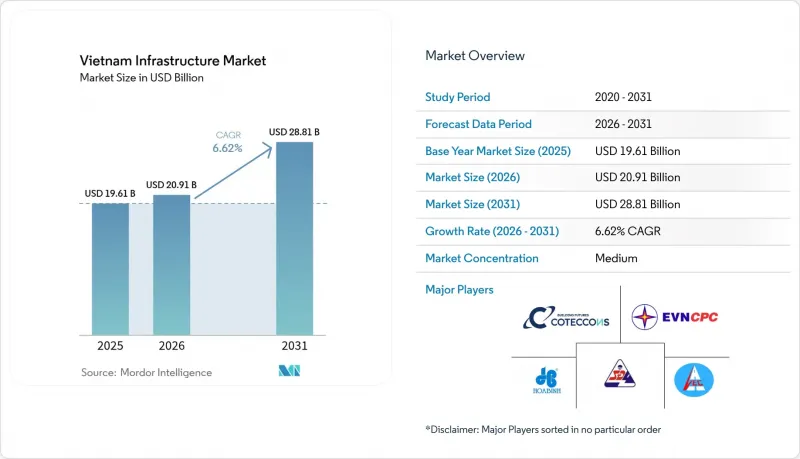
This report is Segmented by Infrastructure (Transportation Infrastructure, Utilities Infrastructure, Social Infrastructure, Extraction Infrastructure), by Construction Type (New Construction, Renovation), by Investment Source (Public, Private), and by Geography (Ho Chi Minh City, Hanoi, Da Nang, Rest of Vietnam). The Market Forecasts are Provided in Terms of Value (USD).
Vietnam Infrastructure Market Trends and Insights
Rapid Expansion of the Public-Sector CAPEX Pipeline
The government lifted its 2025 public investment allocation to USD 3.5 billion, 12% above 2024, and aims for full disbursement before year-end. Standardized construction cost norms under Decision 409/QD-BXD now guide spending and shrink approval backlogs. Eighty priority projects worth USD 18.4 billion were green-lit in April 2025, giving contractors forward visibility and boosting cement demand, which is expected to rise 15% annually through 2027. Higher public outlays stimulate jobs, materials, and equipment sales across the Vietnam infrastructure market. Continuous monitoring of disbursement progress is likely to keep pressure on ministries to maintain schedule discipline.
Surge in Foreign-Funded Mega-Projects (ODA & FDI)
FDI into Vietnamese infrastructure reached USD 38.23 billion in 2024, led by Singapore, South Korea, and Japan. Iconic examples include Huadian's USD 2.4 billion green-hydrogen complex and the USD 14 billion Long Thanh International Airport. Foreign EPC firms bring advanced project-management practices, but their dominance also heightens competition for domestic builders. To preserve local capabilities, the government now reserves 30% of public contracts for Vietnamese bidders. A steady pipeline of ODA-backed highways and power plants should keep the Vietnam infrastructure market attractive to global investors well into the next decade.
Fragmented Contractor Landscape Driving Cost Overruns
More than 50,000 registered builders share the market, and the top 10 hold only 15% of revenue. Coordination across dozens of subcontractors inflates costs by 20-35% and prolongs scheduling on mega-projects such as the North-South Expressway. International firms like Kajima and GS E&C fill capability gaps but charge premiums. The Ministry of Construction is promoting mergers and joint ventures to create 5-7 national champions by 2030, yet regional contractors often resist consolidation. Until scale improves, the Vietnam infrastructure market will continue to face budget volatility and quality risks.
Other drivers and restraints analyzed in the detailed report include:
- Accelerated PPP Adoption Under the 2024 Amended PPP Law
- Electrification & Grid-Ready Renewables Build-Out
- Weak Absorptive Capacity of Public-Investment Disbursement
For complete list of drivers and restraints, kindly check the Table Of Contents.
Segment Analysis
Transportation captured 47.86% of Vietnam's infrastructure market share in 2025, thanks to marquee assets such as the USD 67 billion North-South High-Speed Railway and the USD 59 billion expressway expansion. Utilities assets, though smaller, are projected to grow faster at an 8.58% CAGR.
The transportation build-out anchors supply-chain resilience for export-oriented manufacturers, reducing door-to-port times and lowering logistics charges. Conversely, grid expansion underpins Vietnam's energy transition and supplies industrial parks with reliable power, making utilities the next magnet for private capital.
Complete Report Scope:
- By Infrastructure
- Transportation Infrastructure
- Utilities Infrastructure
- Social Infrastructure
- Extraction Infrastructure
- By Construction Type
- New Construction
- Renovation
- By Investment Source
- Public
- Private
- By Geography
- Ho Chi Minh City
- Hanoi
- Da Nang
- Rest of Vietnam
List of Companies Covered in this Report:
- Vietnam Expressway Corporation (VEC)
- Coteccons Construction JSC
- Hoa Binh Construction Group JSC
- Central Power Corporation (EVNCPC)
- Song Da Corporation JSC
- Fecon Corp.
- Deoca Group
- Vietnam National Construction Consultants Corp. (VNCC)
- Long Thanh Airport Project Mgmt. Board
- Power Construction 1 (PCC1)
- Thang Long Infrastructure Development
- Licogi 16 JSC
- Truong Son Construction Corp.
- Petroleum Construction JSC (PVC)
- Vinaconex
- Cienco4 Group
- Trung Nam Group
- Vietur Consortium
Additional Benefits:
- The market estimate (ME) sheet in Excel format
- 3 months of analyst support
TABLE OF CONTENTS
1 Introduction
- 1.1 Study Assumptions & Market Definition
- 1.2 Scope of the Study
2 Research Methodology
3 Executive Summary
4 Market Landscape
- 4.1 Market Overview
- 4.2 Market Drivers
- 4.2.1 Rapid expansion of public-sector CAPEX pipeline
- 4.2.2 Surge in foreign-funded mega-projects (ODA & FDI)
- 4.2.3 Accelerated PPP adoption under 2024 amended PPP Law
- 4.2.4 Electrification & grid-ready renewables build-out
- 4.2.5 Under-radar: Provincial sand-shortage resolution unlocking road/rail projects
- 4.2.6 Under-radar: "TOD zoning" around new metro & HSR stations
- 4.3 Market Restraints
- 4.3.1 Fragmented contractor landscape driving cost overruns
- 4.3.2 Weak absorptive capacity of public-investment disbursement
- 4.3.3 Under-radar: Chronic scarcity of high-spec construction aggregates
- 4.3.4 Under-radar: Volatile long-term VND bond yields curb domestic PPP financing
- 4.4 Value / Supply-Chain Analysis
- 4.4.1 Overview
- 4.4.2 Real Estate Developers and Contractors - Key Quantitative and Qualitative Insights
- 4.4.3 Architectural and Engineering Companies - Key Quantitative and Qualitative Insights
- 4.4.4 Building Material and Equipment Companies - Key Quantitative and Qualitative Insights
- 4.5 Government Initiatives & Vision
- 4.6 Regulatory or Technological Outlook
- 4.7 Industry Attractiveness - Porter's Five Force Analysis
- 4.7.1 Threat of New Entrants
- 4.7.2 Bargaining Power of Suppliers
- 4.7.3 Bargaining Power of Buyers
- 4.7.4 Threat of Substitutes
- 4.7.5 Competitive Rivalry
- 4.8 Pricing (Construction Materials) and Construction Cost (Materials, Labour, Equipment) Analysis
- 4.9 Comparison of Key Industry Metrics of Vietnam with Other Countries
- 4.10 Key Upcoming/Ongoing Projects (with a focus on Mega Projects)
5 Market Size & Growth Forecasts (Value, In USD Billion)
- 5.1 By Infrastructure
- 5.1.1 Transportation Infrastructure
- 5.1.2 Utilities Infrastructure
- 5.1.3 Social Infrastructure
- 5.1.4 Extraction Infrastructure
- 5.2 By Construction Type
- 5.2.1 New Construction
- 5.2.2 Renovation
- 5.3 By Investment Source
- 5.3.1 Public
- 5.3.2 Private
- 5.4 By Geography
- 5.4.1 Ho Chi Minh City
- 5.4.2 Hanoi
- 5.4.3 Da Nang
- 5.4.4 Rest of Vietnam
6 Competitive Landscape
- 6.1 Market Concentration
- 6.2 Strategic Moves
- 6.3 Market Share Analysis
- 6.4 Company Profiles (includes Global level Overview, Market level overview, Core Segments, Financials as available, Strategic Information, Products & Services, and Recent Developments)
- 6.4.1 Vietnam Expressway Corporation (VEC)
- 6.4.2 Coteccons Construction JSC
- 6.4.3 Hoa Binh Construction Group JSC
- 6.4.4 Central Power Corporation (EVNCPC)
- 6.4.5 Song Da Corporation JSC
- 6.4.6 Fecon Corp.
- 6.4.7 Deoca Group
- 6.4.8 Vietnam National Construction Consultants Corp. (VNCC)
- 6.4.9 Long Thanh Airport Project Mgmt. Board
- 6.4.10 Power Construction 1 (PCC1)
- 6.4.11 Thang Long Infrastructure Development
- 6.4.12 Licogi 16 JSC
- 6.4.13 Truong Son Construction Corp.
- 6.4.14 Petroleum Construction JSC (PVC)
- 6.4.15 Vinaconex
- 6.4.16 Cienco4 Group
- 6.4.17 Trung Nam Group
- 6.4.18 Vietur Consortium
7 Market Opportunities & Future Outlook
- 7.1 White-space & Unmet-need Assessment

