PUBLISHER: Mordor Intelligence | PRODUCT CODE: 2121906

PUBLISHER: Mordor Intelligence | PRODUCT CODE: 2121906
Infrastructure In Asia Pacific - Market Share Analysis, Industry Trends & Statistics, Growth Forecasts (2026 - 2031)
According to Mordor Intelligence, APAC infrastructure market size in 2026 is estimated at USD 1.71 trillion, growing from 2025 value of USD 1.61 trillion with 2031 projections showing USD 2.33 trillion, growing at 6.3% CAGR over 2026-2031.
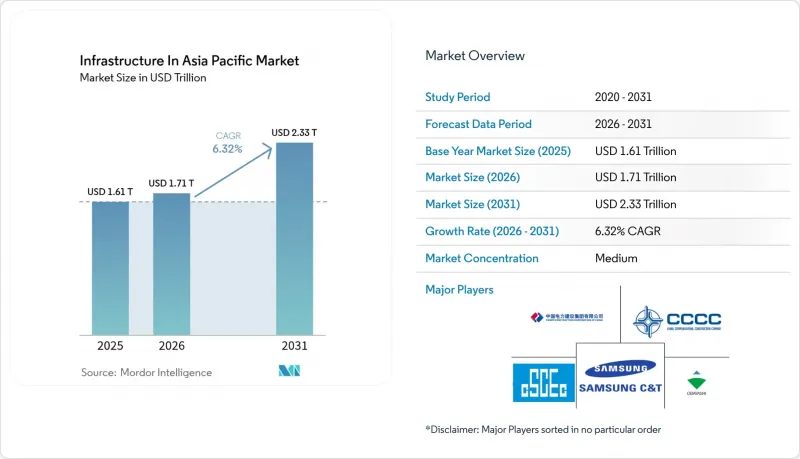
This report is Segmented by Infrastructure Segment (Transportation Infrastructure, Utilities Infrastructure, Social Infrastructure, Extraction Infrastructure), by Construction Type (New Construction, Renovation), by Investment Source (Public, Private), and by Geography (China, India, Japan, South Korea, ASEAN, Rest of Asia Pacific). The Market Forecasts are Provided in Terms of Value (USD).
Infrastructure In Asia Pacific Market Trends and Insights
Robust Government Infrastructure Spending
Public budgets across the region continue to hit record levels. China has earmarked over USD 551 billion for "hidden" urban utilities and smart-city upgrades while concurrently adding 3,800 kilometers of high-speed rail by year-end. Japan is underwriting semiconductor "chip cities" with USD 27 billion in direct support that catalyzes USD 120 billion in downstream economic benefits. South Korea's parliament approved USD 471 billion for a Gyeonggi semiconductor cluster and complementary road and rail links. These policies both stimulate near-term growth and strengthen technological sovereignty. Together, they raise baseline demand for construction services, machinery, and advanced project management tools across the APAC infrastructure market.
Accelerating Urbanization & Middle-Class Demand
Rapid urban migration is swelling consumption and stretching city limits. Southeast Asia's GDP reached USD 3.6 trillion in 2022, and household spending is projected to cross USD 4 trillion by 2031, intensifying demand for mass transit and smart-utility grids. Programs such as Indonesia's "Movement Toward 100 Smart Cities" layer digital sensors, open-data platforms, and climate-resilient drainage into every new township. Vietnam's USD 67 billion north-to-south high-speed railway will cut travel times to six hours for 80% of urban residents, illustrating how quality-of-life upgrades translate into large transportation outlays. Urban green retrofits like Singapore's Bishan-Ang Mo Kio Park show that nature-based drainage can raise biodiversity by 30% and still save 15% over concrete alternatives. These examples clarify why recurring city budgets and private mortgages will keep funneling capital into the APAC infrastructure market long after mega-projects finish.
Land-Acquisition & Permitting Delays
Regulatory bottlenecks extend timelines and inflate costs. Japan's Hokuriku Shinkansen extension now exceeds USD 36 billion, more than double the original outlay, after protracted community negotiations. Southeast Asia's USD 100 billion super-grid faces multiple sovereignty approvals before any cable is laid. Even renewables hit hurdles: Australian solar and wind farms must clear heritage surveys, flora scans, and marine assessments despite federal fast-track lists. Local land-rights consultations add two to three years to project schedules in Indonesia and the Philippines. These frictions shave growth from the APAC infrastructure market unless digital permitting portals and standardized right-of-way frameworks scale rapidly.
Other drivers and restraints analyzed in the detailed report include:
- 5G, Data-Center & Fiber Roll-outs
- Green & Sovereign-Wealth Capital Pivot to APAC
- Skilled-Labor Shortfalls in Megaprojects
For complete list of drivers and restraints, kindly check the Table Of Contents.
Segment Analysis
Transportation captured 38.35% of 2025 spending and posts the fastest 8.15% CAGR, giving it a commanding position within the APAC infrastructure market. China's network already spans 80% of the planned 50,000-kilometer high-speed grid and will add 3,800 kilometers this year. Vietnam's USD 67 billion line targets a six-hour Hanoi-Ho Chi Minh trip time, while Thailand's Eastern Economic Corridor channels USD 18.3 billion into airport-to-port rail loops. Smart-ticketing, predictive maintenance, and 5G-enabled driverless metros elevate operating margins and rider experience. Utilities follow as governments chase secure water and energy. China funded 1,488 water-conservancy projects in 2023, lifting spending by 41.7% for that vertical. Social infrastructure sees steady gains as aging demographics require hospitals and elder-care campuses; India's new AIIMS campus spans 1.5 million ft2 and serves as a prototype for tech-enabled healthcare. Extraction assets receive targeted boosts from low-carbon retrofits, such as Indonesia's USD 7 billion CCUS at Tangguh that will bury 15 million tons of CO2. Transportation's dominance thus mirrors both connectivity imperatives and the smart-mobility premium embedded in the APAC infrastructure market.
Segment growth also benefits from financing innovations. Asset-recycling funds in Australia package mature toll roads into listed vehicles, freeing capital for inland freight routes. Digital-twin platforms help optimize rail and port layouts before ground breaks, cutting change orders by 30%. Collectively, these advances reinforce transportation's outsized role in the APAC infrastructure market while opening niches for specialized contractors and software suppliers.
Complete Report Scope:
- By Infrastructure Segment
- Transportation Infrastructure
- Utilities Infrastructure
- Social Infrastructure
- Extraction Infrastructure
- By Construction Type
- New Construction
- Renovation
- By Investment Source
- Public
- Private
- By Geography
- China
- India
- Japan
- South Korea
- ASEAN (Indonesia, Thailand, Philippines, Malaysia, Vietnam)
- Rest of Asia Pacific
List of Companies Covered in this Report:
- China State Construction Engineering (CSCEC)
- China Communications Construction Company (CCCC)
- Power Construction Corporation of China (PowerChina)
- Samsung C&T
- Obayashi Corporation
- Shanghai Construction Group
- Hyundai E&C
- Larsen & Toubro (L&T)
- China Metallurgical Group
- China Railway Group (CREC)
- China Railway Construction Corporation (CRCC)
- Shimizu Corporation
- Kajima Corporation
- Vinci Construction
- Fluor Corporation
- AECOM
- Toyo Engineering
- SK ecoplant
- Gamuda Berhad
- CPB Contractors
Additional Benefits:
- The market estimate (ME) sheet in Excel format
- 3 months of analyst support
TABLE OF CONTENTS
1 Introduction
- 1.1 Study Assumptions & Market Definition
- 1.2 Scope of the Study
2 Research Methodology
3 Executive Summary
4 Market Landscape
- 4.1 Market Overview
- 4.2 Market Drivers
- 4.2.1 Robust government infrastructure spending
- 4.2.2 Accelerating urbanisation & middle-class demand
- 4.2.3 5G, data-centre & fibre roll-outs
- 4.2.4 Green & sovereign-wealth capital pivot to APAC
- 4.2.5 Supply-chain diversification into ASEAN
- 4.2.6 Climate-resilience upgrade mandates
- 4.3 Market Restraints
- 4.3.1 Land-acquisition & permitting delays
- 4.3.2 Public-debt & budget constraints
- 4.3.3 Skilled-labour shortfalls in megaprojects
- 4.3.4 Heightened geopolitical risk premiums
- 4.4 Value / Supply-Chain Analysis
- 4.4.1 Overview
- 4.4.2 Real Estate Developers and Contractors - Key Quantitative and Qualitative Insights
- 4.4.3 Architectural and Engineering Companies - Key Quantitative and Qualitative Insights
- 4.4.4 Building Material and Equipment Companies - Key Quantitative and Qualitative Insights
- 4.5 Regulatory Outlook
- 4.6 Technological Outlook
- 4.7 Industry Attractiveness - Porter's Five Force Analysis
- 4.7.1 Bargaining Power of Suppliers
- 4.7.2 Bargaining Power of Buyers/Consumers
- 4.7.3 Threat of New Entrants
- 4.7.4 Threat of Substitutes
- 4.7.5 Intensity of Competitive Rivalry
- 4.8 Pricing (Construction Materials) and Construction Cost (Materials, Labour, Equipment) Analysis
- 4.9 Comparison of Key Industry Metrics of Top Countries
- 4.10 Key Upcoming/Ongoing Projects (with a focus on Mega Projects)
5 Market Size & Growth Forecasts(Values, In USD Billion)
- 5.1 By Infrastructure Segment
- 5.1.1 Transportation Infrastructure
- 5.1.2 Utilities Infrastructure
- 5.1.3 Social Infrastructure
- 5.1.4 Extraction Infrastructure
- 5.2 By Construction Type
- 5.2.1 New Construction
- 5.2.2 Renovation
- 5.3 By Investment Source
- 5.3.1 Public
- 5.3.2 Private
- 5.4 By Geography
- 5.4.1 China
- 5.4.2 India
- 5.4.3 Japan
- 5.4.4 South Korea
- 5.4.5 ASEAN (Indonesia, Thailand, Philippines, Malaysia, Vietnam)
- 5.4.6 Rest of Asia Pacific
6 Competitive Landscape
- 6.1 Market Concentration
- 6.2 Strategic Moves
- 6.3 Market Share Analysis
- 6.4 Company Profiles (includes Global level Overview, Market level overview, Core Segments, Financials as available, Strategic Information, Products & Services, and Recent Developments)
- 6.4.1 China State Construction Engineering (CSCEC)
- 6.4.2 China Communications Construction Company (CCCC)
- 6.4.3 Power Construction Corporation of China (PowerChina)
- 6.4.4 Samsung C&T
- 6.4.5 Obayashi Corporation
- 6.4.6 Shanghai Construction Group
- 6.4.7 Hyundai E&C
- 6.4.8 Larsen & Toubro (L&T)
- 6.4.9 China Metallurgical Group
- 6.4.10 China Railway Group (CREC)
- 6.4.11 China Railway Construction Corporation (CRCC)
- 6.4.12 Shimizu Corporation
- 6.4.13 Kajima Corporation
- 6.4.14 Vinci Construction
- 6.4.15 Fluor Corporation
- 6.4.16 AECOM
- 6.4.17 Toyo Engineering
- 6.4.18 SK ecoplant
- 6.4.19 Gamuda Berhad
- 6.4.20 CPB Contractors
7 Market Opportunities & Future Outlook
- 7.1 White-space & Unmet-Need Assessment

