PUBLISHER: Mordor Intelligence | PRODUCT CODE: 2113394

PUBLISHER: Mordor Intelligence | PRODUCT CODE: 2113394
Asia-Pacific Maize - Market Share Analysis, Industry Trends & Statistics, Growth Forecasts (2026 - 2031)
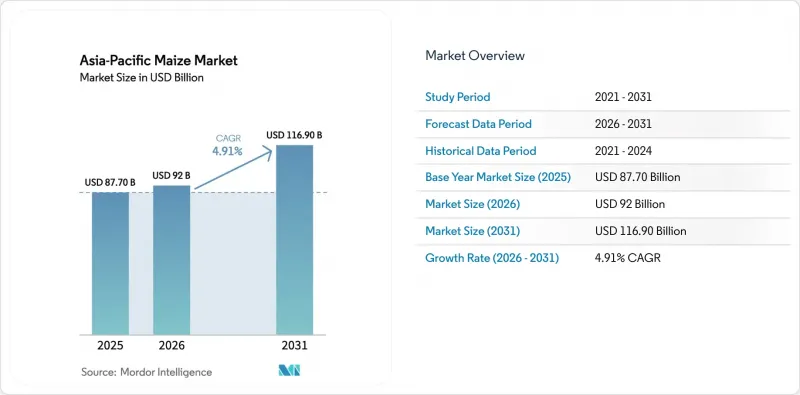
According to Mordor Intelligence, the Asia-Pacific maize market is projected to grow from USD 87.70 billion in 2025 to USD 92.00 billion in 2026, and is forecast to reach USD 116.90 billion by 2031, with a 4.91% CAGR over 2026-2031.
This report is Segmented by Geography (India, China, Indonesia, and More). The Report Includes Production Analysis (Volume), Consumption Analysis (Value and Volume), Import Analysis (Value and Volume), Export Analysis (Value and Volume), Wholesale Price Trend Analysis and Forecast, List of Key Players, and More. The Market Forecasts are Provided in Terms of Value (USD) and Volume (Metric Tons).
Asia-Pacific Maize Market Trends and Insights
Feed demand expansion from poultry, aquaculture and dairy sector
China's feed maize absorption reached 193.5 million metric tons in the 2025/26 marketing year, which anchored base demand despite profit-pressure periods for breeders during late 2025. Livestock and poultry inventories remained elevated by the end of 2025, which supported steady compound feed use and sustained corn inclusion within least-cost formulations. India's poultry and cattle segments together absorbed large maize volumes in 2024-25, with official dashboards showing sustained pull from poultry integrators and dairy ration programs in key clusters. Aquaculture feed is expanding in Vietnam as stocking densities rise in priority basins and integrators scale higher performance formulas for shrimp and finfish. Corporate feed leaders have added capacity and digital traceability in recent years, with Charoen Pokphand Foods operating significant regional feed manufacturing and maintaining verified 100% traceable corn sourcing for Thailand, which reinforces procurement standards across the Asia-Pacific maize market. Policy programs in large consuming markets promote grain-saving actions and precision nutrition, which together sustain disciplined use of maize while protecting feed efficiency targets within the Asia-Pacific maize market.
Industrial maize deep processing capacity build-out in China and Southeast Asia
China's corn-starch and deep-processing system is projected to operate with an installed capacity exceeding 125 million metric tons by 2025. Throughput and operating rates are projected to improve, supported by better margins later in the year. In 2024, China's corn starch output reached 37.99 million metric tons, representing 63.3% of the global share. Additionally, nearly two-thirds of the national output was concentrated among top processors, highlighting scale advantages in energy and water management. Demand for high-fructose corn syrup (HFCS) across the Asia-Pacific region is anticipated to grow significantly during the forecast period. This growth supports steady corn demand for starch-sugar conversion in beverage and processed food channels. Multinational companies continue to invest in integrated processing hubs to secure feedstock and serve regional customers. For instance, Cargill's Songyuan complex in Jilin converts corn into starches, HFCS, industrial alcohols, and feed coproducts, while also piloting water and fertilizer programs with contract growers. The extensive processing ecosystem in China allows for flexible product switching across starch derivatives and amino acids, enabling adaptability to shifting demand. This flexibility strengthens the Asia-Pacific maize market during fluctuations in commodity prices. Meanwhile, Southeast Asian facilities in Indonesia and Thailand are enhancing their capabilities to cater to halal and regional buyers. These developments gradually diversify sourcing away from China while anchoring regional value addition within the Asia-Pacific maize market.
Limited access to quality inputs (certified seed and balanced fertilizers)
Certified seed use and balanced fertilizer application remain inconsistent across parts of South and Southeast Asia, which constrains yield gains in rain-fed zones and keeps productivity below global front-runners in several belts of the Asia-Pacific maize market. Public programs are attempting to improve input access and extension, but logistics constraints slow last-mile delivery for smallholders in outer islands and remote districts. The Philippines has rolled out funding for seed R&D and price protection schemes for growers, which support hybrid adoption and help stabilize returns during market swings. Regional variability in credit access also limits farmers' ability to upgrade inputs and mechanize at scale, which slows the pace of agronomic gains in the Asia-Pacific maize market. Over time, better extension, seed quality assurance, and nutrient stewardship are projected to lift the input baseline and reduce yield dispersion across districts.
Other drivers and restraints analyzed in the detailed report include:
- India ethanol blending policy pull for grain-based ethanol
- Hybrid seed adoption and mechanization improving yields in South and Southeast Asia
- Substitution pressure from wheat, cassava and Distillers Dried Grains with Solubles (DDGS) in feed during price spreads
For complete list of drivers and restraints, kindly check the Table Of Contents.
Complete Report Scope:
- By Geography
- India
- Production Analysis (Area Harvested, Yield, and Production Volume)
- Consumption Analysis (Consumption Value and Volume)
- Import Market Analysis (Import Value, Volume, and Key Supplying Markets)
- Export Market Analysis (Export Value, Volume, and Key Destination Markets)
- Wholesale Price Trend Analysis and Forecast
- Regulatory Framework
- List of Key Players
- Logistics and Infrastructure
- Seasonality Analysis
- China
- Production Analysis (Area Harvested, Yield, and Production Volume)
- Consumption Analysis (Consumption Value and Volume)
- Import Market Analysis (Import Value, Volume, and Key Supplying Markets)
- Export Market Analysis (Export Value, Volume, and Key Destination Markets)
- Wholesale Price Trend Analysis and Forecast
- Regulatory Framework
- List of Key Players
- Logistics and Infrastructure
- Seasonality Analysis
- Indonesia
- Production Analysis (Area Harvested, Yield, and Production Volume)
- Consumption Analysis (Consumption Value and Volume)
- Import Market Analysis (Import Value, Volume, and Key Supplying Markets)
- Export Market Analysis (Export Value, Volume, and Key Destination Markets)
- Wholesale Price Trend Analysis and Forecast
- Regulatory Framework
- List of Key Players
- Logistics and Infrastructure
- Seasonality Analysis
- Philippines
- Production Analysis (Area Harvested, Yield, and Production Volume)
- Consumption Analysis (Consumption Value and Volume)
- Import Market Analysis (Import Value, Volume, and Key Supplying Markets)
- Export Market Analysis (Export Value, Volume, and Key Destination Markets)
- Wholesale Price Trend Analysis and Forecast
- Regulatory Framework
- List of Key Players
- Logistics and Infrastructure
- Seasonality Analysis
- India
Additional Benefits:
- The market estimate (ME) sheet in Excel format
- 3 months of analyst support
TABLE OF CONTENTS
1 Introduction
- 1.1 Study Assumption and Market Definition
- 1.2 Scope of the Study
2 Research Methodology
3 Executive Summary
4 Market Landscape
- 4.1 Market Overview
- 4.2 Market Drivers
- 4.2.1 Feed demand expansion from poultry, aquaculture and dairy sector
- 4.2.2 Industrial maize deep processing capacity build-out in China and Southeast Asia
- 4.2.3 India ethanol blending policy pull for grain-based ethanol
- 4.2.4 Hybrid seed adoption and mechanization improving yields in South and Southeast Asia
- 4.2.5 Trade facilitation and tariff adjustments under RCEP benefiting maize derivatives
- 4.2.6 Diversification of feed formulations increasing corn inclusion where competitive
- 4.3 Market Restraints
- 4.3.1 Limited access to agricultural finance among smallholders
- 4.3.2 Limited access to quality inputs (certified seed and balanced fertilizers)
- 4.3.3 Sanitary and Phytosanitary (SPS) and Genetically Modified Organism (GMO) regulatory frictions limiting cross-border trade and planting
- 4.3.4 Substitution pressure from wheat, cassava and Distillers Dried Grains with Solubles (DDGS) in feed during price spreads
- 4.4 Opportunities
- 4.5 Challenges
- 4.6 Value Chain Analysis
- 4.7 Technologies and usage of AI in the Industry
- 4.8 Input Market Analysis
- 4.8.1 Seeds
- 4.8.2 Fertilizers
- 4.8.3 Crop Protection Chemicals
- 4.9 Distribution Channel Analysis
- 4.10 Market Sentiment Analysis
- 4.11 PESTLE Analysis
5 Market Size and Growth Forecasts (Value and Volume)
- 5.1 By Geography
- 5.1.1 India
- 5.1.1.1 Production Analysis (Area Harvested, Yield, and Production Volume)
- 5.1.1.2 Consumption Analysis (Consumption Value and Volume)
- 5.1.1.3 Import Market Analysis (Import Value, Volume, and Key Supplying Markets)
- 5.1.1.4 Export Market Analysis (Export Value, Volume, and Key Destination Markets)
- 5.1.1.5 Wholesale Price Trend Analysis and Forecast
- 5.1.1.6 Regulatory Framework
- 5.1.1.7 List of Key Players
- 5.1.1.8 Logistics and Infrastructure
- 5.1.1.9 Seasonality Analysis
- 5.1.2 China
- 5.1.2.1 Production Analysis (Area Harvested, Yield, and Production Volume)
- 5.1.2.2 Consumption Analysis (Consumption Value and Volume)
- 5.1.2.3 Import Market Analysis (Import Value, Volume, and Key Supplying Markets)
- 5.1.2.4 Export Market Analysis (Export Value, Volume, and Key Destination Markets)
- 5.1.2.5 Wholesale Price Trend Analysis and Forecast
- 5.1.2.6 Regulatory Framework
- 5.1.2.7 List of Key Players
- 5.1.2.8 Logistics and Infrastructure
- 5.1.2.9 Seasonality Analysis
- 5.1.3 Indonesia
- 5.1.3.1 Production Analysis (Area Harvested, Yield, and Production Volume)
- 5.1.3.2 Consumption Analysis (Consumption Value and Volume)
- 5.1.3.3 Import Market Analysis (Import Value, Volume, and Key Supplying Markets)
- 5.1.3.4 Export Market Analysis (Export Value, Volume, and Key Destination Markets)
- 5.1.3.5 Wholesale Price Trend Analysis and Forecast
- 5.1.3.6 Regulatory Framework
- 5.1.3.7 List of Key Players
- 5.1.3.8 Logistics and Infrastructure
- 5.1.3.9 Seasonality Analysis
- 5.1.4 Philippines
- 5.1.4.1 Production Analysis (Area Harvested, Yield, and Production Volume)
- 5.1.4.2 Consumption Analysis (Consumption Value and Volume)
- 5.1.4.3 Import Market Analysis (Import Value, Volume, and Key Supplying Markets)
- 5.1.4.4 Export Market Analysis (Export Value, Volume, and Key Destination Markets)
- 5.1.4.5 Wholesale Price Trend Analysis and Forecast
- 5.1.4.6 Regulatory Framework
- 5.1.4.7 List of Key Players
- 5.1.4.8 Logistics and Infrastructure
- 5.1.4.9 Seasonality Analysis
- 5.1.1 India
6 End Use Applications and Industries
- 6.1 Primary Applications and Emerging Applications
- 6.2 Consumption Breakdown by Industries
7 Competitive Landscape
- 7.1 Overview of the Competition
- 7.2 Recent Developments
- 7.3 Market Concentration Analysis
8 Market Opportunities and Future Outlook

