PUBLISHER: Mordor Intelligence | PRODUCT CODE: 2113449

PUBLISHER: Mordor Intelligence | PRODUCT CODE: 2113449
Europe Maize - Market Share Analysis, Industry Trends & Statistics, Growth Forecasts (2026 - 2031)
According to Mordor Intelligence, the Europe maize market size was valued at USD 35.73 billion in 2025 and estimated to grow from USD 37.18 billion in 2026 to reach USD 45.39 billion by 2031, at a CAGR of 4.07% during the forecast period (2026-2031).
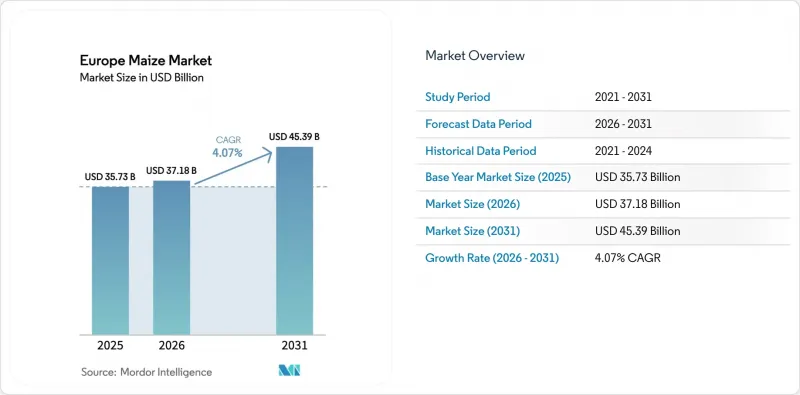
This report is Segmented by Geography (Ukraine, France, Italy, Germany, Romania, and More). The Report Includes Production Analysis (Volume), Consumption Analysis (Value and Volume), Export Analysis (Value and Volume), Import Analysis (Value and Volume), Wholesale Price Trend Analysis and Forecast, List of Key Players, and More. The Market Forecasts are Provided in Terms of Value (USD) and Volume (Metric Tons).
Europe Maize Market Trends and Insights
High-Yield Hybrid Adoption
Genetic gains from proprietary breeding programs are raising on-farm yields by 1-2% each year as Corteva Agriscience, Bayer AG, KWS SAAT SE & Co. KGaA, and Syngenta Group introduce stacked insect resistance and herbicide tolerance suited to local climates. Corteva Agriscience's Qrome hybrids now cover 15% of French acres and deliver stable performance under variable rainfall. Bayer AG combines Dekalb germplasm with the Climate FieldView platform so growers can fine-tune nitrogen timing, a practice already common in Lower Saxony. KWS SAAT SE & Co. KGaA opened additional breeding stations in Mediterranean zones during 2025 to fast-track drought-tolerant lines, while Syngenta Group prioritizes early maturity for northern latitudes. Although cost premiums of EUR 80-120 per hectare (USD 86.4-129.6) deter some Romanian and Polish growers, cooperative seed financing and contract farming are improving access to these markets.
Bioethanol Blending Mandate Expansion
The Renewable Energy Directive II caps crop-based feedstocks at the 2020 baseline plus 1% point, which holds the Europe maize market demand for ethanol near 5-6 million metric tons through 2031. E10 gasoline blends continue to roll out, yet new volume growth must come from advanced biofuels rather than additional grain. France and Germany host the continent's largest ethanol plants operated by CropEnergies and Tereos, and both rely on stable procurement contracts to guarantee supply. Because eligibility for the new 65% greenhouse gas savings threshold favors high-yield areas with efficient input use, the directive reinforces demand concentration in France's Beauce plain and Spain's Ebro valley.
War-Time Supply-Chain Disruptions
Ukrainian maize exports decreased significantly in 2024-2025 due to the termination of the Black Sea Grain Initiative. This has redirected grain shipments through the Danube corridor, where additional freight costs amount to EUR 15-25 per metric ton (USD 16.2-27). The port of Constanta has been operating above its rated capacity, while import bans in neighboring countries have disrupted single-market trade flows. Damaged silos and mined farmland are projected to hinder Ukraine's recovery, limiting its ability to meet export demands. As a result, European Union processors are willing to shift toward South American suppliers, despite ocean freight premiums of USD 30-40 per metric tons. This shift may lead to increased competition for South American maize, potentially driving up prices. Persistent logistical uncertainties, along with these challenges, are projected to lower the growth forecast for the Europe maize market.
Other drivers and restraints analyzed in the detailed report include:
- Livestock Feed Demand Recovery
- Water-Efficient Precision Farming
- Rising Farm-Gate Labor Costs
For complete list of drivers and restraints, kindly check the Table Of Contents.
Complete Report Scope:
- By Geography
- Ukraine
- Production Analysis (Area Harvested, Yield, and Production Volume)
- Consumption Analysis (Consumption Value and Volume)
- Import Market Analysis (Import Value, Volume, and Key Supplying Markets)
- Export Market Analysis (Export Value, Volume, and Key Destination Markets)
- Wholesale Price Trend Analysis and Forecast
- Regulatory Framework
- List of Key Players
- Logistics and Infrastructure
- Seasonality Analysis
- Germany
- Production Analysis (Area Harvested, Yield, and Production Volume)
- Consumption Analysis (Consumption Value and Volume)
- Import Market Analysis (Import Value, Volume, and Key Supplying Markets)
- Export Market Analysis (Export Value, Volume, and Key Destination Markets)
- Wholesale Price Trend Analysis and Forecast
- Regulatory Framework
- List of Key Players
- Logistics and Infrastructure
- Seasonality Analysis
- France
- Production Analysis (Area Harvested, Yield, and Production Volume)
- Consumption Analysis (Consumption Value and Volume)
- Import Market Analysis (Import Value, Volume, and Key Supplying Markets)
- Export Market Analysis (Export Value, Volume, and Key Destination Markets)
- Wholesale Price Trend Analysis and Forecast
- Regulatory Framework
- List of Key Players
- Logistics and Infrastructure
- Seasonality Analysis
- Italy
- Production Analysis (Area Harvested, Yield, and Production Volume)
- Consumption Analysis (Consumption Value and Volume)
- Import Market Analysis (Import Value, Volume, and Key Supplying Markets)
- Export Market Analysis (Export Value, Volume, and Key Destination Markets)
- Wholesale Price Trend Analysis and Forecast
- Regulatory Framework
- List of Key Players
- Logistics and Infrastructure
- Seasonality Analysis
- Romania
- Production Analysis (Area Harvested, Yield, and Production Volume)
- Consumption Analysis (Consumption Value and Volume)
- Import Market Analysis (Import Value, Volume, and Key Supplying Markets)
- Export Market Analysis (Export Value, Volume, and Key Destination Markets)
- Wholesale Price Trend Analysis and Forecast
- Regulatory Framework
- List of Key Players
- Logistics and Infrastructure
- Seasonality Analysis
- Poland
- Production Analysis (Area Harvested, Yield, and Production Volume)
- Consumption Analysis (Consumption Value and Volume)
- Import Market Analysis (Import Value, Volume, and Key Supplying Markets)
- Export Market Analysis (Export Value, Volume, and Key Destination Markets)
- Wholesale Price Trend Analysis and Forecast
- Regulatory Framework
- List of Key Players
- Logistics and Infrastructure
- Seasonality Analysis
- Spain
- Production Analysis (Area Harvested, Yield, and Production Volume)
- Consumption Analysis (Consumption Value and Volume)
- Import Market Analysis (Import Value, Volume, and Key Supplying Markets)
- Export Market Analysis (Export Value, Volume, and Key Destination Markets)
- Wholesale Price Trend Analysis and Forecast
- Regulatory Framework
- List of Key Players
- Logistics and Infrastructure
- Seasonality Analysis
- Ukraine
Additional Benefits:
- The market estimate (ME) sheet in Excel format
- 3 months of analyst support
TABLE OF CONTENTS
1 Introduction
- 1.1 Study Assumptions and Market Definition
- 1.2 Scope of the Study
2 Research Methodology
3 Executive Summary
4 Market Landscape
- 4.1 Market Overview
- 4.2 Market Drivers
- 4.2.1 High-Yield Hybrid Adoption
- 4.2.2 Bioethanol Blending Mandate Expansion
- 4.2.3 Livestock Feed Demand Recovery
- 4.2.4 Water-Efficient Precision Farming
- 4.2.5 Contract Farming with Multinationals
- 4.2.6 Port Logistics Modernization
- 4.3 Market Restraints
- 4.3.1 War-Time Supply-Chain Disruptions
- 4.3.2 Rising Farm-Gate Labor Costs
- 4.3.3 Land-Fragmentation Inefficiencies
- 4.3.4 Volatile Energy Prices for Drying
- 4.4 Opportunities
- 4.5 Challenges
- 4.6 Value Chain Analysis
- 4.7 Technologies and Usage of AI in the Industry
- 4.8 Input Market Analysis
- 4.8.1 Seeds
- 4.8.2 Fertilizers
- 4.8.3 Crop Protection Chemicals
- 4.9 Distribution Channel Analysis
- 4.10 Market Sentiment Analysis
- 4.11 PESTLE Analysis
5 Market Size and Growth Forecasts (Value and Volume)
- 5.1 By Geography
- 5.1.1 Ukraine
- 5.1.1.1 Production Analysis (Area Harvested, Yield, and Production Volume)
- 5.1.1.2 Consumption Analysis (Consumption Value and Volume)
- 5.1.1.3 Import Market Analysis (Import Value, Volume, and Key Supplying Markets)
- 5.1.1.4 Export Market Analysis (Export Value, Volume, and Key Destination Markets)
- 5.1.1.5 Wholesale Price Trend Analysis and Forecast
- 5.1.1.6 Regulatory Framework
- 5.1.1.7 List of Key Players
- 5.1.1.8 Logistics and Infrastructure
- 5.1.1.9 Seasonality Analysis
- 5.1.2 Germany
- 5.1.2.1 Production Analysis (Area Harvested, Yield, and Production Volume)
- 5.1.2.2 Consumption Analysis (Consumption Value and Volume)
- 5.1.2.3 Import Market Analysis (Import Value, Volume, and Key Supplying Markets)
- 5.1.2.4 Export Market Analysis (Export Value, Volume, and Key Destination Markets)
- 5.1.2.5 Wholesale Price Trend Analysis and Forecast
- 5.1.2.6 Regulatory Framework
- 5.1.2.7 List of Key Players
- 5.1.2.8 Logistics and Infrastructure
- 5.1.2.9 Seasonality Analysis
- 5.1.3 France
- 5.1.3.1 Production Analysis (Area Harvested, Yield, and Production Volume)
- 5.1.3.2 Consumption Analysis (Consumption Value and Volume)
- 5.1.3.3 Import Market Analysis (Import Value, Volume, and Key Supplying Markets)
- 5.1.3.4 Export Market Analysis (Export Value, Volume, and Key Destination Markets)
- 5.1.3.5 Wholesale Price Trend Analysis and Forecast
- 5.1.3.6 Regulatory Framework
- 5.1.3.7 List of Key Players
- 5.1.3.8 Logistics and Infrastructure
- 5.1.3.9 Seasonality Analysis
- 5.1.4 Italy
- 5.1.4.1 Production Analysis (Area Harvested, Yield, and Production Volume)
- 5.1.4.2 Consumption Analysis (Consumption Value and Volume)
- 5.1.4.3 Import Market Analysis (Import Value, Volume, and Key Supplying Markets)
- 5.1.4.4 Export Market Analysis (Export Value, Volume, and Key Destination Markets)
- 5.1.4.5 Wholesale Price Trend Analysis and Forecast
- 5.1.4.6 Regulatory Framework
- 5.1.4.7 List of Key Players
- 5.1.4.8 Logistics and Infrastructure
- 5.1.4.9 Seasonality Analysis
- 5.1.5 Romania
- 5.1.5.1 Production Analysis (Area Harvested, Yield, and Production Volume)
- 5.1.5.2 Consumption Analysis (Consumption Value and Volume)
- 5.1.5.3 Import Market Analysis (Import Value, Volume, and Key Supplying Markets)
- 5.1.5.4 Export Market Analysis (Export Value, Volume, and Key Destination Markets)
- 5.1.5.5 Wholesale Price Trend Analysis and Forecast
- 5.1.5.6 Regulatory Framework
- 5.1.5.7 List of Key Players
- 5.1.5.8 Logistics and Infrastructure
- 5.1.5.9 Seasonality Analysis
- 5.1.6 Poland
- 5.1.6.1 Production Analysis (Area Harvested, Yield, and Production Volume)
- 5.1.6.2 Consumption Analysis (Consumption Value and Volume)
- 5.1.6.3 Import Market Analysis (Import Value, Volume, and Key Supplying Markets)
- 5.1.6.4 Export Market Analysis (Export Value, Volume, and Key Destination Markets)
- 5.1.6.5 Wholesale Price Trend Analysis and Forecast
- 5.1.6.6 Regulatory Framework
- 5.1.6.7 List of Key Players
- 5.1.6.8 Logistics and Infrastructure
- 5.1.6.9 Seasonality Analysis
- 5.1.7 Spain
- 5.1.7.1 Production Analysis (Area Harvested, Yield, and Production Volume)
- 5.1.7.2 Consumption Analysis (Consumption Value and Volume)
- 5.1.7.3 Import Market Analysis (Import Value, Volume, and Key Supplying Markets)
- 5.1.7.4 Export Market Analysis (Export Value, Volume, and Key Destination Markets)
- 5.1.7.5 Wholesale Price Trend Analysis and Forecast
- 5.1.7.6 Regulatory Framework
- 5.1.7.7 List of Key Players
- 5.1.7.8 Logistics and Infrastructure
- 5.1.7.9 Seasonality Analysis
- 5.1.1 Ukraine
6 End Use Applications and Industries
- 6.1 Primary Applications and Emerging Applications
- 6.2 Consumption Breakdown by Industries
7 Competitive Landscape
- 7.1 Overview of the Competition
- 7.2 Recent Developments
- 7.3 Market Concentration Analysis
8 Market Opportunities and Future Outlook

