PUBLISHER: Mordor Intelligence | PRODUCT CODE: 2121798

PUBLISHER: Mordor Intelligence | PRODUCT CODE: 2121798
Africa Maize - Market Share Analysis, Industry Trends & Statistics, Growth Forecasts (2026 - 2031)
According to Mordor Intelligence, the Africa maize market size was valued at USD 44.5 billion in 2025 and estimated to grow from USD 46.98 billion in 2026 to reach USD 61.64 billion by 2031, at a CAGR of 5.58% during the forecast period (2026-2031).
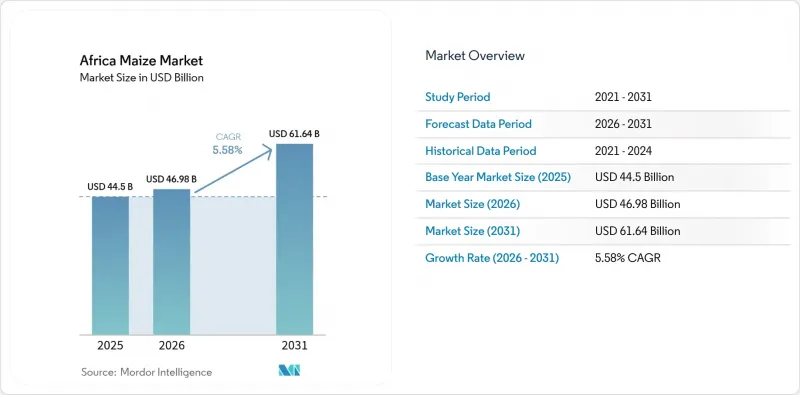
This report is Segmented by Geography (Nigeria, South Africa, Ethiopia, and More). The Report Offers Production Analysis (Volume), Consumption Analysis (Volume and Value), Import Analysis (Volume and Value), Export Analysis (Volume and Value), Wholesale Price Trend Analysis and Forecast, and More. The Report Offers the Market Size and Forecast in Both Value (USD) and Volume (Metric Tons).
Africa Maize Market Trends and Insights
Population-Driven Food-Grain Demand Surge
Between 2020 and 2025, Africa's urban population grew significantly. This growth led to an increase in maize meal consumption in countries like Nigeria and Ethiopia. In Sub-Saharan Africa, maize serves as a vital staple food, with demand projected to rise by over 300% by 2050. Urban centers, with their concentrated purchasing power, are leaning towards factory-milled, vitamin-fortified flour. This trend is boosting profit margins for processors who prioritize shelf stability. To stabilize retail prices and mitigate civil unrest, Nigeria implemented a price ceiling, a measure that held firm through December 2025. Ethiopian cities saw a rise in maize consumption after the government redirected wheat subsidies to bolster local cereals. With projections indicating Africa's urban populace will continue to grow, the continent's maize consumption value market is poised to thrive.
Expansion of Compound Animal Feed Mills
Nigeria expanded its poultry population, while aquaculture growth in Ghana increased the demand for yellow maize. Integrators adjusted maize inclusion in broiler feed formulations to address foreign exchange fluctuations. South Africa leads the market with major producers such as Meadow Feeds, Epol (RCL Foods), and AFGRI, collectively producing approximately 11 million metric tons of compound feed annually. South African feed mills favored yellow maize over white maize due to its higher energy density. According to the National Agriculture Production Report 2025 by the Kenya National Bureau of Statistics (KNBS), maize cultivation in Kenya spanned 2.41 million hectares, yielding 4.03 million metric tons. In Kenya, dairy cooperatives improved yields by combining maize silage with Napier grass. In Uganda, fish farms incorporated maize into their feed, reflecting the link between Africa's maize consumption and the growing demand for protein. Additionally, De Heus has made notable investments in East and West Africa, including a 240,000-metric-ton plant in Kenya set for completion in 2026 and a new aqua feed factory in Uganda.
Fall Armyworm and Emerging Pest Pressures
The fall armyworm(FAW) is a significant pest affecting Africa's farming systems. Yield losses in maize have been reported to have reached up to 58% due to its impact, worth annual economic losses of USD 9.4 billion. Infestations severely impacted maize production, forcing farmers to rely heavily on insecticides in the previous few years. However, most chemical pesticides are highly toxic to the environment, and the FAW insect has the ability to develop resistance to many available pesticides, thereby reducing their effectiveness. According to a study conducted in December 2025 on the impact of fall armyworm (FAW) infestation on nutrition security outcomes in eastern Uganda, low FAW intensity led to a reduction in maize sales by 122 kg, while high FAW intensity caused a decrease of 265 kg. Nigeria introduced bio-fortified hybrids with partial resistance, but adoption remained low due to slow seed multiplication. In Kenya, push-pull intercropping significantly reduced larval density, though scaling its impact requires broader extension efforts. Tanzania approved biopesticides as cost-effective alternatives to pyrethroids, which are increasingly facing resistance.
Other drivers and restraints analyzed in the detailed report include:
- National Subsidy and E-Voucher Programs
- Rise of Starch-Based Biomaterials and Bioplastics
- High Post-Harvest Losses in Storage and Logistics
For complete list of drivers and restraints, kindly check the Table Of Contents.
Complete Report Scope:
- Geography
- Nigeria
- Production Analysis (Production Volume)
- Consumption Analysis (Consumption Value and Volume)
- Import Market Analysis (Import Value, Volume, and Key Supplying Markets)
- Export Market Analysis (Export Value, Volume, and Key Destination Markets)
- Wholesale Price Trend Analysis and Forecast
- Regulatory Framework
- List of Key Players
- Logistics and Infrastructure
- Seasonality Analysis
- South Africa
- Production Analysis (Production Volume)
- Consumption Analysis (Consumption Value and Volume)
- Import Market Analysis (Import Value, Volume, and Key Supplying Markets)
- Export Market Analysis (Export Value, Volume, and Key Destination Markets)
- Wholesale Price Trend Analysis and Forecast
- Regulatory Framework
- List of Key Players
- Logistics and Infrastructure
- Seasonality Analysis
- Ethiopia
- Production Analysis (Production Volume)
- Consumption Analysis (Consumption Value and Volume)
- Import Market Analysis (Import Value, Volume, and Key Supplying Markets)
- Export Market Analysis (Export Value, Volume, and Key Destination Markets)
- Wholesale Price Trend Analysis and Forecast
- Regulatory Framework
- List of Key Players
- Logistics and Infrastructure
- Seasonality Analysis
- Tanzania
- Production Analysis (Production Volume)
- Consumption Analysis (Consumption Value and Volume)
- Import Market Analysis (Import Value, Volume, and Key Supplying Markets)
- Export Market Analysis (Export Value, Volume, and Key Destination Markets)
- Wholesale Price Trend Analysis and Forecast
- Regulatory Framework
- List of Key Players
- Logistics and Infrastructure
- Seasonality Analysis
- Kenya
- Production Analysis (Production Volume)
- Consumption Analysis (Consumption Value and Volume)
- Import Market Analysis (Import Value, Volume, and Key Supplying Markets)
- Export Market Analysis (Export Value, Volume, and Key Destination Markets)
- Wholesale Price Trend Analysis and Forecast
- Regulatory Framework
- List of Key Players
- Logistics and Infrastructure
- Seasonality Analysis
- Uganda
- Production Analysis (Production Volume)
- Consumption Analysis (Consumption Value and Volume)
- Import Market Analysis (Import Value, Volume, and Key Supplying Markets)
- Export Market Analysis (Export Value, Volume, and Key Destination Markets)
- Wholesale Price Trend Analysis and Forecast
- Regulatory Framework
- List of Key Players
- Logistics and Infrastructure
- Seasonality Analysis
- Nigeria
Additional Benefits:
- The market estimate (ME) sheet in Excel format
- 3 months of analyst support
TABLE OF CONTENTS
1 Introduction
- 1.1 Study Assumptions and Market Definition
- 1.2 Scope of the Study
2 Research Methodology
3 Executive Summary
4 Market Landscape
- 4.1 Market Overview
- 4.2 Market Drivers
- 4.2.1 Population-driven food-grain demand surge
- 4.2.2 Expansion of compound animal feed mills
- 4.2.3 National subsidy and e-voucher programs
- 4.2.4 Rise of starch-based biomaterials and bioplastics
- 4.2.5 Adoption of digital agronomy for yield gains
- 4.2.6 Soil-carbon credit revenue streams
- 4.3 Market Restraints
- 4.3.1 Fall Armyworm and emerging pest pressures
- 4.3.2 High post-harvest losses in storage and logistics
- 4.3.3 Soil nutrient depletion and micronutrient gaps
- 4.3.4 Fertilizer price volatility for smallholders
- 4.4 Opportunities
- 4.5 Challenges
- 4.6 Value Chain Analysis
- 4.7 Technologies and usage of AI in the Industry
- 4.8 Input Market Analysis
- 4.8.1 Seeds
- 4.8.2 Fertilizers
- 4.8.3 Crop Protection Chemicals
- 4.9 Distribution Channel Analysis
- 4.10 Market Sentiment Analysis
- 4.11 PESTLE Analysis
5 Market Size and Growth Forecasts (Value and Volume)
- 5.1 Geography
- 5.1.1 Nigeria
- 5.1.1.1 Production Analysis (Production Volume)
- 5.1.1.2 Consumption Analysis (Consumption Value and Volume)
- 5.1.1.3 Import Market Analysis (Import Value, Volume, and Key Supplying Markets)
- 5.1.1.4 Export Market Analysis (Export Value, Volume, and Key Destination Markets)
- 5.1.1.5 Wholesale Price Trend Analysis and Forecast
- 5.1.1.6 Regulatory Framework
- 5.1.1.7 List of Key Players
- 5.1.1.8 Logistics and Infrastructure
- 5.1.1.9 Seasonality Analysis
- 5.1.2 South Africa
- 5.1.2.1 Production Analysis (Production Volume)
- 5.1.2.2 Consumption Analysis (Consumption Value and Volume)
- 5.1.2.3 Import Market Analysis (Import Value, Volume, and Key Supplying Markets)
- 5.1.2.4 Export Market Analysis (Export Value, Volume, and Key Destination Markets)
- 5.1.2.5 Wholesale Price Trend Analysis and Forecast
- 5.1.2.6 Regulatory Framework
- 5.1.2.7 List of Key Players
- 5.1.2.8 Logistics and Infrastructure
- 5.1.2.9 Seasonality Analysis
- 5.1.3 Ethiopia
- 5.1.3.1 Production Analysis (Production Volume)
- 5.1.3.2 Consumption Analysis (Consumption Value and Volume)
- 5.1.3.3 Import Market Analysis (Import Value, Volume, and Key Supplying Markets)
- 5.1.3.4 Export Market Analysis (Export Value, Volume, and Key Destination Markets)
- 5.1.3.5 Wholesale Price Trend Analysis and Forecast
- 5.1.3.6 Regulatory Framework
- 5.1.3.7 List of Key Players
- 5.1.3.8 Logistics and Infrastructure
- 5.1.3.9 Seasonality Analysis
- 5.1.4 Tanzania
- 5.1.4.1 Production Analysis (Production Volume)
- 5.1.4.2 Consumption Analysis (Consumption Value and Volume)
- 5.1.4.3 Import Market Analysis (Import Value, Volume, and Key Supplying Markets)
- 5.1.4.4 Export Market Analysis (Export Value, Volume, and Key Destination Markets)
- 5.1.4.5 Wholesale Price Trend Analysis and Forecast
- 5.1.4.6 Regulatory Framework
- 5.1.4.7 List of Key Players
- 5.1.4.8 Logistics and Infrastructure
- 5.1.4.9 Seasonality Analysis
- 5.1.5 Kenya
- 5.1.5.1 Production Analysis (Production Volume)
- 5.1.5.2 Consumption Analysis (Consumption Value and Volume)
- 5.1.5.3 Import Market Analysis (Import Value, Volume, and Key Supplying Markets)
- 5.1.5.4 Export Market Analysis (Export Value, Volume, and Key Destination Markets)
- 5.1.5.5 Wholesale Price Trend Analysis and Forecast
- 5.1.5.6 Regulatory Framework
- 5.1.5.7 List of Key Players
- 5.1.5.8 Logistics and Infrastructure
- 5.1.5.9 Seasonality Analysis
- 5.1.6 Uganda
- 5.1.6.1 Production Analysis (Production Volume)
- 5.1.6.2 Consumption Analysis (Consumption Value and Volume)
- 5.1.6.3 Import Market Analysis (Import Value, Volume, and Key Supplying Markets)
- 5.1.6.4 Export Market Analysis (Export Value, Volume, and Key Destination Markets)
- 5.1.6.5 Wholesale Price Trend Analysis and Forecast
- 5.1.6.6 Regulatory Framework
- 5.1.6.7 List of Key Players
- 5.1.6.8 Logistics and Infrastructure
- 5.1.6.9 Seasonality Analysis
- 5.1.1 Nigeria
6 End Use Applications and Industries
- 6.1 Primary Applications and Emerging Applications
- 6.2 Consumption Breakdown by Industries
7 Competitive Landscape
- 7.1 Overview of the Competition
- 7.2 Recent Developments
- 7.3 Market Concentration Analysis
8 Market Opportunities and Future Outlook

