PUBLISHER: Mordor Intelligence | PRODUCT CODE: 2113437

PUBLISHER: Mordor Intelligence | PRODUCT CODE: 2113437
South And Central America Smart Meters - Market Share Analysis, Industry Trends & Statistics, Growth Forecasts (2026 - 2031)
According to Mordor Intelligence, South and Central America Smart Meters Market size in 2026 is estimated at USD 2.12 billion, growing from 2025 value of USD 1.98 billion with 2031 projections showing USD 2.99 billion, growing at 7.11% CAGR over 2026-2031.
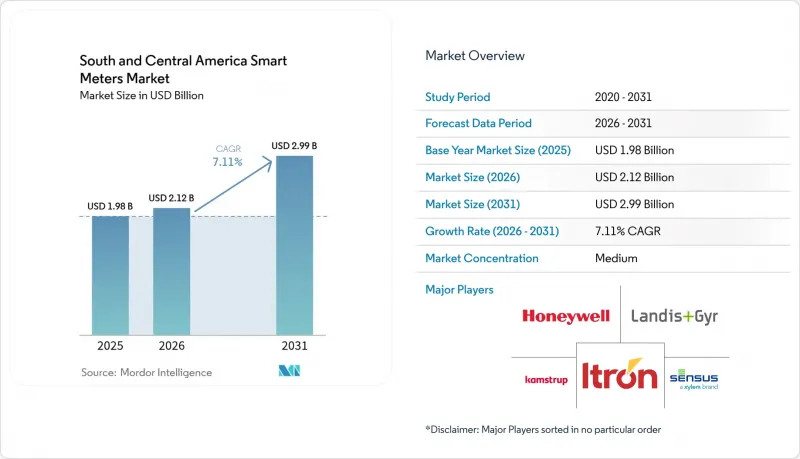
This report is Segmented by Meter Type (Smart Electricity Meters, Smart Water Meters, Smart Gas Meters), Communication Technology (RF Mesh, PLC, Cellular IoT), End-User Industry (Residential, Commercial, Industrial), and Country. The Market Forecasts are Provided in Terms of Value (USD) and Volume (Shipments).
South And Central America Smart Meters Market Trends and Insights
Rising Investments in AMI-Ready Smart-Grid Projects
Utilities are accelerating capital expenditure on modern AMI platforms to retire electromechanical meters, automate outage management, and support bi-directional power flows. Brazil's Copel deployed 500,000 smart meters in 2024, reporting a 20% cut in truck rolls and a measurable drop in peak-hour technical losses. Colombian and Chilean distribution firms are bundling AMI with feeder automation to maximize returns on network digitalization. Funding support from the Inter-American Development Bank eases debt burdens in high-interest environments, enabling utilities to spread capex over longer tenors. Cellular NB-IoT connectivity is gaining ground because it leverages existing towers, avoiding the up-front civil works tied to pole-top RF mesh repeaters. Collectively, these moves enlarge the smart meters market by pulling forward procurement decisions that previously hinged on tariff-review cycles.
National Net-Metering Mandates and Dynamic Tariff Programs
Brazil's ANEEL now obligates smart meters for every prosumer with >75 kW rooftop solar, a rule mirrored by ENRE in Argentina for self-managed distributed resources. Chile's time-of-use tariff regime further demands 15-minute interval data to bill consumers fairly under dynamic pricing. These rules force utilities to swap legacy AMR devices for AMI units able to log import-export energy flows in real time. The design shift enlarges the smart meters market because installations cannot be deferred until assets reach the end of life; they are legal prerequisites for grid interconnection. As new rooftop arrays go online, meter upgrades occur concurrently, creating a demand flywheel that supports component localization and job creation inside national meter factories.
High Upfront CAPEX and Long Pay-Back Periods
A full AMI refresh can cost USD 150-300 per meter, saddling utilities with nine-figure program budgets that stretch internal debt capacity. Currency volatility further amplifies cost risk because most electronic components are sourced in USD yet billed in local pesos or reais. Smaller municipal distributors hesitate to proceed unless regulators grant accelerated cost recovery in tariff plans, delaying penetration in secondary cities. Development banks offer concessional loans, but disbursement milestones sometimes clash with political election cycles that stall board approvals. The resulting lag subdues near-term growth for the smart meters market, even though the long-term business case remains intact.
Other drivers and restraints analyzed in the detailed report include:
- Migration from Electromechanical to Smart Pre-Paid Meters in Low-Income Areas
- Utilities' Drive to Curb Non-Technical Losses
- Cyber-Security Vulnerabilities in Legacy AMI Head-End Systems
For complete list of drivers and restraints, kindly check the Table Of Contents.
Segment Analysis
Smart electricity meters accounted for a 63.65% smart meters market share in 2025, while smart water meters delivered the highest 9.22% CAGR outlook through 2031. The electricity segment benefits from a decade of AMR experience that simplifies procurement specifications and installer training. Utilities exploit voltage sag analytics and phase-imbalance alarms to cut technical loss plus improve power-quality reporting to regulators. Water utilities, especially in drought-stricken Chile and Peru, are fast-tracking ultrasonic meters fitted with acoustic leakage modules that immediately expose bursts and illegal taps. Because those utilities bill in local pesos but buy electronics in USD, meter suppliers increasingly locate assembly plants inside Mercosur zones to hedge forex swings. Smart gas meters form a nascent slice of the smart meters market size, but hydrogen-compatible variants now appear in pilot microgrids serving industrial clusters in Argentina's Rio Negro province.
The electricity segment's maturity anchors vendor revenue, but hardware replacement cycles every 10-12 years open room for value-added upgrades such as edge AI anomaly detection and over-the-air tariff table pushes. In the water space, leak analytics slash non-revenue water from 45% to 30%, freeing operating cash that funds meter-as-a-service contracts. Although gas networks remain limited outside Argentina and Brazil, industrial customers that face ESG pressure are demanding transparent hydrogen flow measurement, attracting niche suppliers and prompting standards bodies to define hydrogen measuring protocols. These combined trends reinforce the widening breadth of the overarching smart meters market.
Complete Report Scope:
- By Meter Type
- Smart Electricity Meters
- Smart Water Meters
- Smart Gas Meters
- By Communication Technology
- RF Mesh
- PLC
- Cellular IoT (NB-IoT, LTE-M)
- By End-user Industry
- Residential
- Commercial
- Industrial
- By Country
- Brazil
- Argentina
- Chile
- Colombia
- Rest of South and Central America
List of Companies Covered in this Report:
- Landis+Gyr Group AG
- Itron Inc.
- Honeywell International Inc.(Elster)
- Sensus (Xylem)
- Kamstrup A/S
- Diehl Metering GmbH
- Wasion Holdings Limited
- Aclara Technologies LLC
- EDMI Limited
- Hexing Electrical Co., Ltd.
- Holley Technology Ltd.
- Siemens AG
- Sagemcom SAS
- Arad Group
- Zenner International GmbH & Co. KG
- Badger Meter Inc.
- AEM Metering S.r.l.
Additional Benefits:
- The market estimate (ME) sheet in Excel format
- 3 months of analyst support
TABLE OF CONTENTS
1 INTRODUCTION
- 1.1 Study Assumptions and Market Definition
- 1.2 Scope of the Study
2 RESEARCH METHODOLOGY
3 EXECUTIVE SUMMARY
4 MARKET LANDSCAPE
- 4.1 Market Overview
- 4.2 Market Drivers
- 4.2.1 Rising investments in AMI-ready smart-grid projects
- 4.2.2 National net-metering mandates and dynamic tariff programs
- 4.2.3 Migration from electromechanical to smart pre-paid meters in low-income areas
- 4.2.4 Utilities' drive to curb non-technical losses
- 4.2.5 Green hydrogen pilots creating demand for advanced gas meters
- 4.2.6 Real-time leakage analytics in drought-prone regions boosting smart-water roll-outs
- 4.3 Market Restraints
- 4.3.1 High upfront CAPEX and long pay-back periods
- 4.3.2 Cyber-security vulnerabilities in legacy AMI head-end systems
- 4.3.3 Patchy cellular IoT coverage outside tier-1 cities
- 4.3.4 Delays in spectrum allocation for PLC/RF mesh backhaul
- 4.4 Value Chain Analysis
- 4.5 Regulatory Landscape
- 4.6 Porter's Five Forces Analysis
- 4.6.1 Bargaining Power of Suppliers
- 4.6.2 Bargaining Power of Consumers
- 4.6.3 Threat of New Entrants
- 4.6.4 Intensity of Competitive Rivalry
- 4.6.5 Threat of Substitutes
5 MARKET SIZE AND GROWTH FORECASTS (VALUE)
- 5.1 By Meter Type
- 5.1.1 Smart Electricity Meters
- 5.1.2 Smart Water Meters
- 5.1.3 Smart Gas Meters
- 5.2 By Communication Technology
- 5.2.1 RF Mesh
- 5.2.2 PLC
- 5.2.3 Cellular IoT (NB-IoT, LTE-M)
- 5.3 By End-user Industry
- 5.3.1 Residential
- 5.3.2 Commercial
- 5.3.3 Industrial
- 5.4 By Country
- 5.4.1 Brazil
- 5.4.2 Argentina
- 5.4.3 Chile
- 5.4.4 Colombia
- 5.4.5 Rest of South and Central America
6 COMPETITIVE LANDSCAPE
- 6.1 Market Concentration
- 6.2 Strategic Moves
- 6.3 Market Share Analysis
- 6.4 Company Profiles (includes Global level Overview, Market level overview, Core Segments, Financials as available, Strategic Information, Market Rank/Share for key companies, Products and Services, and Recent Developments)
- 6.4.1 Landis+Gyr Group AG
- 6.4.2 Itron Inc.
- 6.4.3 Honeywell International Inc.(Elster)
- 6.4.4 Sensus (Xylem)
- 6.4.5 Kamstrup A/S
- 6.4.6 Diehl Metering GmbH
- 6.4.7 Wasion Holdings Limited
- 6.4.8 Aclara Technologies LLC
- 6.4.9 EDMI Limited
- 6.4.10 Hexing Electrical Co., Ltd.
- 6.4.11 Holley Technology Ltd.
- 6.4.12 Siemens AG
- 6.4.13 Sagemcom SAS
- 6.4.14 Arad Group
- 6.4.15 Zenner International GmbH & Co. KG
- 6.4.16 Badger Meter Inc.
- 6.4.17 AEM Metering S.r.l.
7 MARKET OPPORTUNITIES AND FUTURE OUTLOOK
- 7.1 White-space and Unmet-Need Assessment

