PUBLISHER: Mordor Intelligence | PRODUCT CODE: 2121649

PUBLISHER: Mordor Intelligence | PRODUCT CODE: 2121649
Middle East And Africa Smart Meters - Market Share Analysis, Industry Trends & Statistics, Growth Forecasts (2026 - 2031)
According to Mordor Intelligence, the Middle East and Africa smart meters market size is expected to grow from USD 25.42 billion in 2025 to USD 27.61 billion in 2026 and is forecast to reach USD 41.76 billion by 2031 at 8.62% CAGR over 2026-2031.
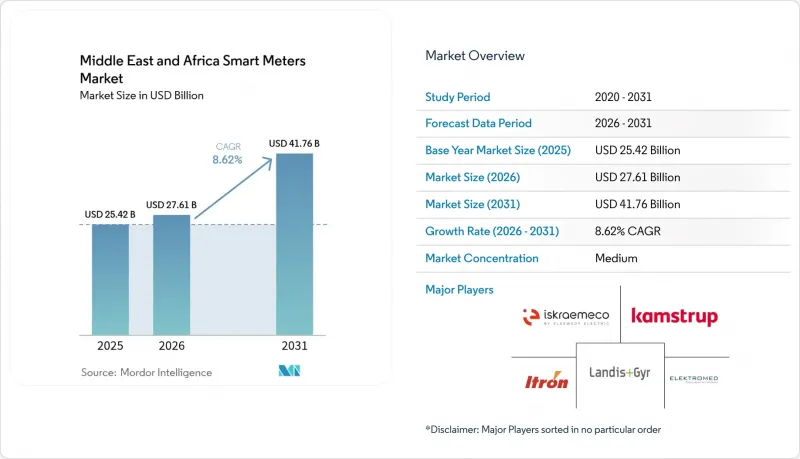
This report is Segmented by End User (Residential, Commercial, and Industrial), Meter Type (Smart Electricity Meters, Smart Gas Meters, and Smart Water Meters), Communication Technology (RF Mesh, Power Line Communication, and Cellular), Phase (Single-Phase, and Three-Phase), and Geography (Middle East, and Africa). The Market Forecasts are Provided in Terms of Value (USD).
Middle East And Africa Smart Meters Market Trends and Insights
Rapid utility push for energy efficiency to reduce AT and C losses
Utilities across the Middle East and Africa lose 15-25% of supplied electricity to technical and commercial inefficiencies, an unacceptable revenue drain that elevates smart-meter programs to strategic priority. Nigeria's distribution companies launched a 1.4-million-meter initiative in 2024 to target theft hotspots, while Zimbabwe accelerated its own installations to tighten billing accuracy. In parallel, Gulf efficiency-label regulations demand granular consumption evidence, so utilities increasingly treat smart-meter data as the compliance backbone. The resulting procurement surge enlarges the Middle East and Africa smart meters market, encourages multi-vendor tenders, and positions analytics services as high-value add-ons. Utilities that quantify loss reductions faster secure tariff-review advantages, amplifying first-mover benefits across the region.
Government mandates and incentives for smart-meter rollouts
Regulatory shifts from voluntary to mandatory deployments create a powerful demand floor. South Africa's National Regulatory System 049:2016 sets advanced-metering specifications, and Cape Town now requires smart meters in new buildings. The Gulf Cooperation Council's G-Mark certification aligns multi-country technical standards, slashing vendor compliance costs and accelerating shipments. Egypt's refreshed IoT framework clears cellular-meter ambiguity, a previous bottleneck. As mandates widen, the Middle East and Africa smart meters market gains predictability that helps financiers back long-term rollouts, even in utilities with constrained balance sheets. Subsidy schemes covering up-front device costs further widen the addressable customer base.
High upfront device and installation costs
Smart-meter hardware ranges from USD 50-150 per unit, and installation adds labour plus communication-network expenses. Sub-Saharan African utilities, often operating under currency volatility, face additional import-price swings that strain budgets. Lack of large-volume purchase power weakens their bargaining position relative to GCC peers. Certification fees from the Standard Transfer Specification Association raise compliance overheads for pre-paid solutions. Although donor-finance programs exist, disbursement timelines rarely align with meter-replacement cycles, prolonging reliance on legacy equipment and constraining the Middle East and Africa smart meters market in low-income regions.
Other drivers and restraints analyzed in the detailed report include:
- Smart city and IoT infrastructure investments
- Rising demand for precise billing and customer-engagement tools
- Limited utility CAPEX and financing constraints
For complete list of drivers and restraints, kindly check the Table Of Contents.
Segment Analysis
Industrial applications accounted for 12.22% CAGR growth potential, signalling the segment's role as the fastest-expanding component of the Middle East and Africa smart meters market size between 2026 and 2031. Industrial facilities including desalination plants, mines, and fast-growing manufacturing hubs in Saudi Arabia and the UAE require granular energy data to optimize production processes and integrate on-site renewables. These requirements stimulate demand for three-phase bi-directional meters capable of power-quality analytics, pushing average selling prices above the residential range and boosting overall revenue contribution. Vision 2030 agendas across Gulf economies strengthen the order pipeline as utilities partner with industrial-estate developers to pre-install smart-meter infrastructure.
Residential deployments, holding a 46.31% share in 2025, remain core to volume shipments within the Middle East and Africa smart meters market. Mandated rollouts in Cape Town and GCC states, coupled with consumer demand for transparent billing, sustain steady unit growth. Affordability concerns in lower-income markets, however, temper residential conversion rates, prompting suppliers to introduce stripped-down prepaid variants. Commercial buildings sit between the two extremes, leveraging meters for demand-response participation and energy-efficiency certification. Together, the three user categories form a diversified demand canvas that insulates the overall market from cyclical stocks in any single sector.
Smart electricity meters commanded 60.85% of Middle East and Africa smart meters market share in 2025, reinforcing electricity's primacy in regional utility operations. They serve as the technological baseline and often anchor multi-utility platforms. Yet, smart water meters, forecast to post a 10.35% CAGR through 2031, gain momentum as desalination reliance and non-revenue water issues intensify financial pressures on water utilities. Ultrasonic and electromagnetic models that withstand harsh saline environments register robust bid volumes, especially in Oman and Israel.
Gas-meter adoption stays niche because pipeline infrastructure remains limited outside metropolitan pockets. Nevertheless, integrated electricity-water-gas platforms lower lifetime IT costs and make multi-commodity rollouts more attractive. The Middle East and Africa smart meters market size for water applications, while smaller today, exhibits the steepest trajectory, drawing specialized vendors into joint ventures with regional system integrators. Electricity-meter demand continues unabated due to ongoing grid-modernization mandates, but competitive margins narrow as hardware commoditizes, and value migrates to software analytics.
Complete Report Scope:
- By End User
- Residential
- Commercial
- Industrial
- By Meter Type
- Smart Electricity Meters
- Smart Gas Meters
- Smart Water Meters
- By Communication Technology
- RF Mesh
- Power Line Communication
- Cellular
- By Phase
- Single-Phase
- Three-Phase
- By Geography
- Middle East
- Saudi Arabia
- United Arab Emirates
- Qatar
- Kuwait
- Oman
- Bahrain
- Turkey
- Israel
- Jordan
- Lebanon
- Africa
- South Africa
- Egypt
- Nigeria
- Kenya
- Morocco
- Algeria
- Ghana
- Ethiopia
- Tanzania
- Middle East
List of Companies Covered in this Report:
- Landis+Gyr Group AG
- Kamstrup A/S
- Itron Inc.
- Iskraemeco d.d.
- Electromed Termikel Group
- Holley Technology Ltd.
- Hexing Electrical Co. Ltd.
- Sensus - Xylem Inc.
- Diehl Metering GmbH - FZE
- Sagemcom SAS
- Elster Group GmbH - Honeywell
- ADD Grup
- Aclara Technologies LLC
- Apator SA
- ZIV Automation
- Wasion Group Holdings Ltd.
- EDMI Limited
- Gridspertise S.r.l.
- Neptune Technology Group Inc.
- Networked Energy Services Corporation
Additional Benefits:
- The market estimate (ME) sheet in Excel format
- 3 months of analyst support
TABLE OF CONTENTS
1 INTRODUCTION
- 1.1 Study Assumptions and Market Definition
- 1.2 Scope of the Study
2 RESEARCH METHODOLOGY
3 EXECUTIVE SUMMARY
4 MARKET LANDSCAPE
- 4.1 Market Overview
- 4.2 Market Drivers
- 4.2.1 Rapid utility push for energy efficiency to reduce AT and C losses
- 4.2.2 Government mandates and incentives for smart meter rollouts
- 4.2.3 Smart city and IoT infrastructure investments
- 4.2.4 Rising demand for precise billing and customer engagement tools
- 4.2.5 Surge in distributed solar rooftop connections necessitating bi-directional metering
- 4.2.6 Desalination plant electrification driving water meter digitization
- 4.3 Market Restraints
- 4.3.1 High upfront device and installation costs
- 4.3.2 Limited utility CAPEX and financing constraints
- 4.3.3 Cybersecurity skill gap within regional utilities
- 4.3.4 Interoperability challenges between legacy AMR and new AMI architectures
- 4.4 Industry Value-Chain Analysis
- 4.5 Regulatory Landscape
- 4.6 Technological Outlook
- 4.7 Porter's Five Forces Analysis
- 4.7.1 Threat of New Entrants
- 4.7.2 Bargaining Power of Buyers
- 4.7.3 Bargaining Power of Suppliers
- 4.7.4 Threat of Substitute Products
- 4.7.5 Intensity of Competitive Rivalry
- 4.8 Impact of Macroeconomic Factors
5 MARKET SIZE AND GROWTH FORECASTS (VALUE)
- 5.1 By End User
- 5.1.1 Residential
- 5.1.2 Commercial
- 5.1.3 Industrial
- 5.2 By Meter Type
- 5.2.1 Smart Electricity Meters
- 5.2.2 Smart Gas Meters
- 5.2.3 Smart Water Meters
- 5.3 By Communication Technology
- 5.3.1 RF Mesh
- 5.3.2 Power Line Communication
- 5.3.3 Cellular
- 5.4 By Phase
- 5.4.1 Single-Phase
- 5.4.2 Three-Phase
- 5.5 By Geography
- 5.5.1 Middle East
- 5.5.1.1 Saudi Arabia
- 5.5.1.2 United Arab Emirates
- 5.5.1.3 Qatar
- 5.5.1.4 Kuwait
- 5.5.1.5 Oman
- 5.5.1.6 Bahrain
- 5.5.1.7 Turkey
- 5.5.1.8 Israel
- 5.5.1.9 Jordan
- 5.5.1.10 Lebanon
- 5.5.2 Africa
- 5.5.2.1 South Africa
- 5.5.2.2 Egypt
- 5.5.2.3 Nigeria
- 5.5.2.4 Kenya
- 5.5.2.5 Morocco
- 5.5.2.6 Algeria
- 5.5.2.7 Ghana
- 5.5.2.8 Ethiopia
- 5.5.2.9 Tanzania
- 5.5.1 Middle East
6 COMPETITIVE LANDSCAPE
- 6.1 Market Concentration
- 6.2 Strategic Moves
- 6.3 Market Share Analysis
- 6.4 Company Profiles (includes Global level Overview, Market level overview, Core Segments, Financials as available, Strategic Information, Market Rank/Share for key companies, Products and Services, and Recent Developments)
- 6.4.1 Landis+Gyr Group AG
- 6.4.2 Kamstrup A/S
- 6.4.3 Itron Inc.
- 6.4.4 Iskraemeco d.d.
- 6.4.5 Electromed Termikel Group
- 6.4.6 Holley Technology Ltd.
- 6.4.7 Hexing Electrical Co. Ltd.
- 6.4.8 Sensus - Xylem Inc.
- 6.4.9 Diehl Metering GmbH - FZE
- 6.4.10 Sagemcom SAS
- 6.4.11 Elster Group GmbH - Honeywell
- 6.4.12 ADD Grup
- 6.4.13 Aclara Technologies LLC
- 6.4.14 Apator SA
- 6.4.15 ZIV Automation
- 6.4.16 Wasion Group Holdings Ltd.
- 6.4.17 EDMI Limited
- 6.4.18 Gridspertise S.r.l.
- 6.4.19 Neptune Technology Group Inc.
- 6.4.20 Networked Energy Services Corporation
7 MARKET OPPORTUNITIES AND FUTURE OUTLOOK
- 7.1 White-space and unmet-need assessment

