PUBLISHER: Mordor Intelligence | PRODUCT CODE: 2113499

PUBLISHER: Mordor Intelligence | PRODUCT CODE: 2113499
Asia-Pacific Spirulina Extract - Market Share Analysis, Industry Trends & Statistics, Growth Forecasts (2026 - 2031)
According to Mordor Intelligence, the Asia-Pacific spirulina extract market size is expected to grow from USD 223.00 million in 2025 to USD 249.37 million in 2026 and is forecast to reach USD 436.12 million by 2031 at 11.83% CAGR over 2026-2031.
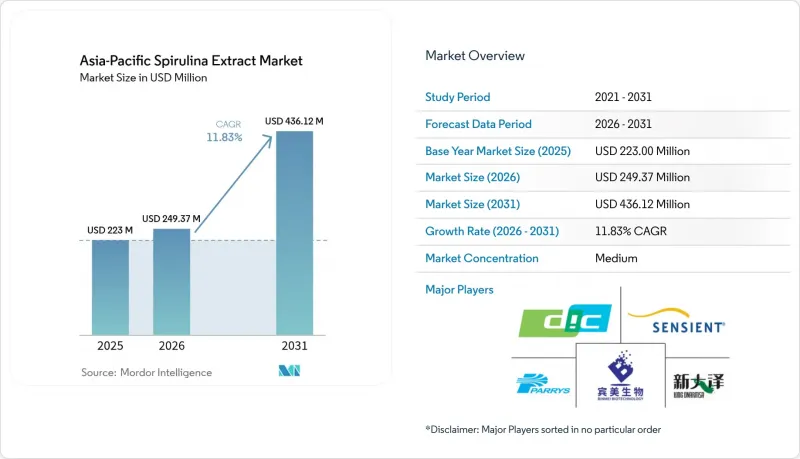
This report is Segmented by Nature (Organic, Conventional), Application (Food and Beverage, Pharmaceutical and Supplements, Animal Feed, Cosmetics and Personal Care, Others), and Geography (China, India, Japan, Australia, Indonesia, South Korea, Thailand, Rest of Asia-Pacific). The Market Forecasts are Provided in Terms of Value (USD).
Asia-Pacific Spirulina Extract Market Trends and Insights
Rising health and wellness focus, with consumers seeking nutrient-dense, antioxidant-rich ingredients
The increasing focus on health and wellness is driving the adoption of spirulina extract as a nutrient-dense, multifunctional ingredient across food, beverage, and supplement applications. With a high protein content of 55-70% and digestibility of 80-95%, spirulina extract serves as a compact nutritional booster for calorie-conscious and portion-controlled products, aligning with preventive health trends. Suppliers like DIC Corporation are enabling brands to fortify snacks, RTD beverages, and supplements with clean-label, whole-food microalgae sources. Standardized to contain 10-15 grams of phycocyanin per 100 grams dry weight, spirulina extract offers a consistent functional pigment that doubles as an antioxidant, supporting visual differentiation and wellness cues. Companies such as Far East Microalgae Industries (FEMICO) and E.I.D. Parry provides phycocyanin-focused portfolios for visually appealing products like blue and teal-toned beverages, jellies, and gummies. Japan and South Korea, with their advanced health and beauty cultures, are key markets where spirulina extract is used in functional foods targeting immunity, eye health, and metabolic support, as seen in DIC's solutions for aging populations. Clinical evidence highlighting spirulina's ability to enhance antioxidant enzymes and reduce inflammatory markers strengthens its appeal among consumers seeking measurable health outcomes. Brands like Cyanotech leverage this evidence to market spirulina-based supplements and powders for immunity and metabolic wellness. Additionally, spirulina's dual role as a natural colorant and bioactive carrier supports reformulation efforts to replace artificial colors while maintaining functionality, with companies like Fuqing King Dnarmsa Spirulina and Jiangshan Comp Spirulina meeting regulatory and sensory demands. The rise of precision nutrition further positions spirulina extract as a versatile ingredient for targeted formulations, such as diabetic-friendly drinks and anti-fatigue shots, offered by specialists like Necton and FEMICO. This convergence of health trends, clinical validation, and natural solutions is transforming spirulina extract into a strategic ingredient for evolving consumer needs.
Expanding use of spirulina extract in functional foods and beverages
Spirulina extract's role as a natural blue colorant and protein enhancer is driving its adoption in functional foods and beverages across the Asia-Pacific region. Companies are leveraging their dual benefits to enhance both the visual appeal and nutritional value of health-focused product lines. The U.S. FDA's progressive expansion of approved applications, covering alcoholic beverages under 20% ABV, non-alcoholic beverages, condiments, sauces, dips, dairy alternatives, salad dressings, and unheated seasoning mixes, provides a strong regulatory framework for Asia-Pacific manufacturers and export-oriented producers, ensuring compliance with global standards. This regulatory support aligns with the increasing consumption of health functional foods in South Korea, where approximately 82-83% of consumers or households purchased such products in 2024, as per the Korea Health Functional Food Association, highlighting the potential for spirulina-based ingredients in beverages, fermented dairy alternatives, and convenient snacks . Suppliers like Far East Bio-Tec (FEBICO), offering organic spirulina powders and tablets, enable manufacturers to create energy drinks, vegan products, and fortified bakery items, translating these trends into innovative offerings. The ability to incorporate spirulina extract into both low-alcohol RTD cocktails and non-alcoholic wellness beverages allows brands to develop cohesive "better-for-you" portfolios, with the natural blue color serving as a functional marker across diverse product formats. For manufacturers in South Korea and Japan targeting health-conscious consumers, spirulina extract offers opportunities to enhance beverages, sauces, and seasoning mixes with color, protein content, and perceived health benefits, encouraging repeat purchases. These factors collectively position spirulina extract as a cornerstone of functional food and beverage innovation in the Asia-Pacific region.
Supply chain inconsistencies and contamination risks
Contamination risks from heavy metals such as arsenic, lead, cadmium, and mercury, along with microcystin toxins, continue to present significant quality control challenges, constraining market growth and driving up compliance costs for producers. Spirulina's propensity to bioaccumulate heavy metals from cultivation water, combined with co-contamination risks from toxic cyanobacteria strains, necessitates rigorous testing protocols, particularly for pharmaceutical, infant, and export markets. The U.S. FDA mandates strict specifications for spirulina extracts, including lead <=2 mg/kg, arsenic <=2 mg/kg, mercury <=1 mg/kg, and negative microcystin tests . However, many small-scale producers, especially in the Asia-Pacific region, face difficulties meeting these standards due to limited laboratory infrastructure and inconsistent water quality. Contamination incidents can result in batch rejections, export bans, and reputational damage, as evidenced by periodic import alerts on spirulina products in developed markets. Supply chain inefficiencies, stemming from fragmented cultivation practices, inadequate traceability systems, and insufficient cold-chain logistics, further exacerbate quality variability and increase the risk of product degradation during storage and transport. Larger producers with vertically integrated operations and certifications such as ISO 22000 or FSSC 22000 are better positioned to ensure batch-to-batch consistency and full traceability, enabling them to command premium pricing. However, these capabilities remain concentrated among a minority of regional players. Addressing these contamination risks requires substantial investments in closed photobioreactor systems, water purification technologies, analytical testing equipment, and workforce training. For small and medium enterprises, these capital expenditures are often prohibitive, limiting their ability to compete and slowing market expansion in price-sensitive segments.
Other drivers and restraints analyzed in the detailed report include:
- Rapid development of plant-based and vegan products where spirulina supports protein, color, and "plant-based" positioning
- Government and institutional initiatives in several Asia-Pacific countries
- Fragmented heavy-metal regulations across Asia-Pacific
For complete list of drivers and restraints, kindly check the Table Of Contents.
Segment Analysis
Conventional spirulina extract is projected to maintain a significant 77.93% share of the Asia-Pacific market in 2025, supported by cost efficiency, established supply chains, and adaptability for high-volume applications prioritizing affordability. Leading producers such as Yunnan Green A, Chenghai Paul, and Hainan DIC leverage advanced cultivation techniques and optimized production protocols to deliver consistent output at costs 30-50% lower than organic alternatives. This cost advantage ensures a steady supply for price-sensitive sectors, including animal feed and aquaculture, where spirulina is valued as a natural pigment and immune booster without the need for organic certification. Additionally, in mass-market supplements and industrial food colorants, conventional extracts meet demand for consistent quality at competitive pricing, allowing organic variants to focus on niche, premium markets.
Organic spirulina extract, while holding a smaller market share, is expected to grow at a compound annual growth rate (CAGR) of 12.22% through 2031. This growth is driven by increasing demand for certified products in supplements, functional foods, and cosmetics, where organic certification supports premium pricing and appeals to consumers seeking clean-label products. Certifications such as USDA Organic, EU Regulation 2018/848, and ASEAN's ACT Organic ensure compliance with stringent standards, enabling access to export markets and upscale retail channels. Companies like T Far East Bio-Tec Co., Ltd. (FEBICO) cater to this demand, positioning organic spirulina as a premium ingredient in high-end supplements and vegan functional products. This dual-market structure allows conventional spirulina to address bulk demand while organic spirulina captures growth in lifestyle-focused categories.
Complete Report Scope:
- By Nature
- Organic
- Conventional
- By Application
- Food and Beverage
- Pharmaceutical and Supplements
- Animal Feed
- Cosmetics and Personal Care
- Others
- By Country
- China
- India
- Japan
- Australia
- Indonesia
- South Korea
- Thailand
- Rest of Asia-Pacific
List of Companies Covered in this Report:
- DIC Corporation
- Earthrise Nutritionals
- Sensient Technologies Corp.
- Novonesis
- Naturex (Givaudan)
- Dohler GmbH
- BASF SE
- E.I.D. Parry (India) Ltd.
- Fuqing King Dnarmsa Spirulina Co. Ltd.
- Zhejiang Binmei Biotechnology Co. Ltd.
- Inner Mongolia Rejuve Biotech Co. Ltd.
- Cyanotech Corp.
- Dongtai City Spirulina Bio-Engineering Co. Ltd.
- Far East Microalgae Industries Co. Ltd.
- Prolgae Spirulina Supplies Pvt. Ltd.
- Yunnan Green A Biological Project Co. Ltd.
- Jiangshan Comp Spirulina Co. Ltd.
- Nan Pao International Biotech Co. Ltd.
- Bluetec Naturals Co. Ltd.
- Plankton Australia Pty Ltd.
- Seagrass Tech Pvt. Ltd.
- JUNE Spirulina (Myanmar)
Additional Benefits:
- The market estimate (ME) sheet in Excel format
- 3 months of analyst support
TABLE OF CONTENTS
1 INTRODUCTION
- 1.1 Study Assumptions and Market Definition
- 1.2 Scope of the Study
2 RESEARCH METHODOLOGY
3 EXECUTIVE SUMMARY
4 MARKET DYNAMICS
- 4.1 Market Overview
- 4.2 Market Drivers
- 4.2.1 Rising health and wellness focus, with consumers seeking nutrient-dense, antioxidant-rich ingredients
- 4.2.2 Expanding use of spirulina extract in funmctional foods and beverages
- 4.2.3 Rapid development of plant-based and vegan products where spirulina supports protein, color, and "plant-based" positioning
- 4.2.4 Government and institutional initiatives in several Asia-Pacific countries
- 4.2.5 Ongoing technological advances in extraction and stabilization that improve color intensity and shelf life
- 4.2.6 Sustainability and production advantages
- 4.3 Market Restraints
- 4.3.1 Supply chain inconsistencies and contamination risks
- 4.3.2 Fragmented heavy-metal regulations across Asia-Pacific
- 4.3.3 Formulation challenges in cosmetics/supplements
- 4.3.4 Limited local reaseach and development
- 4.4 Supply Chain Analysis
- 4.5 Regulatory Landscape
- 4.6 Technological Outlook
- 4.7 Porter's Five Forces
- 4.7.1 Threat of New Entrants
- 4.7.2 Bargaining Power of Suppliers
- 4.7.3 Bargaining Power of Buyers
- 4.7.4 Threat of Substitutes
- 4.7.5 Intensity of Competitive Rivalry
5 MARKET SIZE AND GROWTH FORECASTS (VALUE)
- 5.1 By Nature
- 5.1.1 Organic
- 5.1.2 Conventional
- 5.2 By Application
- 5.2.1 Food and Beverage
- 5.2.2 Pharmaceutical and Supplements
- 5.2.3 Animal Feed
- 5.2.4 Cosmetics and Personal Care
- 5.2.5 Others
- 5.3 By Country
- 5.3.1 China
- 5.3.2 India
- 5.3.3 Japan
- 5.3.4 Australia
- 5.3.5 Indonesia
- 5.3.6 South Korea
- 5.3.7 Thailand
- 5.3.8 Rest of Asia-Pacific
6 COMPETITIVE LANDSCAPE
- 6.1 Market Concentration
- 6.2 Strategic Moves
- 6.3 Market Positioning Analysis
- 6.4 Company Profiles (includes Global level Overview, Market level overview, Core Segments, Financials as available, Strategic Information, Market Rank/Share for key companies, Products and Services, and Recent Developments)
- 6.4.1 DIC Corporation
- 6.4.2 Earthrise Nutritionals
- 6.4.3 Sensient Technologies Corp.
- 6.4.4 Novonesis
- 6.4.5 Naturex (Givaudan)
- 6.4.6 Dohler GmbH
- 6.4.7 BASF SE
- 6.4.8 E.I.D. Parry (India) Ltd.
- 6.4.9 Fuqing King Dnarmsa Spirulina Co. Ltd.
- 6.4.10 Zhejiang Binmei Biotechnology Co. Ltd.
- 6.4.11 Inner Mongolia Rejuve Biotech Co. Ltd.
- 6.4.12 Cyanotech Corp.
- 6.4.13 Dongtai City Spirulina Bio-Engineering Co. Ltd.
- 6.4.14 Far East Microalgae Industries Co. Ltd.
- 6.4.15 Prolgae Spirulina Supplies Pvt. Ltd.
- 6.4.16 Yunnan Green A Biological Project Co. Ltd.
- 6.4.17 Jiangshan Comp Spirulina Co. Ltd.
- 6.4.18 Nan Pao International Biotech Co. Ltd.
- 6.4.19 Bluetec Naturals Co. Ltd.
- 6.4.20 Plankton Australia Pty Ltd.
- 6.4.21 Seagrass Tech Pvt. Ltd.
- 6.4.22 JUNE Spirulina (Myanmar)
7 MARKET OPPORTUNITIES AND FUTURE OUTLOOK

