PUBLISHER: Mordor Intelligence | PRODUCT CODE: 2113559

PUBLISHER: Mordor Intelligence | PRODUCT CODE: 2113559
European Spirulina Extract - Market Share Analysis, Industry Trends & Statistics, Growth Forecasts (2026 - 2031)
According to Mordor Intelligence, European spirulina market size in 2026 is estimated at USD 144.43 million, growing from 2025 value of USD 136.22 million with 2031 projections showing USD 193.56 million, growing at 6.03% CAGR over 2026-2031.
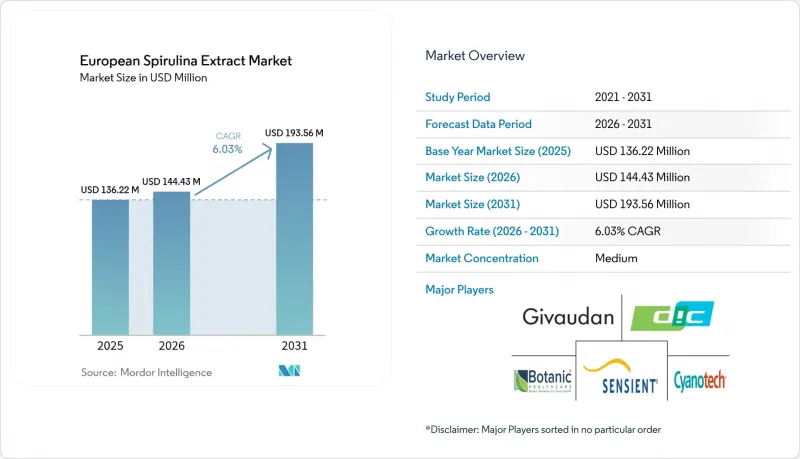
This report is Segmented by Category (Powder, Liquid, and Others), Nature (Conventional, and Organic), Application (Food and Beverages, Pharmaceuticals and Dietary Supplements, Animal Feed, Cosmetics and Personal Care, and Others), and Geography (Germany, United Kingdom, Italy, France, Spain, and More). The Market Forecasts are Provided in Terms of Value (USD) and Volume (Tons).
European Spirulina Extract Market Trends and Insights
Rising consumer health and wellness awareness
The European spirulina extract market is primarily driven by increasing consumer awareness of health and wellness, which has significantly influenced purchasing behavior and product demand across the region. Consumers in Europe are increasingly focusing on nutrient-rich, natural, and functional ingredients in their diets, seeking products that promote immunity, energy, detoxification, and overall well-being. Spirulina, known for its high content of protein, vitamins, minerals, antioxidants, and bioactive compounds like phycocyanin, aligns well with these shifting consumer preferences. The rise of fitness and lifestyle trends, such as plant-based diets, veganism, and preventive healthcare, has further boosted demand for spirulina. It is regarded not only as a dietary supplement but also as a versatile superfood that can be easily integrated into meals, smoothies, and beverages. Moreover, the proliferation of information through social media, health blogs, and wellness platforms has increased consumer awareness of spirulina's functional benefits, driving demand for natural, clean-label, and sustainable products.
Advancements in algae farming and extraction technologies
Advancements in algae farming and extraction technologies are driving the market by improving the quality and scalability of spirulina production. Modern cultivation methods, such as photobioreactors, closed-system farms, and optimized open-pond systems, enable higher yields, controlled nutrient profiles, and reduced contamination risks compared to traditional farming practices. These technological advancements ensure consistent biomass quality, making it possible to meet the increasing demand from industries such as dietary supplements, functional foods, beverages, and cosmetics. On the extraction side, innovations like supercritical CO2 extraction, enzymatic processing, microencapsulation, and advanced drying techniques enhance the bioavailability, stability, and color retention of spirulina extracts. These advancements allow manufacturers to produce high-purity, standardized ingredients suitable for premium and specialized applications. By improving efficiency, lowering production costs, and enabling value-added formulations, technological progress in algae farming and extraction is significantly enhancing market accessibility, expanding application possibilities, and driving overall growth in the European spirulina extract market.
High production and processing costs
A key restraint for the European spirulina extract market is the high production and processing costs involved in its cultivation and extraction. Spirulina cultivation requires controlled conditions, including precise light, temperature, and nutrient management, particularly in closed systems or photobioreactors, which demand significant capital and operational investments. Furthermore, while advanced extraction techniques enhance product quality and bioavailability, they also contribute to higher production costs. These elevated costs are often reflected in the final product price, reducing accessibility for price-sensitive consumers and limiting adoption in cost-competitive segments such as mass-market food and beverages. The combination of labor-intensive cultivation processes, high energy requirements, and complex downstream processing poses a financial challenge for smaller manufacturers, potentially hindering market growth despite increasing demand. This remains a significant obstacle to the wider adoption of spirulina products in Europe.
Other drivers and restraints analyzed in the detailed report include:
- Strong nutraceutical sector demand
- Sustainable and organic product preference
- Taste and sensory challenges
For complete list of drivers and restraints, kindly check the Table Of Contents.
Segment Analysis
In 2025, powder spirulina held a dominant 55.98% share of the European spirulina extract market, highlighting its widespread adoption and significant contribution to market growth. The powder form's versatility makes it the preferred choice for various applications, including dietary supplements, functional foods, beverages, and nutraceutical products. It can be easily incorporated into formulations without significantly altering taste, texture, or nutritional content. Its convenience and precise dosage control are particularly valued in supplements and clinical formulations, ensuring consistent delivery of essential nutrients such as proteins, antioxidants, and immune-supporting compounds. Additionally, the segment benefits from the growing emphasis on organic, clean-label, and sustainable products, aligning with regulatory standards and consumer expectations for transparency and environmentally responsible production.
The liquid spirulina segment is experiencing steady growth in the European spirulina extract market, with a CAGR of 6.48% projected through 2031. This growth reflects its increasing adoption in functional beverages, nutraceuticals, and liquid supplement formulations. The segment's inherent convenience and ready-to-use format enable manufacturers and consumers to incorporate spirulina directly into drinks, smoothies, shots, and other liquid-based wellness products without additional preparation. Liquid spirulina is valued for its enhanced bioavailability and ease of mixing, ensuring consistent nutrient intake. This makes it particularly appealing to health-conscious consumers seeking quick and efficient supplementation. Furthermore, advancements in formulation technologies, such as flavor masking, stabilization techniques, and fortified blends, address the strong algae taste and improve shelf life. These innovations enhance the palatability and commercial viability of liquid spirulina products.
Complete Report Scope:
- By Category
- Powder
- Liquid
- Others
- By Nature
- Conventional
- Organic
- By Application
- Food and Beverages
- Pharmaceuticals and Dietary Supplements
- Animal Feed
- Cosmetics and Personal Care
- Others
- By Geography
- Germany
- United Kingdom
- Italy
- France
- Spain
- Netherlands
- Poland
- Belgium
- Sweden
- Rest of Europe
List of Companies Covered in this Report:
- Sensient Technologies Corporation
- Givaudan S.A.
- DIC Corporation (Earthrise Nutritionals)
- Chr. Hansen Holding A/S
- Bolise Co., Limited.
- Cyanotech Corporation
- Botanic Healthcare
- Aliga Microalgae
- Elementa Ingredients
- Allmicroalgae Natural Products S.A.
- AlgaEnergy S.A.
- GNT Group B.V.
- Far East Bio-Tec Co., Ltd. (FEBICO)
- Sun Chlorella Corporation
- Yunnan Green A Biological Project Co., Ltd.
- Parry Nutraceuticals (EID Parry)
- NOW Foods
- Roquette Freres
- Prolgae Spirulina Supplies Pvt Ltd
Additional Benefits:
- The market estimate (ME) sheet in Excel format
- 3 months of analyst support
TABLE OF CONTENTS
1 INTRODUCTION
- 1.1 Study Assumptions and Market Definition
- 1.2 Scope of the Study
2 RESEARCH METHODOLOGY
3 EXECUTIVE SUMMARY
4 MARKET LANDSCAPE
- 4.1 Market Overview
- 4.2 Market Drivers
- 4.2.1 Rising consumer health and wellness awareness
- 4.2.2 Advancements in algae farming and extraction technologies
- 4.2.3 Strong nutraceutical sector demand
- 4.2.4 Sustainable and organic product preference
- 4.2.5 Innovative product development
- 4.2.6 Use of spirulina as a natural blue colorant in beverages and dairy alternatives
- 4.3 Market Restraints
- 4.3.1 High production and processing costs
- 4.3.2 Taste and sensory challenges
- 4.3.3 Limited awareness in certain regions
- 4.3.4 Supply chain vulnerability
- 4.4 Supply Chain Analysis
- 4.5 Regulatory Landscape
- 4.6 Technological Outlook
- 4.7 Porter's Five Forces Analysis
- 4.7.1 Threat of New Entrants
- 4.7.2 Bargaining Power of Buyers
- 4.7.3 Bargaining Power of Suppliers
- 4.7.4 Threat of Substitutes
- 4.7.5 Intensity of Competitive Rivalry
5 MARKET SIZE AND GROWTH FORECASTS (VALUE AND VOLUME)
- 5.1 By Category
- 5.1.1 Powder
- 5.1.2 Liquid
- 5.1.3 Others
- 5.2 By Nature
- 5.2.1 Conventional
- 5.2.2 Organic
- 5.3 By Application
- 5.3.1 Food and Beverages
- 5.3.2 Pharmaceuticals and Dietary Supplements
- 5.3.3 Animal Feed
- 5.3.4 Cosmetics and Personal Care
- 5.3.5 Others
- 5.4 By Geography
- 5.4.1 Germany
- 5.4.2 United Kingdom
- 5.4.3 Italy
- 5.4.4 France
- 5.4.5 Spain
- 5.4.6 Netherlands
- 5.4.7 Poland
- 5.4.8 Belgium
- 5.4.9 Sweden
- 5.4.10 Rest of Europe
6 COMPETITIVE LANDSCAPE
- 6.1 Market Concentration
- 6.2 Strategic Moves
- 6.3 Market Positioning Analysis
- 6.4 Company Profiles (includes Global level Overview, Market level overview, Core Segments, Financials as available, Strategic Information, Market Rank/Share for key companies, Products and Services, and Recent Developments)
- 6.4.1 Sensient Technologies Corporation
- 6.4.2 Givaudan S.A.
- 6.4.3 DIC Corporation (Earthrise Nutritionals)
- 6.4.4 Chr. Hansen Holding A/S
- 6.4.5 Bolise Co., Limited.
- 6.4.6 Cyanotech Corporation
- 6.4.7 Botanic Healthcare
- 6.4.8 Aliga Microalgae
- 6.4.9 Elementa Ingredients
- 6.4.10 Allmicroalgae Natural Products S.A.
- 6.4.11 AlgaEnergy S.A.
- 6.4.12 GNT Group B.V.
- 6.4.13 Far East Bio-Tec Co., Ltd. (FEBICO)
- 6.4.14 Sun Chlorella Corporation
- 6.4.15 Yunnan Green A Biological Project Co., Ltd.
- 6.4.16 Parry Nutraceuticals (EID Parry)
- 6.4.17 NOW Foods
- 6.4.18 Roquette Freres
- 6.4.19 Prolgae Spirulina Supplies Pvt Ltd
7 MARKET OPPORTUNITIES AND FUTURE OUTLOOK

