PUBLISHER: Mordor Intelligence | PRODUCT CODE: 2113526

PUBLISHER: Mordor Intelligence | PRODUCT CODE: 2113526
South America Spirulina Extract - Market Share Analysis, Industry Trends & Statistics, Growth Forecasts (2026 - 2031)
According to Mordor Intelligence, the South America spirulina extract market size was valued at USD 167.54 million in 2025 and estimated to grow from USD 180.31 million in 2026 to reach USD 260.25 million by 2031, at a CAGR of 7.62% during the forecast period (2026-2031).
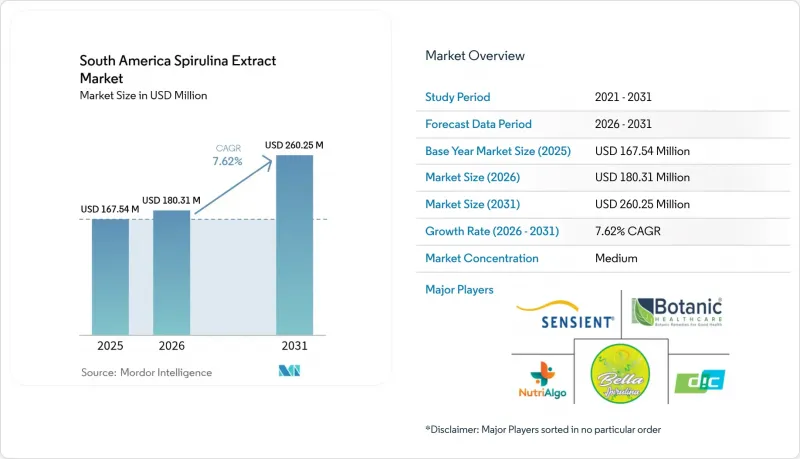
This report is Segmented by Nature (Organic and Conventional), Application (Food and Beverage, Animal Feed, and More), and Country (Brazil, Colombia, Chile, Peru, Argentina, and Rest of South America). The Market Forecasts are Provided in Terms of Value (USD).
South America Spirulina Extract Market Trends and Insights
Increasing awareness of spirulina's high protein, antioxidant, and immunity-supporting properties
The South America spirulina extract market is growing steadily, driven by increasing scientific research and the rising demand for clean-label, functional ingredients. Spirulina is highly valued for its exceptional protein content, which comprises 50-70% of its dry weight, as reported by PubMed Central in November 2024. This high protein density has made spirulina a popular ingredient in sports nutrition products, fortified beverages, and supplements designed to boost immunity. In response to this demand, producers in the region, particularly in Chile, are moving away from selling bulk spirulina powder. Instead, they are focusing on creating standardized, high-purity extracts that meet the quality requirements of international markets, allowing for premium pricing. As brands prioritize consistent quality and nutrient potency, South American suppliers with advanced analytical capabilities and ISO-certified processing facilities are gaining a competitive edge.
Growth of lactose intolerance and dairy-free consumption trends
The increasing prevalence of lactose intolerance and the growing preference for dairy-free diets are driving the demand for spirulina extracts in South America. For instance, in Brazil, lactose intolerance is expected to affect 0.63% of the population by 2025, as per the World Population Review. This has encouraged beverage manufacturers to develop more non-dairy products while also adhering to regulatory requirements, such as avoiding Argentina's ANMAT octagonal warning seals. Plant-based eating habits are gaining momentum in the region. As of June 2025, 8.8% of university students in Latin America were reported to follow plant-based diets, according to the Multidisciplinary Digital Publishing Institute. This trend has increased the need for clean-label and nutrient-rich ingredients. Spirulina, renowned for its high protein content, is gaining popularity as a fortifier for plant-based milk alternatives. It enables manufacturers to meet nutritional standards without relying on dairy ingredients.
Concerns about contamination with heavy metals or micro-toxins
Concerns about contamination with heavy metals and micro-toxins are becoming a major challenge in the South America spirulina extract market as governments enforce stricter quality and safety regulations. Current regional standards limit cadmium to 3 mg/kg, lead to 120 mg/kg, and mercury to 1 mg/kg. Finished products must be completely free of harmful bacteria, such as Salmonella and E. coli. In Brazil, regulations have become even more stringent, requiring producers to implement batch-level traceability. This means they must provide detailed records of the origin, handling, and testing of every batch of spirulina they produce. These tighter regulations have increased production costs, estimated to rise by USD 0.50-0.80 per kg, as producers need to invest in advanced testing equipment, quality assurance systems, and compliance processes. Smaller farms and processors, in particular, are struggling to meet these requirements due to limited resources.
Other drivers and restraints analyzed in the detailed report include:
- Use of spirulina as a natural blue colorant in beverages and dairy alternatives
- Growing preference for natural, clean-label, and plant-based ingredients
- Competition from other plant-based superfoods like chia, maca, etc.
For complete list of drivers and restraints, kindly check the Table Of Contents.
Segment Analysis
Conventional spirulina was the largest segment in the South America spirulina extract market in 2025, accounting for 72.56% of the total market share. Its widespread use is due to its affordability, easy availability, and established role in products like dietary supplements, beverages, and natural colorants. Countries such as Chile and Brazil have played a crucial role in supporting this segment through large-scale cultivation and efficient supply chains. However, with growing concerns about product safety and the need for better traceability, producers are focusing on improving quality control measures to meet stricter regulations and rising consumer expectations for safer and more reliable products.
Organic spirulina, on the other hand, is witnessing rapid growth and is the fastest-growing segment in the market. This growth is fueled by increasing consumer preference for clean-label, eco-friendly, and certified products. The segment is projected to grow at a CAGR of 8.62% from 2026 to 2031, as it finds applications in premium products like functional foods, plant-based beverages, and high-purity phycocyanin extracts. The expansion of farms in South America that adhere to USDA-NOP and EU standards is improving the availability of organic spirulina. This has encouraged multinational companies to establish long-term supply agreements, as sustainability and transparency become key factors driving consumer choices. Organic spirulina is expected to capture a larger share of the market in the coming years.
Complete Report Scope:
- By Nature
- Organic
- Conventional
- By Application
- Food and Beverage
- Pharmaceutical and Supplements
- Animal Feed
- Cosmetics and Personal Care
- Others
- By Country
- Brazil
- Colombia
- Chile
- Peru
- Argentina
- Rest of South America
List of Companies Covered in this Report:
- Sensient Technologies Corporation
- DIC Corporation - Earthrise Nutritionals
- Nutrialgo
- Botanic Healthcare
- Givaudan SA (Naturex)
- Bella Spirulina
- Fazenda Tamandua
- Matha Exports International
- Spirulina Mater
- Andes Spirulina
- Spirux
- King Dnarmsa Spirulina
- Hydrolina Biotech
- Allmicroalgae
- NOW Foods
- Nutrex Hawaii
- GNT Group
- Dohler Group
- AgroAndres C. Ltda.
- Viridia Biotech
Additional Benefits:
- The market estimate (ME) sheet in Excel format
- 3 months of analyst support
TABLE OF CONTENTS
1 INTRODUCTION
- 1.1 Study Assumptions and Market Definition
- 1.2 Scope of the Study
2 RESEARCH METHODOLOGY
3 EXECUTIVE SUMMARY
4 MARKET LANDSCAPE
- 4.1 Market Overview
- 4.2 Market Drivers
- 4.2.1 Rising consumer focus on health and preventive nutrition
- 4.2.2 Increasing awareness of spirulina's high protein, antioxidant, and immunity-supporting properties
- 4.2.3 Growing preference for natural, clean-label, and plant-based ingredients
- 4.2.4 Use of spirulina as a natural blue colorant in beverages and dairy alternatives
- 4.2.5 Favorable climatic conditions and rising local cultivation capacity
- 4.2.6 Growth of lactose intolerance and dairy-free consumption trends
- 4.3 Market Restraints
- 4.3.1 Competition from other plant-based superfoods like chia, maca, etc.
- 4.3.2 Concerns about contamination with heavy metals or micro-toxins
- 4.3.3 Variability in water availability and rising drought events in certain regions
- 4.3.4 Use of spirulina as a natural blue colorant in beverages and dairy alternatives
- 4.4 Regulatory Outlook
- 4.5 Supply Chain Analysis
- 4.6 Porter's Five Forces
- 4.6.1 Threat of New Entrants
- 4.6.2 Bargaining Power of Buyers
- 4.6.3 Bargaining Power of Suppliers
- 4.6.4 Threat of Substitute Products
- 4.6.5 Intensity of Competitive Rivalry
5 MARKET SIZE AND GROWTH FORECASTS (VALUE)
- 5.1 By Nature
- 5.1.1 Organic
- 5.1.2 Conventional
- 5.2 By Application
- 5.2.1 Food and Beverage
- 5.2.2 Pharmaceutical and Supplements
- 5.2.3 Animal Feed
- 5.2.4 Cosmetics and Personal Care
- 5.2.5 Others
- 5.3 By Country
- 5.3.1 Brazil
- 5.3.2 Colombia
- 5.3.3 Chile
- 5.3.4 Peru
- 5.3.5 Argentina
- 5.3.6 Rest of South America
6 COMPETITIVE LANDSCAPE
- 6.1 Market Concentration
- 6.2 Strategic Moves
- 6.3 Market Positioning Analysis
- 6.4 Company Profiles (includes Global-level Overview, Market-level Overview, Core Segments, Financials (if available), Strategic Information, Market Rank/Share, Products and Services, Recent Developments)
- 6.4.1 Sensient Technologies Corporation
- 6.4.2 DIC Corporation - Earthrise Nutritionals
- 6.4.3 Nutrialgo
- 6.4.4 Botanic Healthcare
- 6.4.5 Givaudan SA (Naturex)
- 6.4.6 Bella Spirulina
- 6.4.7 Fazenda Tamandua
- 6.4.8 Matha Exports International
- 6.4.9 Spirulina Mater
- 6.4.10 Andes Spirulina
- 6.4.11 Spirux
- 6.4.12 King Dnarmsa Spirulina
- 6.4.13 Hydrolina Biotech
- 6.4.14 Allmicroalgae
- 6.4.15 NOW Foods
- 6.4.16 Nutrex Hawaii
- 6.4.17 GNT Group
- 6.4.18 Dohler Group
- 6.4.19 AgroAndres C. Ltda.
- 6.4.20 Viridia Biotech
7 MARKET OPPORTUNITIES AND FUTURE OUTLOOK

