PUBLISHER: Mordor Intelligence | PRODUCT CODE: 2113618

PUBLISHER: Mordor Intelligence | PRODUCT CODE: 2113618
North America Spirulina Extract - Market Share Analysis, Industry Trends & Statistics, Growth Forecasts (2026 - 2031)
According to Mordor Intelligence, the spirulina ingredient market size in North America in 2026 is estimated at USD 259.79 million, growing from 2025 value of USD 239.20 million with 2031 projections showing USD 392.62 million, growing at 8.61% CAGR over 2026-2031.
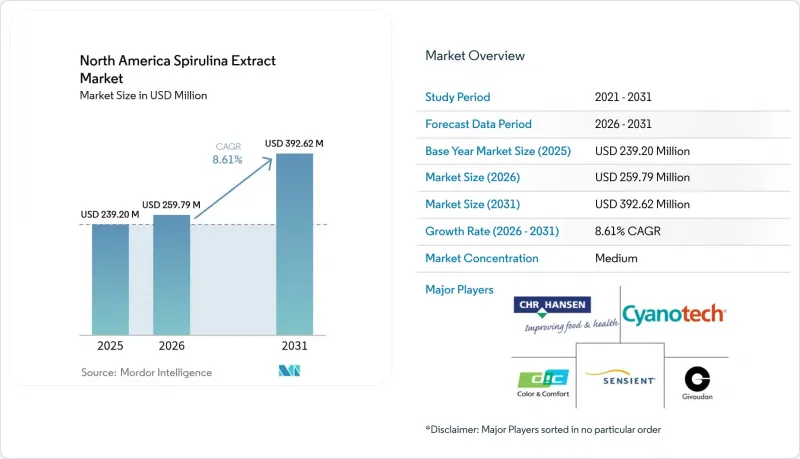
This report is Segmented by Form (Powder, Liquid, Others), Application (Food and Beverage, Pharmaceuticals and Dietary Supplements, Animal Feed, Other Industrial Uses), and Geography (United States, Canada, Mexico, Rest of North America). The Market Forecasts are Provided in Terms of Value (USD Million) and Volume (Tons).
North America Spirulina Extract Market Trends and Insights
Growing Use of Spirulina in Dietary Supplements and Functional Foods
Spirulina's high protein content (55-70% dry weight) makes it an efficient, sustainable source of amino acids, supporting the growing US organic supplement market, which reached USD 5.9 billion in 2023. A 2025 meta-analysis confirmed the benefits for body composition, providing formulators with clinical evidence for labeling and marketing. E.I.D. Parry's USP Dietary Ingredient Verification highlights the rising importance of third-party quality assurance, while Lonza's 2025 Organicaps pullulan capsules enable fully organic spirulina supplements without gelatin, opening premium retail shelf space. The market is also shifting toward multi-ingredient blends that include ashwagandha, turmeric, or omega-3 fatty acids, thereby expanding overall volume despite the fragmentation of SKUs.
Expansion of Clean-Label and Organic Product Formulations
Clean-label trends are driving the growth of spirulina, whose single-ingredient profile provides transparency that synthetic colorants cannot. The FDA's 2025 updates to the "healthy" claim and GNT USA's 2022 approval for dairy alternatives and plant-based beverages position spirulina for front-of-pack nutrition messaging and 15-20% price premiums. Canada's SFC traceability rules favor local producers with farm-to-facility documentation, limiting offshore imports. While organic certification adds USD 0.50-1.00/kg in costs, certified organic spirulina commands wholesale prices 40-60% higher, making it attractive for mid-sized premium brands.
High Production Cost and Input-Price Volatility
Spirulina cultivation is energy- and cost-intensive, with fluctuations in electricity prices directly affecting margins. Open-pond systems in California benefit from sunlight but face rising water costs, while Hawaii's Cyanotech facility contends with peak electricity rates exceeding USD 0.30/kWh. Nutrient inputs, such as sodium bicarbonate and nitrogen, are subject to commodity cycles; a 20% increase in bicarbonate can reduce gross margins by 3-5 points. Closed photobioreactors offer contamination control and year-round output but require USD 2-5 million per hectare, limiting access for smaller producers and concentrating production among integrated firms. Labor for harvesting, drying, and quality control accounts for 15-25% of costs, with wage inflation prompting producers to consider automation or margin erosion. The market is bifurcated between commodity powder (USD 8-12/kg) and pharmaceutical-grade extracts (USD 40-60/kg), forcing producers to focus on either volume or premium supply chains, which limits flexibility and exacerbates fluctuations in electricity prices.
Other drivers and restraints analyzed in the detailed report include:
- Rising Demand for Plant-Based and Natural Nutritional Ingredients
- Increasing Consumer Focus on Preventive Healthcare and Immunity Support
- Complex FDA/CFIA Compliance for Novel Ingredients
For complete list of drivers and restraints, kindly check the Table Of Contents.
Segment Analysis
Sensient's March 2024 launch of a heat-stable spirulina ingredient is opening up high-temperature applications that were previously unavailable, including baked snacks and UHT beverages. In 2025, powder dominated the market with a 70.92% share, primarily due to its compatibility with tablets, capsules, and protein blends. In contrast, liquid extracts are projected to grow at a 10.65% CAGR through 2031, offering water-dispersible solutions that eliminate the gritty mouthfeel associated with powders. Tablets remain popular for dosing convenience, but demand is shifting toward capsules, especially pullulan-based organic options like Lonza's 2025 Organicaps, that avoid gelatin and synthetic polymers. Fresh, texturized spirulina, exemplified by SimpliiGood's 2025 smoked salmon analog, preserves heat-sensitive nutrients and delivers whole-food texture, appealing to flexitarian consumers.
Other innovative forms, including gummies, chews, and "candyceuticals," are capturing younger consumers who prefer fun, convenient formats, though these require premium extracts with minimal off-flavors. Liquid spirulina products, such as YANGGE BIOTECH's blue honey-like extract, target beverage manufacturers seeking natural blue colorants that comply with FDA 21 CFR 73.530 standards. While powder maintains volume leadership at USD 8-12/kg wholesale, liquid and fresh formats are carving out premium niches, commanding 2-3X price premiums due to superior sensory performance and clean-label appeal.
Complete Report Scope:
- By Form
- Powder
- Liquid
- Others
- By Application
- Food and Beverage
- Pharmaceuticals and Dietary Supplements
- Animal Feed
- Other Industrial Uses
- By Country
- United States
- Canada
- Mexico
- Rest of North America
List of Companies Covered in this Report:
- Cyanotech Corporation
- DIC Corporation / Earthrise Nutritionals
- Sensient Technologies Corporation
- Chr. Hansen A/S
- DDW - The Color House
- Dohler Group
- NOW Health Group Inc.
- Naturex (Givaudan)
- Parry Nutraceuticals (E.I.D. Parry)
- Lumen Bioscience
- C.B.N. Spirulina Canada Co.
- Algama Foods
- Aim Grow Biotech Co. Ltd
- Fuqing King Dnarmsa Spirulina Co. Ltd
- Prolgae Spirulina Supplies Pvt. Ltd
- Allmicroalgae Natural Products
- Bluetec Naturals Co. Ltd
- Dongtai City Spirulina Bio-Engineering
- Roquette Klotze GmbH & Co. KG
- GNT Group
Additional Benefits:
- The market estimate (ME) sheet in Excel format
- 3 months of analyst support
TABLE OF CONTENTS
1 INTRODUCTION
- 1.1 Study Assumptions and Market Definition
- 1.2 Scope of the Study
2 RESEARCH METHODOLOGY
3 EXECUTIVE SUMMARY
4 MARKET DYNAMICS
- 4.1 Market Overview
- 4.2 Market Drivers
- 4.2.1 Growing use of spirulina in dietary supplements and functional foods
- 4.2.2 Expansion of clean-label and organic product formulations
- 4.2.3 Rising demand for plant-based and natural nutritional ingredients
- 4.2.4 Increasing consumer focus on preventive healthcare and immunity support
- 4.2.5 Advancements in spirulina cultivation and extraction technologies
- 4.2.6 Favorable regulatory acceptance of spirulina-based ingredients
- 4.3 Market Restraints
- 4.3.1 High production cost and input-price volatility
- 4.3.2 Complex FDA / CFIA compliance for novel ingredients
- 4.3.3 Taste, odor, and color challenges in food and beverage applications
- 4.3.4 Limited scalability of premium extraction technologies
- 4.4 Supply Chain Analysis
- 4.5 Regulatory Landscape
- 4.6 Technological Outlook
- 4.7 Porter's Five Forces
- 4.7.1 Threat of New Entrants
- 4.7.2 Bargaining Power of Buyers
- 4.7.3 Bargaining Power of Suppliers
- 4.7.4 Threat of Substitute Products
- 4.7.5 Intensity of Competitive Rivalry
5 MARKET SIZE AND GROWTH FORECASTS (VALUE AND VOLUME)
- 5.1 By Form
- 5.1.1 Powder
- 5.1.2 Liquid
- 5.1.3 Others
- 5.2 By Application
- 5.2.1 Food and Beverage
- 5.2.2 Pharmaceuticals and Dietary Supplements
- 5.2.3 Animal Feed
- 5.2.4 Other Industrial Uses
- 5.3 By Country
- 5.3.1 United States
- 5.3.2 Canada
- 5.3.3 Mexico
- 5.3.4 Rest of North America
6 COMPETITIVE LANDSCAPE
- 6.1 Market Concentration
- 6.2 Strategic Moves
- 6.3 Market Positioning Analysis
- 6.4 Company Profiles (includes Global level Overview, Market level overview, Core Segments, Financials, Strategic Information, Market Rank/Share, Products and Services, Recent Developments)
- 6.4.1 Cyanotech Corporation
- 6.4.2 DIC Corporation / Earthrise Nutritionals
- 6.4.3 Sensient Technologies Corporation
- 6.4.4 Chr. Hansen A/S
- 6.4.5 DDW - The Color House
- 6.4.6 Dohler Group
- 6.4.7 NOW Health Group Inc.
- 6.4.8 Naturex (Givaudan)
- 6.4.9 Parry Nutraceuticals (E.I.D. Parry)
- 6.4.10 Lumen Bioscience
- 6.4.11 C.B.N. Spirulina Canada Co.
- 6.4.12 Algama Foods
- 6.4.13 Aim Grow Biotech Co. Ltd
- 6.4.14 Fuqing King Dnarmsa Spirulina Co. Ltd
- 6.4.15 Prolgae Spirulina Supplies Pvt. Ltd
- 6.4.16 Allmicroalgae Natural Products
- 6.4.17 Bluetec Naturals Co. Ltd
- 6.4.18 Dongtai City Spirulina Bio-Engineering
- 6.4.19 Roquette Klotze GmbH & Co. KG
- 6.4.20 GNT Group
7 MARKET OPPORTUNITIES AND FUTURE TRENDS

