PUBLISHER: Mordor Intelligence | PRODUCT CODE: 2154233

PUBLISHER: Mordor Intelligence | PRODUCT CODE: 2154233
South America Agricultural Irrigation Machinery - Market Share Analysis, Industry Trends & Statistics, Growth Forecasts (2026 - 2031)
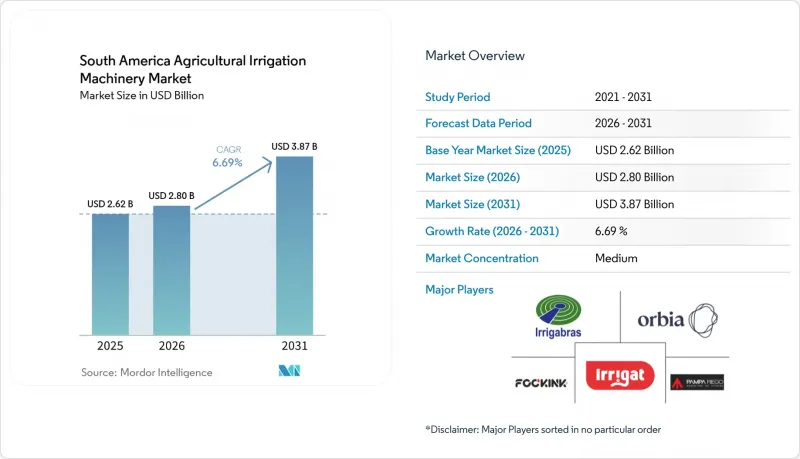
According to Mordor Intelligence, the South America agricultural irrigation machinery market was valued at USD 2.62 billion in 2025 and is forecasted to reach USD 2.80 billion in 2026 and USD 3.87 billion by 2031, registering a CAGR of 6.69% during the forecast period 2026-2031.
South America Agricultural Irrigation Machinery Market Trends and Insights
Expansion of Irrigated High-Value Crops
Perennial and export-oriented crops can support sustained demand for irrigation because production reliability is closely linked to farm revenue and investment capacity. In Brazil, Netafim Ltd. reported 20% growth in 2025 compared with 2024, with strong performance in citrus, coffee, and horticulture, and announced an investment of approximately BRL 100 million (USD 17.5 million) to expand its Ribeirao Preto facility while targeting 12%-15% growth in 2026. In Peru, the Ministry of Agrarian Development and Irrigation (MIDAGRI) reported record agricultural exports of USD 12.7 billion in 2024, including USD 2.27 billion from blueberries, USD 1.71 billion from grapes, and USD 1.25 billion from avocados. The continued expansion of these high-value, export-oriented crops creates a favorable demand base for precision irrigation technologies that provide reliable water delivery and help maintain consistent crop quality.
Government and Development-Finance Support for Water-Efficient Irrigation
Government-backed infrastructure programs are creating a pipeline of irrigation investment across South America. In Peru, the government announced 22 irrigation projects requiring USD 24.1 billion, targeting an additional 1 million hectares of agricultural land, with 85% of investment promotion structured through public-private partnerships (PPPs). Brazil is also expanding irrigation infrastructure through government-supported Irrigated Agriculture Hubs and programs promoting more efficient irrigation technologies. These initiatives are strengthening the project pipeline for irrigation equipment and improving opportunities for suppliers of water-efficient systems across commercial agriculture and family farming, supporting growth in the South America agricultural irrigation machinery market.
High Upfront Cost and Limited Farm-Finance Access
High upfront capital requirements and limited access to suitable agricultural finance can constrain irrigation adoption, particularly among small and mid-sized farms. Modern irrigation systems often require significant investment in pumps, distribution infrastructure, controls, and installation, creating a higher entry barrier than conventional rainfed production. The Food and Agriculture Organization (FAO) highlighted in 2024 that access to finance is an important determinant of farmers' ability to invest in productive assets and that financing constraints can limit agricultural investment, particularly for farmers and small and medium-sized agribusinesses. These financing constraints can extend investment payback periods and make sophisticated irrigation technologies less accessible to smaller producers. As a result, the market may face slower adoption among farms that lack collateral, adequate credit history, or financing products suited to agricultural cash flows, making accessible agricultural credit and public financing mechanisms important for broader irrigation-equipment adoption.
Other drivers and restraints analyzed in the detailed report include:
- Climate-Driven Yield Stabilization in Rainfall-Variable Cropping Regions
- Irrigation Retrofit Demand from Electricity and Pumping-Cost Optimization
- Fragmented Smallholder Plots and Weak Local Service Coverage
For complete list of drivers and restraints, kindly check the Table Of Contents.
Segment Analysis
Drip irrigation held 45.0% of the South America agricultural irrigation machinery market size in 2025. It is widely used in coffee, citrus, sugarcane, blueberries, and avocados, where controlled water delivery supports high-value crop production. Demand for drip irrigation equipment is supported by the expansion of export-oriented crop cultivation in Brazil and Peru, particularly for high-value crops that benefit from precise water application. Large soybean and corn operations use pivots and reels because these systems can cover broad field areas. Irrigabras Irrigacao do Brasil Ltda. launched Irrigabras Conecta in March 2026, a digital platform that allows field users to access equipment documentation through QR codes. The launch indicates that Brazilian pivot suppliers are extending their offering beyond mechanical equipment.
Sprinkler irrigation is forecast to expand at an 8.1% CAGR between 2026 and 2031. Pivot irrigation remains important in Mato Grosso and Goias, where grain farms operate across large areas. Flood and furrow irrigation continue to serve farms where investment capacity remains more limited. The Brazilian Agricultural Research Corporation (Embrapa) Low-Carbon Soybean (SBC) Program provides guidance on documenting water use and irrigation practices for participating farms. As a result, metering and water-management controls can influence equipment selection among farms supplying certified export chains. Overall, the South America agricultural irrigation machinery market is shaped by the differing economic and agronomic requirements of localized and mechanized irrigation systems.
Complete Report Scope:
- By Irrigation Type
- Sprinkler Irrigation
- Drip Irrigation
- Pivot Irrigation
- Other Irrigation Types
- By Application Type
- Grains and Cereals
- Pulses and Oilseeds
- Fruits and Vegetables
- Other Applications
- By Geography
- Brazil
- Argentina
- Peru
- Rest of South America
List of Companies Covered in this Report:
- Fockink Industrias Eletricas Ltda.
- Irrigabras Irrigacao do Brasil Ltda.
- Turbom Argentina Industrial y Comercial S.A.
- Torvil Riegos S.A.
- Irrigat Agricola Ltda.
- Evandro de Castro Silva Fundicao e Solucoes para Irrigacao Ltda.
- Hidro Solo Industria e Comercio Ltda.
- Quiver Plast E.I.R.L.
- Netafim Ltd. (Orbia Advance Corporation, S.A.B. de C.V.)
- Pampa Riego S.A.
- Irrigamais Sistemas de Irrigacao Ltda.
- Bauer do Brasil Irrigacao Ltda.
- Rain Bird Corporation
Additional Benefits:
- The market estimate (ME) sheet in Excel format
- 3 months of analyst support
TABLE OF CONTENTS
1 INTRODUCTION
- 1.1 Study Assumptions and Market Definition
- 1.2 Scope of the Study
2 RESEARCH METHODOLOGY
3 EXECUTIVE SUMMARY
4 MARKET LANDSCAPE
- 4.1 Market Overview
- 4.2 Market Drivers
- 4.2.1 Expansion of irrigated high-value crops
- 4.2.2 Government and development-finance support for water-efficient irrigation
- 4.2.3 Climate-driven yield stabilization in rainfall-variable cropping regions
- 4.2.4 Expansion of mechanized irrigation in large-scale soybean, corn, sugarcane, and fruit operations
- 4.2.5 Irrigation retrofit demand from electricity and pumping-cost optimization
- 4.2.6 Export-oriented farms adopting traceable water-use controls
- 4.3 Market Restraints
- 4.3.1 High upfront cost and limited farm-finance access
- 4.3.2 Uneven grid reliability and high energy cost for pressurized systems
- 4.3.3 Fragmented smallholder plots and weak local service coverage
- 4.3.4 Import-currency exposure and replacement-part lead times
- 4.4 Regulatory Landscape
- 4.5 Technological Outlook
- 4.6 Porter's Five Forces Analysis
- 4.6.1 Bargaining Power of Suppliers
- 4.6.2 Bargaining Power of Buyers
- 4.6.3 Threat of Substitute Products
- 4.6.4 Threat of New Entrants
- 4.6.5 Intensity of Competitive Rivalry
5 MARKET SIZE AND GROWTH FORECASTS (VALUE)
- 5.1 By Irrigation Type
- 5.1.1 Sprinkler Irrigation
- 5.1.2 Drip Irrigation
- 5.1.3 Pivot Irrigation
- 5.1.4 Other Irrigation Types
- 5.2 By Application Type
- 5.2.1 Grains and Cereals
- 5.2.2 Pulses and Oilseeds
- 5.2.3 Fruits and Vegetables
- 5.2.4 Other Applications
- 5.3 By Geography
- 5.3.1 Brazil
- 5.3.2 Argentina
- 5.3.3 Peru
- 5.3.4 Rest of South America
6 COMPETITIVE LANDSCAPE
- 6.1 Market Concentration
- 6.2 Strategic Moves
- 6.3 Market Share Analysis
- 6.4 Company Profiles (Includes Global Level Overview, Market Level Overview, Core Segments, Financials as Available, Strategic Information, Market Rank/Share, Products and Services, Recent Developments)
- 6.4.1 Fockink Industrias Eletricas Ltda.
- 6.4.2 Irrigabras Irrigacao do Brasil Ltda.
- 6.4.3 Turbom Argentina Industrial y Comercial S.A.
- 6.4.4 Torvil Riegos S.A.
- 6.4.5 Irrigat Agricola Ltda.
- 6.4.6 Evandro de Castro Silva Fundicao e Solucoes para Irrigacao Ltda.
- 6.4.7 Hidro Solo Industria e Comercio Ltda.
- 6.4.8 Quiver Plast E.I.R.L.
- 6.4.9 Netafim Ltd. (Orbia Advance Corporation, S.A.B. de C.V.)
- 6.4.10 Pampa Riego S.A.
- 6.4.11 Irrigamais Sistemas de Irrigacao Ltda.
- 6.4.12 Bauer do Brasil Irrigacao Ltda.
- 6.4.13 Rain Bird Corporation
7 MARKET OPPORTUNITIES AND FUTURE OUTLOOK

