PUBLISHER: Mordor Intelligence | PRODUCT CODE: 2121443

PUBLISHER: Mordor Intelligence | PRODUCT CODE: 2121443
Agricultural Irrigation Machinery - Market Share Analysis, Industry Trends & Statistics, Growth Forecasts (2026 - 2031)
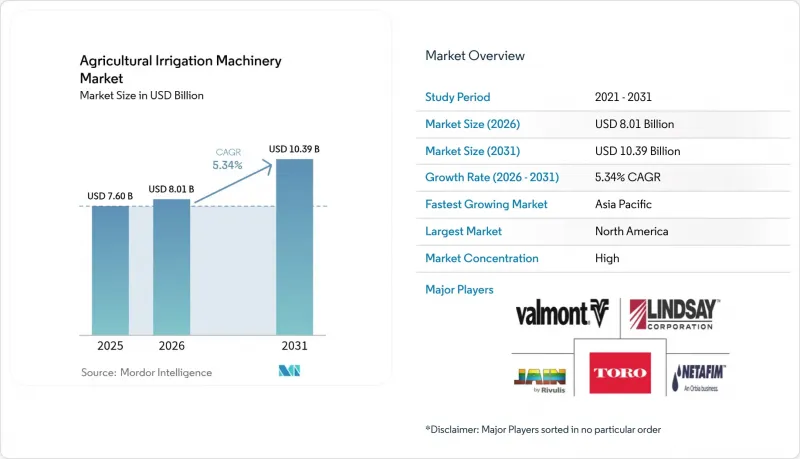
According to Mordor Intelligence, the agricultural irrigation machinery market size was valued at USD 7.60 billion in 2025 and estimated to grow from USD 8.01 billion in 2026 to reach USD 10.39 billion by 2031, at a CAGR of 5.34% during the forecast period (2026-2031).
This report is Segmented by Irrigation Type (Sprinkler Irrigation, Drip Irrigation, Pivot Irrigation, and Other Irrigation Types), by Application Type (Grains and Cereals, Pulses and Oilseeds, Fruits and Vegetables, and Other Applications), and by Geography (North America, Europe, Asia-Pacific, South America, Middle East, and Africa). The Market Forecasts are Provided in Terms of Value (USD).
Global Agricultural Irrigation Machinery Market Trends and Insights
Government Subsidies for Micro-irrigation Adoption
Increased federal conservation funding has made upfront costs more manageable for medium-scale growers. In fiscal year 2024, the United States Department of Agriculture (USDA) Environmental Quality Incentives Program covered up to 75% of system expenses to efficiency initiatives upgrades. The multi-year guarantees provided by the Inflation Reduction Act encourage manufacturers to expand production capacity, while outcome-based metrics align vendor offerings with policy objectives. The program's focus on measurable water-saving outcomes aligns with manufacturers' precision agriculture capabilities, offering a competitive advantage for technology-integrated solutions. These incentives have sparked significant annual order growth among emitter suppliers, signaling durable tailwinds for the agricultural irrigation machinery market.
Rising Water Scarcity Pushing Demand for Precision Irrigation
Mandatory reporting is replacing voluntary conservation, making sensor-equipped systems indispensable. The economic considerations extend beyond water costs to encompass regulatory compliance, as many jurisdictions enforce stricter water-use reporting requirements. The precision irrigation systems' ability to deliver detailed consumption analytics makes them essential tools for compliance rather than optional efficiency enhancements. Coupled with field trials, water savings from subsurface drip Evapotranspiration (ET) replacement, the evidence base now supports both agronomic and regulatory value propositions.
High Upfront Capital Cost for Pivot Systems
Center pivots surpass USD 100,000 per unit, and installation can add another 30%, creating a financing gap that traditional credit seldom fills. Leasing uptake is under 15% because residual values remain opaque, especially in markets lacking secondary equipment exchanges. The capital barrier is also driving interest in hybrid systems that combine pivot infrastructure with drip laterals, allowing growers to phase investment over multiple growing seasons while maintaining flexibility to adjust coverage area as land tenure stabilizes. These systems enable growers to spread investments across multiple growing seasons while retaining the flexibility to modify coverage areas as land tenure becomes more stable. Additionally, hybrid systems offer a scalable approach, allowing farmers to gradually expand irrigation coverage without committing to the full cost upfront, making them a more viable option for resource-constrained growers.
Other drivers and restraints analyzed in the detailed report include:
- Labor Shortages are Accelerating the Mechanization of Mid-size Farms
- Integration of IoT Sensors Enabling Pay-as-You-Grow Service Models
- Growing Concern over Plastic Waste from Drip Lines
For complete list of drivers and restraints, kindly check the Table Of Contents.
Segment Analysis
Drip irrigation held the largest share, accounting for 46.0% of the agricultural irrigation machinery market in 2025, well above the market average. Drip irrigation's market growth is supported by California's reporting regulations favoring metered delivery and India's subsidies for emitters, tubing, and filters. The agricultural irrigation machinery market for drip irrigation components is anticipated to expand, fueled by increasing demand for moisture sensors and variable-rate controllers. While emitters and tubing continue to generate the majority of revenue, sensors represent the fastest-growing segment as farms transition from uniform to data-driven irrigation scheduling.
Sprinkler irrigation is the fastest-growing segment, projected to advance at an 8.0% CAGR through 2031, while mature dealer networks help preserve volumes, new sales skew toward variable-rate configurations that integrate soil probes and flow meters. Field trials in the United States Midwest show 15%-25% water cutbacks without yield loss when pivots shift from fixed to variable-rate application . Component innovation focuses on quick-connect couplers and self-cleaning filters, trimming installation labor by 30%-40%. Other methods, such as surface and furrow, are slipping below 10% combined share as water-scarcity policies tighten.
Complete Report Scope:
- By Irrigation Type
- Sprinkler Irrigation
- Pumping Unit
- Tubing
- Couplers
- Spray or Sprinkler Heads
- Fittings and Accessories
- Sensors
- Controllers
- Injectors
- Flow Meters
- Drip Irrigation
- Valves
- Backflow Preventers
- Pressure Regulators
- Filters
- Emitters
- Tubing
- Other Drip Irrigation Components
- Pivot Irrigation
- Other Irrigation Types
- Sprinkler Irrigation
- By Application Type
- Grains and Cereals
- Pulses and Oilseeds
- Fruits and Vegetables
- Other Applications
- By Geography
- North America
- United States
- Canada
- Mexico
- Rest of North America
- Europe
- Germany
- United Kingdom
- France
- Italy
- Netherlands
- Russia
- Rest of Europe
- Asia-Pacific
- China
- India
- Japan
- Cambodia
- Rest of Asia-Pacific
- South America
- Brazil
- Argentina
- Peru
- Rest of South America
- Middle East
- Saudi Arabia
- Turkey
- Rest of Middle East
- Africa
- South Africa
- Egypt
- Rest of Africa
- North America
Geography Analysis
North America was the largest region, with 32.1% in 2025. Upgrades dominate because most irrigable acreage is already networked with pivots. Compliance mandates such as California's Senate Bill 88 fuel retrofits that integrate flow meters and telemetry. Arizona's grants are bridging the capital gap for sensor add-ons, sustaining pivot margins even as unit volumes plateau. Canada's Prairie Provinces and Mexico's Bajio region offer incremental growth but still account for only a fraction of the United States' demand.
Asia-Pacific is set to log the fastest-growing regional CAGR at 8.0% through 2031. Smallholder fragmentation means modular drip kits priced under USD 800 per hectare outsell large pivots by 4:1. Japan's greenhouse boom is another tailwind, driving demand for high-pressure drip and fertigation controllers that command premium margins in the agricultural irrigation machinery market.
Europe is experiencing steady growth under the environmental pillar of the Common Agricultural Policy, which recognizes precision irrigation as a sustainable activity eligible for green financing. In the Mediterranean region, recurring droughts are accelerating the adoption of subsurface irrigation systems, while countries like the Netherlands and Germany focus on closed-loop greenhouse irrigation systems. In the Middle East and Africa, demand is driven by state-supported megafarms and climate-smart agricultural corridors. Meanwhile, South America's soybean-producing regions are investing in pivot irrigation systems to mitigate rainfall variability, contributing to a geographically diversified revenue stream within the agricultural irrigation machinery market.
- Netafim Ltd. (Orbia Advance Corporation)
- Valmont Industries, Inc. (Valley Irrigation)
- Lindsay Corporation
- Jain Irrigation Systems Limited (Rivulis Irrigation Limited)
- The Toro Company
- Nelson Irrigation Corporation
- Rain Bird Corporation
- Mahindra & Mahindra Limited
- Hunter Industries Incorporated
- Reinke Manufacturing Company, Inc.
- Ningbo Rainfine Irrigation Co., Ltd.
- T-L Irrigation Company
- Sistemas Azud, S.A.
- Antelco Pty Ltd.
Additional Benefits:
- The market estimate (ME) sheet in Excel format
- 3 months of analyst support
TABLE OF CONTENTS
1 Introduction
- 1.1 Study Assumptions and Market Definition
- 1.2 Scope of the Study
2 Research Methodology
3 Executive Summary
4 Market Landscape
- 4.1 Market Overview
- 4.2 Market Drivers
- 4.2.1 Government subsidies for micro-irrigation adoption
- 4.2.2 Rising water scarcity is pushing demand for precision irrigation
- 4.2.3 Labor shortages are accelerating the mechanization of mid-size farms
- 4.2.4 Integration of IoT sensors enabling pay-as-you-grow service models
- 4.2.5 Environmental, Social, and Governance (ESG)-linked finance rewarding water-efficiency investments
- 4.2.6 Surge in carbon-credit schemes for water-saving technologies
- 4.3 Market Restraints
- 4.3.1 High upfront capital cost for pivot systems
- 4.3.2 Fragmented land holdings limiting equipment Return on investment (ROI) in developing countries
- 4.3.3 Growing concern over plastic waste from drip lines
- 4.3.4 Cyber-vulnerability of connected irrigation networks
- 4.4 Regulatory Landscape
- 4.5 Technological Outlook
- 4.6 Porter's Five Forces Analysis
- 4.6.1 Bargaining Power of Suppliers
- 4.6.2 Bargaining Power of Buyers
- 4.6.3 Threat of Substitute Products
- 4.6.4 Threat of New Entrants
- 4.6.5 Intensity of Competitive Rivalry
5 Market Size and Growth Forecasts (Value)
- 5.1 By Irrigation Type
- 5.1.1 Sprinkler Irrigation
- 5.1.1.1 Pumping Unit
- 5.1.1.2 Tubing
- 5.1.1.3 Couplers
- 5.1.1.4 Spray or Sprinkler Heads
- 5.1.1.5 Fittings and Accessories
- 5.1.1.6 Sensors
- 5.1.1.7 Controllers
- 5.1.1.8 Injectors
- 5.1.1.9 Flow Meters
- 5.1.2 Drip Irrigation
- 5.1.2.1 Valves
- 5.1.2.2 Backflow Preventers
- 5.1.2.3 Pressure Regulators
- 5.1.2.4 Filters
- 5.1.2.5 Emitters
- 5.1.2.6 Tubing
- 5.1.2.7 Other Drip Irrigation Components
- 5.1.3 Pivot Irrigation
- 5.1.4 Other Irrigation Types
- 5.1.1 Sprinkler Irrigation
- 5.2 By Application Type
- 5.2.1 Grains and Cereals
- 5.2.2 Pulses and Oilseeds
- 5.2.3 Fruits and Vegetables
- 5.2.4 Other Applications
- 5.3 By Geography
- 5.3.1 North America
- 5.3.1.1 United States
- 5.3.1.2 Canada
- 5.3.1.3 Mexico
- 5.3.1.4 Rest of North America
- 5.3.2 Europe
- 5.3.2.1 Germany
- 5.3.2.2 United Kingdom
- 5.3.2.3 France
- 5.3.2.4 Italy
- 5.3.2.5 Netherlands
- 5.3.2.6 Russia
- 5.3.2.7 Rest of Europe
- 5.3.3 Asia-Pacific
- 5.3.3.1 China
- 5.3.3.2 India
- 5.3.3.3 Japan
- 5.3.3.4 Cambodia
- 5.3.3.5 Rest of Asia-Pacific
- 5.3.4 South America
- 5.3.4.1 Brazil
- 5.3.4.2 Argentina
- 5.3.4.3 Peru
- 5.3.4.4 Rest of South America
- 5.3.5 Middle East
- 5.3.5.1 Saudi Arabia
- 5.3.5.2 Turkey
- 5.3.5.3 Rest of Middle East
- 5.3.6 Africa
- 5.3.6.1 South Africa
- 5.3.6.2 Egypt
- 5.3.6.3 Rest of Africa
- 5.3.1 North America
6 Competitive Landscape
- 6.1 Market Concentration
- 6.2 Strategic Moves
- 6.3 Market Share Analysis
- 6.4 Company Profiles (Includes Global-level Overview, Market-level Overview, Core Segments, Financials as Available, Strategic Information, Market Rank or Share, Products and Services, and Recent Developments)
- 6.4.1 Netafim Ltd. (Orbia Advance Corporation)
- 6.4.2 Valmont Industries, Inc. (Valley Irrigation)
- 6.4.3 Lindsay Corporation
- 6.4.4 Jain Irrigation Systems Limited (Rivulis Irrigation Limited)
- 6.4.5 The Toro Company
- 6.4.6 Nelson Irrigation Corporation
- 6.4.7 Rain Bird Corporation
- 6.4.8 Mahindra & Mahindra Limited
- 6.4.9 Hunter Industries Incorporated
- 6.4.10 Reinke Manufacturing Company, Inc.
- 6.4.11 Ningbo Rainfine Irrigation Co., Ltd.
- 6.4.12 T-L Irrigation Company
- 6.4.13 Sistemas Azud, S.A.
- 6.4.14 Antelco Pty Ltd.
7 Market Opportunities and Future Outlook

