PUBLISHER: Mordor Intelligence | PRODUCT CODE: 2154229

PUBLISHER: Mordor Intelligence | PRODUCT CODE: 2154229
Asia-Pacific Agricultural Irrigation Machinery - Market Share Analysis, Industry Trends & Statistics, Growth Forecasts (2026 - 2031)
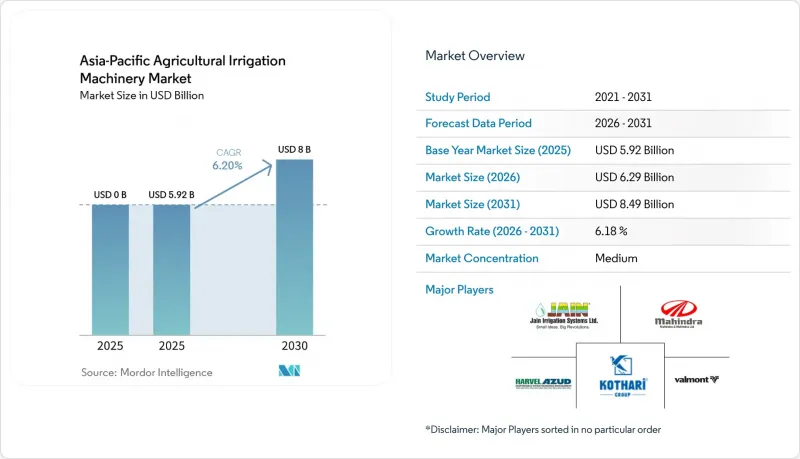
According to Mordor Intelligence, the Asia-Pacific agricultural irrigation machinery market size was valued at USD 5.92 billion in 2025 and is forecast to grow from USD 6.29 billion in 2026 to USD 8.49 billion by 2031, at a CAGR of 6.18% from 2026 to 2031.
Asia-Pacific Agricultural Irrigation Machinery Market Trends and Insights
Increasing Demand for Efficient Water Management in Agriculture
Growing demand for efficient water management is driving the adoption of irrigation machinery, as water-stressed farming systems seek precise water delivery methods. The Asian Development Bank (ADB) reported in 2025 that, in a case study in the Ningxia Hui Autonomous Region, China, switching to drip irrigation could reduce water use by 60%. This supports the resource-efficiency case for drip irrigation in farms facing water constraints and pressure to produce more with available supplies. As a result, demand for water-efficient irrigation equipment is contributing to market growth across Asia-Pacific agricultural production systems.
Government Subsidies and Water-Saving Irrigation Programs
Government-backed irrigation programs are supporting machinery demand by funding infrastructure that enables modern irrigation systems and improves water-use efficiency. In April 2025, the Government of India approved the Modernization of Command Area Development and Water Management sub-scheme under Pradhan Mantri Krishi Sinchayee Yojana (PMKSY) with a total outlay of INR 1,600 crore (USD 192 million). The program includes underground pressurized piped irrigation and micro-irrigation infrastructure from established water sources to farm gates. This policy support broadens opportunities for irrigation machinery suppliers and strengthens machinery adoption across Indian agricultural systems.
High Initial Cost and Payback Uncertainty
High upfront costs and uncertain payback periods can limit the adoption of irrigation machinery among smallholder farmers, particularly where access to agricultural finance is limited. The Asian Development Bank (ADB) reported in 2025 that smart drip irrigation in China involves high upfront costs, energy requirements, and maintenance expenses, creating financial barriers to adoption. These costs can extend investment recovery periods and increase the financing burden for farmers with limited capital and variable agricultural income. As a result, affordability constraints, limited financing options, and uncertain returns can delay purchases of irrigation machinery and restrict broader market expansion across smallholder farming systems in the Asia-Pacific.
Other drivers and restraints analyzed in the detailed report include:
- Precision Agriculture and Connected Irrigation Adoption
- Climate-Driven Irrigation Reliability Requirements
- Fragmented Landholdings and Difficult System Standardization
For complete list of drivers and restraints, kindly check the Table Of Contents.
Segment Analysis
Drip irrigation accounted for the largest Asia-Pacific agricultural irrigation machinery market share in 2025, at 46.5%, and is projected to grow at the fastest CAGR of 13.1% from 2026 to 2031. Its modular configuration enables controlled water delivery through emitters, tubing, filters, valves, and pressure regulators across diverse crops and field sizes. Integration with fertigation, sensors, controllers, and automation further expands its functionality. These capabilities support precise water management, flexible system deployment, and resource-efficient production, driving the adoption of drip irrigation across diverse agricultural systems in the Asia-Pacific.
Sprinkler irrigation supports broad agricultural applications where uniform overhead water distribution is appropriate, including grains and cereals, as well as selected horticultural systems. Pivot irrigation provides mechanized field coverage and is particularly relevant to larger commercial agricultural operations where field layouts support mobile irrigation machinery. Other irrigation types, including subsurface and subirrigation systems, serve agricultural production environments where soil conditions, crop requirements, water availability, and local infrastructure influence irrigation system selection. These irrigation methods address specific agricultural conditions and production requirements across the Asia-Pacific region.
Complete Report Scope:
- By Irrigation Type
- Sprinkler Irrigation
- Drip Irrigation
- Pivot Irrigation
- Other Irrigation Types
- By Application Type
- Grains and Cereals
- Pulses and Oilseeds
- Fruits and Vegetables
- Other Applications
- By Geography
- China
- India
- Japan
- Cambodia
- Rest of Asia-Pacific
List of Companies Covered in this Report:
- Jain Irrigation Systems Limited
- Netafim Ltd. (Orbia Advance Corporation, S.A.B. de C.V.)
- Rivulis Irrigation Ltd. (Temasek Holdings Private Limited and Jain Irrigation Systems Limited)
- Valmont Industries, Inc.
- Lindsay Corporation
- The Toro Company
- Rain Bird Corporation
- Mahindra EPC Irrigation Limited (Mahindra and Mahindra Limited)
- Dayu Irrigation Group Co., Ltd.
- Hunter Industries, Inc.
- Nelson Irrigation Corporation
- Antelco Pty Ltd
Additional Benefits:
- The market estimate (ME) sheet in Excel format
- 3 months of analyst support
TABLE OF CONTENTS
1 INTRODUCTION
- 1.1 Study Assumptions and Market Definition
- 1.2 Scope of the Study
2 RESEARCH METHODOLOGY
3 EXECUTIVE SUMMARY
4 MARKET LANDSCAPE
- 4.1 Market Drivers
- 4.1.1 Increasing Demand for Efficient Water Management in Agriculture
- 4.1.2 Government Subsidies and Water-Saving Irrigation Programs
- 4.1.3 Expansion of High-Value Crops and Protected Cultivation
- 4.1.4 Precision Agriculture and Connected Irrigation Adoption
- 4.1.5 Climate-Driven Irrigation Reliability Requirements
- 4.1.6 Local Manufacturing and Dealer-Led Affordability Improvements
- 4.2 Market Restraints
- 4.2.1 High Initial Cost and Payback Uncertainty
- 4.2.2 Limited Awareness and Technical Support Among Smallholder Farmers
- 4.2.3 Fragmented Landholdings and Difficult System Standardization
- 4.2.4 Clogging, Water Quality, and Maintenance Burden
- 4.3 Regulatory Landscape
- 4.4 Technological Outlook
- 4.5 Porter's Five Forces Analysis
- 4.5.1 Bargaining Power of Suppliers
- 4.5.2 Bargaining Power of Buyers
- 4.5.3 Threat of New Entrants
- 4.5.4 Threat of Substitutes
- 4.5.5 Intensity of Competitive Rivalry
5 MARKET SIZE AND GROWTH FORECASTS (VALUE)
- 5.1 By Irrigation Type
- 5.1.1 Sprinkler Irrigation
- 5.1.2 Drip Irrigation
- 5.1.3 Pivot Irrigation
- 5.1.4 Other Irrigation Types
- 5.2 By Application Type
- 5.2.1 Grains and Cereals
- 5.2.2 Pulses and Oilseeds
- 5.2.3 Fruits and Vegetables
- 5.2.4 Other Applications
- 5.3 By Geography
- 5.3.1 China
- 5.3.2 India
- 5.3.3 Japan
- 5.3.4 Cambodia
- 5.3.5 Rest of Asia-Pacific
6 COMPETITIVE LANDSCAPE
- 6.1 Market Concentration
- 6.2 Strategic Moves
- 6.3 Market Share Analysis
- 6.4 Company Profiles (Includes Global Level Overview, Market Level Overview, Core Segments, Financials as available, Strategic Information, Market Rank/Share, Products and Services, Recent Developments)
- 6.4.1 Jain Irrigation Systems Limited
- 6.4.2 Netafim Ltd. (Orbia Advance Corporation, S.A.B. de C.V.)
- 6.4.3 Rivulis Irrigation Ltd. (Temasek Holdings Private Limited and Jain Irrigation Systems Limited)
- 6.4.4 Valmont Industries, Inc.
- 6.4.5 Lindsay Corporation
- 6.4.6 The Toro Company
- 6.4.7 Rain Bird Corporation
- 6.4.8 Mahindra EPC Irrigation Limited (Mahindra and Mahindra Limited)
- 6.4.9 Dayu Irrigation Group Co., Ltd.
- 6.4.10 Hunter Industries, Inc.
- 6.4.11 Nelson Irrigation Corporation
- 6.4.12 Antelco Pty Ltd
7 MARKET OPPORTUNITIES AND FUTURE OUTLOOK

