PUBLISHER: Mordor Intelligence | PRODUCT CODE: 2113587

PUBLISHER: Mordor Intelligence | PRODUCT CODE: 2113587
North America Wheat Seed Treatment - Market Share Analysis, Industry Trends & Statistics, Growth Forecasts (2026 - 2031)
According to Mordor Intelligence, North America wheat seed treatment market size in 2026 is estimated at USD 467.25 million, growing from 2025 value of USD 437.4 million with 2031 projections showing USD 648.76 million, growing at 6.82% CAGR over 2026-2031.
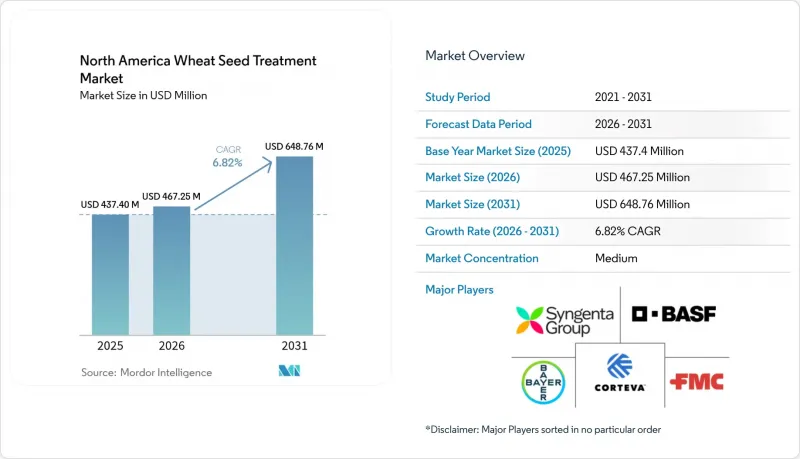
This report is Segmented by Product Type (Insecticides, Fungicides, Nematicides, and More), by Formulation Type (Liquid Flowable, Suspension Concentrate, Dry Powder, and More), by Application (Commercial, and Farm Level), and by Geography (United States, Canada, Mexico, and More). The Market Forecasts are Provided in Terms of Value (USD).
North America Wheat Seed Treatment Market Trends and Insights
Rising Limitations of Soil and Foliar Pesticide Applications
In the North America wheat seed treatment market, tighter pollinator-protection windows and rising fuel costs have reduced the practicality of broadcast sprays . Seed-applied products offer an alternative by avoiding issues such as drift and re-entry restrictions, as the active ingredient remains confined within the furrow. Trials conducted in North Dakota demonstrated that a single seed treatment can achieve the same efficacy as two foliar sprays, while reducing labor and fuel costs by 40% . Growers participating in conservation programs are moving away from multiple tillage passes associated with granular soil insecticides, increasing the demand for seed treatments. With 72% of wheat acres in the United States under conservation compliance, the economic benefits of seed treatments are further reinforced.
Escalating Insect and Pest Pressure in Wheat-Growing Belts
Stripe rust, tan spot, and Fusarium head blight caused USD 1.8 billion in crop losses in 2024, significantly driving the demand for fungicides as farmers seek to mitigate these substantial losses . Warmer winters, attributed to changing climatic conditions, now enable pests such as Hessian fly and wheat stem sawfly to survive in regions that were previously too cold, resulting in increased reliance on insecticides to protect wheat crops. In Mexico, the Karnal bunt surveillance program has introduced a requirement for treated seed in interstate movement, effectively transforming what was once a voluntary practice into a legally enforced mandate across 492,404 hectares. This regulatory shift aims to contain the spread of Karnal bunt and safeguard wheat production.
Limited Grower Awareness of Optimal Application Rates
Surveys conducted in Kansas and Oklahoma indicate that 42% of farm-level applicators either underdose or overapply seed treatments, reducing their effectiveness and, in some cases, causing phytotoxicity, according to the Kansas State University (K-State). Similarly, smallholders in Mexico encounter knowledge gaps, as extension services are concentrated in irrigated regions. Misapplication of seed treatments can result in excess active ingredients leaching into groundwater, leading to increased regulatory scrutiny and potential restrictions on product labels. Training programs under SENASICA's NOM-022 aim to improve application standards; however, there are fewer than 200 certified providers currently available to meet national demand.
Other drivers and restraints analyzed in the detailed report include:
- Growing Demand for Certified Seed Quality and Uniform Stands
- Blockchain-Enabled Grain Traceability Premiums for Treated Seed
- Retailer Pressure for Lower Chemical Residues in Value-Chain Certified Wheat
For complete list of drivers and restraints, kindly check the Table Of Contents.
Segment Analysis
Fungicides accounted for 45.60% of the North America wheat seed treatment market revenue in 2025, as growers addressed challenges from stripe rust, tan spot, and Fusarium head blight, which collectively resulted in USD 1.8 billion in crop losses. Strobilurin and succinate dehydrogenase inhibitor combinations provided systemic protection for four to six weeks of seedling growth, driving high adoption rates. Following the phase-down of thiram, growers transitioned to premium sedaxane and fludioxonil blends, increasing the average per-acre expenditure to USD 5.20 and contributing to the current market size for this segment.
Insecticides represent the fastest-growing category, with a projected CAGR of 7.85% through 2031, driven by warmer winters that are expanding the range of pests such as the Hessian fly and wheat stem sawfly. Alternatives like chlorantraniliprole are gaining traction in regions where concerns over neonicotinoid exports persist, highlighting a strategic shift projected to expand the insecticide segment of the North America wheat seed treatment market by the end of the decade. Nematicides continue to play a niche role due to their inconsistent standalone efficacy.
Complete Report Scope:
- By Product Type
- Insecticides
- Fungicides
- Nematicides
- Other Product Types
- By Formulation Type
- Liquid Flowable
- Suspension Concentrate
- Dry Powder
- Polymer Film-Coat
- By Application
- Commercial
- Farm Level
- By Geography
- United States
- Canada
- Mexico
- Rest of North America
List of Companies Covered in this Report:
- Bayer AG
- Syngenta Group
- Corteva Agriscience
- BASF SE
- UPL Limited
- Sumitomo Chemical Co. Ltd
- Nufarm Limited
- Albaugh, LLC
- FMC Corporation
- Helena Agri-Enterprises, LLC (Marubeni America Corporation)
- Wilbur-Ellis Company LLC
- Nutrien Ltd.
- Vive Crop Protection, Inc.
- Meristem Crop Performance Group, LLC
Additional Benefits:
- The market estimate (ME) sheet in Excel format
- 3 months of analyst support
TABLE OF CONTENTS
1 Introduction
- 1.1 Study Assumptions and Market Definition
- 1.2 Scope of the Study
2 Research Methodology
3 Executive Summary
4 Market Dynamics
- 4.1 Market Overview
- 4.2 Market Drivers
- 4.2.1 Rising limitations of soil and foliar pesticide applications
- 4.2.2 Escalating insect and pest pressure in wheat-growing belts
- 4.2.3 Growing demand for certified seed quality and uniform stands
- 4.2.4 Stricter United States and Canadian re-entry interval rules favoring seed treatment
- 4.2.5 Blockchain-enabled grain traceability premiums for treated seed
- 4.2.6 Climate-driven expansion of winter-wheat acres in the Northern Plains
- 4.3 Market Restraints
- 4.3.1 Limited grower awareness of optimal application rates
- 4.3.2 Rapid adoption of wheat hybrids with stacked pest-resistant traits
- 4.3.3 Retailer pressure for lower chemical residues in value-chain certified wheat
- 4.3.4 Active-ingredient shortages following the Environmental Protection Agency phase-down of thiram
- 4.4 Regulatory Landscape
- 4.5 Technological Outlook
- 4.6 Porter's Five Forces Analysis
- 4.6.1 Threat of New Entrants
- 4.6.2 Bargaining Power of Consumers
- 4.6.3 Bargaining Power of Suppliers
- 4.6.4 Threat of Substitute Products
- 4.6.5 Intensity of Competitive Rivalry
5 Market Size and Growth Forecasts (Value)
- 5.1 By Product Type
- 5.1.1 Insecticides
- 5.1.2 Fungicides
- 5.1.3 Nematicides
- 5.1.4 Other Product Types
- 5.2 By Formulation Type
- 5.2.1 Liquid Flowable
- 5.2.2 Suspension Concentrate
- 5.2.3 Dry Powder
- 5.2.4 Polymer Film-Coat
- 5.3 By Application
- 5.3.1 Commercial
- 5.3.2 Farm Level
- 5.4 By Geography
- 5.4.1 United States
- 5.4.2 Canada
- 5.4.3 Mexico
- 5.4.4 Rest of North America
6 Competitive Landscape
- 6.1 Market Concentration
- 6.2 Strategic Moves
- 6.3 Market Share Analysis
- 6.4 Company Profiles (Includes Global Level Overview, Market Level Overview, Core Segments, Financials as Available, Strategic Information, Market Rank/Share for Key Companies, Products and Services, and Recent Developments)
- 6.4.1 Bayer AG
- 6.4.2 Syngenta Group
- 6.4.3 Corteva Agriscience
- 6.4.4 BASF SE
- 6.4.5 UPL Limited
- 6.4.6 Sumitomo Chemical Co. Ltd
- 6.4.7 Nufarm Limited
- 6.4.8 Albaugh, LLC
- 6.4.9 FMC Corporation
- 6.4.10 Helena Agri-Enterprises, LLC (Marubeni America Corporation)
- 6.4.11 Wilbur-Ellis Company LLC
- 6.4.12 Nutrien Ltd.
- 6.4.13 Vive Crop Protection, Inc.
- 6.4.14 Meristem Crop Performance Group, LLC
7 Market Opportunities and Future Outlook

