PUBLISHER: Mordor Intelligence | PRODUCT CODE: 2113616

PUBLISHER: Mordor Intelligence | PRODUCT CODE: 2113616
Middle-East And Africa Metal Cans - Market Share Analysis, Industry Trends & Statistics, Growth Forecasts (2026 - 2031)
According to Mordor Intelligence, the middle-East and Africa metal cans market size is expected to grow from USD 4.55 billion in 2025 to USD 4.75 billion in 2026 and is forecast to reach USD 5.89 billion by 2031 at 4.41% CAGR over 2026-2031.
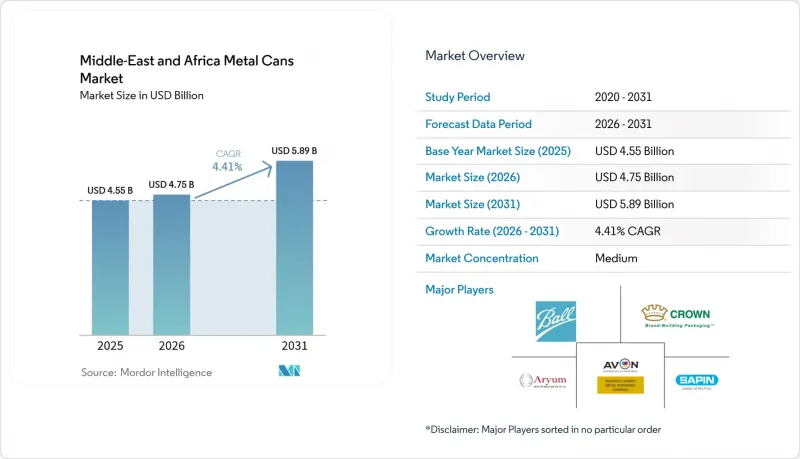
This report is Segmented by Material Type (Aluminium, and Steel), Can Structure (Two-Piece, Three-Piece, and Monobloc Aerosol), Capacity/Size (<=250 Ml, 250-500 Ml, 500-1, 000 Ml, and >1, 000 Ml), Manufacturing Process (D&I, and More), End-User Industry (Food, Beverage, Personal Care and Cosmetics, and More), and Geography. The Market Forecasts are Provided in Terms of Value (USD).
Middle-East And Africa Metal Cans Market Trends and Insights
Rising Disposable Income and Modern Retail Boost Packaged FandB Demand
Middle-class expansion across Egypt, Saudi Arabia, and South Africa funnels higher spending into packaged staples and indulgent ready-to-drink beverages. Egypt's processed-food exports climbed to USD 6.1 billion in 2024, up 21%, underscoring escalating production volumes that favor robust metal protection for shipping-intensive routes. Hypermarket chains proliferate, stocking premium canned products that promise tamper evidence and long shelf life. Vision 2030 aims for 70% industrial localization, channeling fresh demand to domestic can makers. New offerings like a Saudi date-sweetened cola illustrate brand use of lithographed aluminum to differentiate on crowded shelves. Rising oil income cushions further translate into greater acceptance of slightly dearer yet longer-lasting metal packaging.
Government Sustainability Mandates Spur Aluminium-Can Recycling
Kenya's Extended Producer Responsibility (EPR) law, effective May 2025, obliges can producers to register and finance post-use collection programs. South Africa has enforced similar rules since 2021, pushing Producer Responsibility Organizations to fund national recycling networks. The UAE supports this policy wave through Emirates Global Aluminium's USD 90 million recycling complex, already 50% complete by May 2025. These statutes lift recovered-metal feedstock availability, granting aluminum a circularity edge over multilayer plastics while supplying converters with lower-carbon billet that meets brand ESG goals.
Flexible Plastics Substitution in Price-Sensitive Food Segments
Large rural populations still base purchase decisions on unit cost, giving lightweight pouches an edge for staples like tomato paste or rice. Suppliers such as UFlex run 40,000 TPA film in the UAE and 114,000 TPA in Egypt, marketing metallized BOPET that mimics the barrier levels of cans at lower material weight. Senegal's 35% import tariffs on processed foods accentuate cost pressures, steering fillers to cheaper substrates. To stem share loss, can makers emphasize 100% recyclability, flavor neutrality and resistance to pilferage in remote logistics chains.
Other drivers and restraints analyzed in the detailed report include:
- Expansion of GCC Beverage-Can Capacity Lowers Import Reliance
- RTD Energy Drinks and Canned Coffee Adoption by Gen-Z Consumers
- Volatile Primary-Aluminium Premiums Amid Geopolitical Supply Risk
For complete list of drivers and restraints, kindly check the Table Of Contents.
Segment Analysis
Aluminum retained 70.76% of the Middle-East and Africa metal cans market share in 2025, vastly outstripping steel thanks to its 100% recyclability and favorable weight-to-strength ratio. Aluminum's superior circularity aligns with new EPR schemes and brand decarbonization targets, prompting producers to channel capex into billet casting and in-house scrap recovery. Emirates Global Aluminium's half-built recycling hub highlights this pivot, promising regional access to low-carbon feed that could unlock further lightweighting. Steel continues serving large-format food and industrial cans where impact resistance outweighs weight penalties; yet BPA substitute rules and higher freight costs curb its longer-term appeal. Novelis projects 4% annual demand growth for aluminum beverage sheet through 2031, underscoring confidence in the alloy's trajectory.
The Middle-East and Africa metal cans market size for aluminum is projected to expand alongside a robust 5.27% CAGR to 2031, supported by GCC mining deals totaling USD 9.32 billion that assure upstream supply. Regulatory carrots such as reduced EPR fees for high-recycled-content packs reinforce alloy uptake in beverage, pharmaceutical, and cosmetic lines. Steel's future hinges on cost leadership and niche applications like retortable 3-piece cans for industrial sauces, where thickness and dent resistance remain critical.
Two-piece designs delivered 54.12% share in 2025 due to their material-efficient draw and iron process that suits high-volume colas and energy drinks. Their thinner walls lower shipping mass, a boon for e-commerce distributors now handling rising beverage traffic. Monobloc aerosol cans, however, post the fastest 6.18% CAGR as personal care, household, and pharmaceutical sprays proliferate across emerging urban centers. Ball Corporation produces 1.2 billion aluminum aerosols annually, most carrying the Aluminum Stewardship Initiative certification that resonates with eco-minded shoppers. Three-piece formats survive where can height exceeds D&I limits, notably in powdered milk tins and bulk edible-oil packs.
Aerosol innovation centers on ultra-smooth internal coatings and dimensional accuracy for medical inhalers. Specialist firms apply plasma fluorocarbon layers to ensure zero drug interaction and accurate dosage control as Middle-East and Africa pharmacies broaden OTC shelves, demand for GMP-compliant aluminum canisters accelerates, widening the opportunity pool for highly automated extrusion lines. Converters simultaneously refine two-piece lines with taller draw ratios, enabling slim 250 ml cans popular among Gen-Z coffee drinkers.
Complete Report Scope:
- By Material Type
- Aluminium
- Steel
- By Can Structure
- Two-Piece
- Three-Piece
- Monobloc Aerosol
- By Capacity / Size
- <=250 ml
- 250-500 ml
- 500-1,000 ml
- >1,000 ml
- By Manufacturing Process
- Drawn and Ironed (D&I)
- Drawn and Redrawn (DRD)
- Impact Extrusion
- By End-User Industry
- Food
- Beverage
- Personal Care and Cosmetics
- Pharmaceuticals
- Paints and Industrial Chemicals
- Automotive Fluids and Lubricants
- Other End-User Industries
- By Geography
- Middle East and Africa
- Middle East
- Saudi Arabia
- United Arab Emirates
- Turkey
- Rest of Middle East
- Africa
- South Africa
- Nigeria
- Egypt
- Rest of Africa
- Middle East
- Middle East and Africa
List of Companies Covered in this Report:
- ARYUM Metal Aluminyum Tup Sanayi ve Ticaret A.S.
- Ball Corporation
- Crown Holdings, Inc.
- SAPIN Saudi Arabian Packaging Industry Co. Ltd.
- Avon Crowncaps and Containers Nigeria Ltd.
- Nampak Limited
- CANPACK S.A.
- Middle East Metal Can LLC
- Gulf Cans Industries LLC
- CanSmart (Pty) Ltd.
- Ardagh Group S.A.
- Silgan Containers LLC
- Trivium Packaging B.V.
- CCL Industries Inc.
- Novelis Inc.
- Toyo Seikan Group Holdings, Ltd.
- Mahmood Saeed Beverage Cans and Ends Industry Co. Ltd.
- ORG Technology Co., Ltd.
- Hindustan Tin Works Limited
- Sidel Group
Additional Benefits:
- The market estimate (ME) sheet in Excel format
- 3 months of analyst support
TABLE OF CONTENTS
1 INTRODUCTION
- 1.1 Study Assumptions and Market Definition
- 1.2 Scope of the Study
2 RESEARCH METHODOLOGY
3 EXECUTIVE SUMMARY
4 MARKET LANDSCAPE
- 4.1 Market Overview
- 4.2 Market Drivers
- 4.2.1 Rising disposable income and modern retail boost packaged FandB demand
- 4.2.2 Government sustainability mandates spur aluminium-can recycling
- 4.2.3 Expansion of GCC beverage-can capacity lowers import reliance
- 4.2.4 RTD energy drinks and canned coffee adoption by Gen-Z consumers
- 4.2.5 Halal-certified canned-food export surge within intra-MEA trade
- 4.2.6 E-commerce growth drives demand for dent-resistant lightweight packs
- 4.3 Market Restraints
- 4.3.1 Flexible plastics substitution in price-sensitive food segments
- 4.3.2 Volatile primary-aluminium premiums amid geopolitical supply risk
- 4.3.3 Weak post-consumer metal-collection systems in Sub-Saharan Africa
- 4.3.4 Regulatory uncertainty over BPA/PFAS can-linings
- 4.4 Industry Value Chain Analysis
- 4.5 Regulatory Landscape
- 4.6 Technological Outlook
- 4.7 Porter's Five Forces Analysis
- 4.7.1 Bargaining Power of Suppliers
- 4.7.2 Bargaining Power of Buyers/Consumers
- 4.7.3 Threat of New Entrants
- 4.7.4 Threat of Substitute Products
- 4.7.5 Intensity of Competitive Rivalry
- 4.8 The Impact of Macroeconomic Factors on the Market
- 4.9 Middle-East Metal Industry Landscape
5 MARKET SIZE AND GROWTH FORECASTS (VALUE)
- 5.1 By Material Type
- 5.1.1 Aluminium
- 5.1.2 Steel
- 5.2 By Can Structure
- 5.2.1 Two-Piece
- 5.2.2 Three-Piece
- 5.2.3 Monobloc Aerosol
- 5.3 By Capacity / Size
- 5.3.1 <=250 ml
- 5.3.2 250-500 ml
- 5.3.3 500-1,000 ml
- 5.3.4 >1,000 ml
- 5.4 By Manufacturing Process
- 5.4.1 Drawn and Ironed (D&I)
- 5.4.2 Drawn and Redrawn (DRD)
- 5.4.3 Impact Extrusion
- 5.5 By End-User Industry
- 5.5.1 Food
- 5.5.2 Beverage
- 5.5.3 Personal Care and Cosmetics
- 5.5.4 Pharmaceuticals
- 5.5.5 Paints and Industrial Chemicals
- 5.5.6 Automotive Fluids and Lubricants
- 5.5.7 Other End-User Industries
- 5.6 By Geography
- 5.6.1 Middle East and Africa
- 5.6.1.1 Middle East
- 5.6.1.1.1 Saudi Arabia
- 5.6.1.1.2 United Arab Emirates
- 5.6.1.1.3 Turkey
- 5.6.1.1.4 Rest of Middle East
- 5.6.1.2 Africa
- 5.6.1.2.1 South Africa
- 5.6.1.2.2 Nigeria
- 5.6.1.2.3 Egypt
- 5.6.1.2.4 Rest of Africa
- 5.6.1.1 Middle East
- 5.6.1 Middle East and Africa
6 COMPETITIVE LANDSCAPE
- 6.1 Market Concentration
- 6.2 Strategic Moves
- 6.3 Market Share Analysis
- 6.4 Company Profiles (includes Global level Overview, Market level overview, Core Segments, Financials as available, Strategic Information, Market Rank/Share for key companies, Products and Services, and Recent Developments)
- 6.4.1 ARYUM Metal Aluminyum Tup Sanayi ve Ticaret A.S.
- 6.4.2 Ball Corporation
- 6.4.3 Crown Holdings, Inc.
- 6.4.4 SAPIN Saudi Arabian Packaging Industry Co. Ltd.
- 6.4.5 Avon Crowncaps and Containers Nigeria Ltd.
- 6.4.6 Nampak Limited
- 6.4.7 CANPACK S.A.
- 6.4.8 Middle East Metal Can LLC
- 6.4.9 Gulf Cans Industries LLC
- 6.4.10 CanSmart (Pty) Ltd.
- 6.4.11 Ardagh Group S.A.
- 6.4.12 Silgan Containers LLC
- 6.4.13 Trivium Packaging B.V.
- 6.4.14 CCL Industries Inc.
- 6.4.15 Novelis Inc.
- 6.4.16 Toyo Seikan Group Holdings, Ltd.
- 6.4.17 Mahmood Saeed Beverage Cans and Ends Industry Co. Ltd.
- 6.4.18 ORG Technology Co., Ltd.
- 6.4.19 Hindustan Tin Works Limited
- 6.4.20 Sidel Group
7 MARKET OPPORTUNITIES AND FUTURE OUTLOOK
- 7.1 White-space and Unmet-Need Assessment

