PUBLISHER: Mordor Intelligence | PRODUCT CODE: 2117205

PUBLISHER: Mordor Intelligence | PRODUCT CODE: 2117205
India Metal Cans - Market Share Analysis, Industry Trends & Statistics, Growth Forecasts (2026 - 2031)
According to Mordor Intelligence, the India metal cans market size is expected to grow from USD 1.72 billion in 2025 to USD 1.79 billion in 2026 and is forecast to reach USD 2.21 billion by 2031 at 4.24% CAGR over 2026-2031.
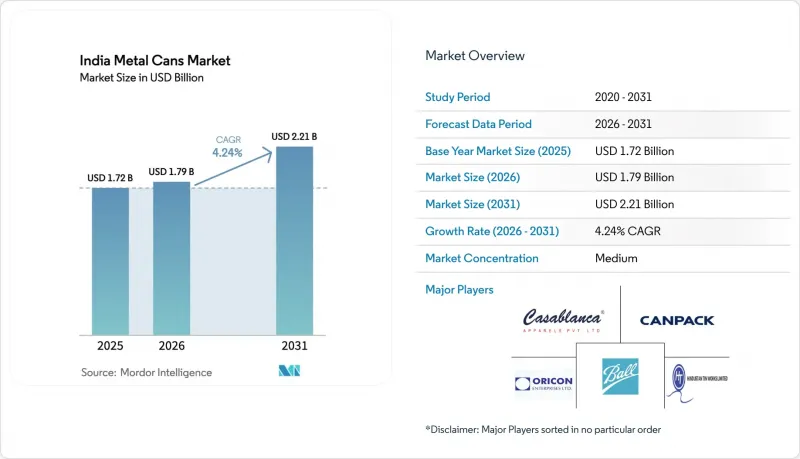
This report is Segmented by Material Type (Aluminium, and Steel), Can Structure (Two-Piece, Three-Piece, and Monobloc Aerosol), Capacity/Size (<=250 Ml, 250-500 Ml, 500-1, 000 Ml, and >1, 000 Ml), Manufacturing Process (Drawn and Ironed, Drawn and Redrawn, and Impact Extrusion), End-User Industry (Food, Beverage, Personal Care and Cosmetics, and More). The Market Forecasts are Provided in Terms of Value (USD)
India Metal Cans Market Trends and Insights
Rapid Growth in Convenience and RTD Foods
Shelf-stable ready-to-drink meals and beverages are pushing manufacturers to adopt metal packaging that supports 18-month ambient life spans, minimizes refrigeration costs, and allows premium positioning on modern retail shelves. The government's Pradhan Mantri Kisan Sampada Yojana has earmarked INR 6,000 crore (USD 720 million) toward food-processing infrastructure, directly backing 42 mega parks that house new canning lines. Brands such as Tata Consumer Products capitalized on this support by introducing 180 ml RTD coffee cans in October 2024, priced 15-20% above PET alternatives yet registering higher off-take in metro supermarkets.Aluminum's strong barrier against oxygen and light maintains flavor integrity, allowing processors to promise authentic chai or coffee taste without cold chain reliance. Subsidies covering 35% of capital cost for canning equipment further tilt the economics in favor of metal, especially for small-format packs geared toward portion-control and premium margins. As organized retail penetration climbs past 12% of India's grocery turnover in 2025, the India metal cans market gains a durable growth engine.
Increasing Beverage-Can Uptake in Craft Beer and Energy Drinks
Aluminum's light weight reduces logistics expenses by around 30% compared with glass, crucial for independent breweries shipping to distant metros. Craft labels in Goa, Maharashtra, and Karnataka increasingly choose 330 ml and 500 ml sizes that fit premium pricing while safeguarding carbonation. Energy-drink makers tout aluminum's thermal conductivity for rapid chilling an important impulse-purchase trigger in India's hot climate. Industry feedback indicates 25% quicker inventory rotation for canned SKUs thanks to extended shelf life and lower breakage. Moreover, the Bureau of Indian Standards' IS 18427 certification, finalized in 2024, gives alcoholic-beverage producers a clear compliance path that removes earlier regulatory ambiguity. As these niche categories scale, the India metal cans market receives incremental high-margin volume that offsets softer demand in commoditized soft-drink segments.
PET and Flexible-Packaging Substitution Pressure
PET bottles and retort pouches still undercut cans by 20-30% on material cost, swaying price-sensitive fillers in carbonated soft drinks and edible oils. Private-equity firm PAG's INR 8,400 crore (USD 1.01 billion) purchase of Manjushree Technopack in November 2024 underscores investor appetite for plastics. PET's clarity caters to consumers who prefer visual product validation, while flexible packs enable stand-up pouches that occupy less shelf space. Plastic players are investing in bottle-to-bottle recycling infrastructure to blunt aluminum's sustainability edge, an effort that could temper the India metal cans market's near-term growth in mass-market segments. Even so, aluminum retains dominance where internal pressure or taste protection is non-negotiable, giving cans a secure beachhead despite substitution risk.
Other drivers and restraints analyzed in the detailed report include:
- Higher Recycling Rates and Circular-Economy Regulations
- Aerosol Demand Surge in Personal-Care Segment
- Volatility in Aluminum and Tin-Plate Costs
For complete list of drivers and restraints, kindly check the Table Of Contents.
Segment Analysis
Aluminum retained 69.92% share of the India metal cans market in 2025, supported by domestic smelter capacity that shields converters from import exposure. The segment is set to post a 4.95% CAGR, underpinned by Hindalco's recycling expansion, which lowers input costs by 20% versus primary metal. Tin-coated steel holds niche relevance in foods demanding elevated sulfur-corrosion resistance, yet its weight disadvantage limits penetration in beverages and aerosols. Consumers increasingly associate aluminum with premium, eco-friendly credentials, reinforcing its dominant role across multiple pack sizes. Supply-chain resilience and regulatory favorability ensure aluminum's grip on the India metal cans market remains firm.
Secondary products such as steel cans for curries and pickles exploit three-piece construction that allows necking and shaping flexibility. However, limited domestic tin-plate manufacturing forces dependence on imports, increasing landed cost and constraining growth. Continuous investments in lightweight aluminum alloys and water-based interior lacquers further widen the performance gap, confirming aluminum as the mainstay of the India metal cans market.
Two-piece drawn-and-wall-ironed (DWI) cans delivered 52.74% share in 2025 thanks to material efficiency and high-speed production lines exceeding 2,000 cans/minute. Seamless walls prevent micro-leaks in carbonated beverages, supporting extended distribution cycles vital in a country where refrigeration grids remain uneven. CANPACK's Uttar Pradesh facility breaking ground in February 2025 will add over 2 billion DWI units annually, easing supply tightness. Monobloc aerosol formats, though only 8.12% of unit volume, are expanding at a market-leading 5.61% CAGR as grooming habits evolve and pharmaceutical inhalers gain traction.
Three-piece bodies continue to serve food staples like ghee and condensed milk, where internal vacuum rather than pressure is the chief concern. Yet sustained capital inflows into DWI automation suggest two-piece cans will keep absorbing market share, once again highlighting productivity as a central lever in the India metal cans market.
Complete Report Scope:
- By Material Type
- Aluminium
- Steel
- By Can Structure
- Two-Piece
- Three-Piece
- Monobloc Aerosol
- By Capacity / Size
- <=250 ml
- 250-500 ml
- 500-1,000 ml
- >1,000 ml
- By Manufacturing Process
- Drawn and Ironed (D & I)
- Drawn and Redrawn (DRD)
- Impact Extrusion
- By End-User Industry
- Food
- Beverage
- Personal Care and Cosmetics
- Pharmaceuticals
- Paints and Industrial Chemicals
- Automotive Fluids and Lubricants
- Other End-User Industry
List of Companies Covered in this Report:
- Ball Corporation
- Crown Holdings, Inc.
- Can-Pack S.A.
- Silgan Containers LLC
- Hindustan Tin Works Ltd.
- Kaira Can Company Limited
- Shetron Limited
- Oricon Enterprises Limited
- Casablanca Industries Pvt. Ltd.
- Asian Aerosol Group Pvt. Ltd.
- Toyo Seikan Group Holdings, Ltd.
- Envases Universales India Pvt. Ltd.
- SVP Industries Pvt. Ltd.
- Euro Can Manufacturing India Pvt. Ltd.
- Metal Container (India) Pvt. Ltd.
- Tata Tinplate Company of India Ltd.
- Mahendra CIE Automotive Ltd. - Packaging Division
- JL Morison (India) Ltd. - Aerosol Cans
- Hindustan Coca-Cola Beverages Pvt. Ltd. - Can Division
- Paharpur 3P - Metal Can Unit
Additional Benefits:
- The market estimate (ME) sheet in Excel format
- 3 months of analyst support
TABLE OF CONTENTS
1 INTRODUCTION
- 1.1 Study Assumptions and Market Definition
- 1.2 Scope of the Study
2 RESEARCH METHODOLOGY
3 EXECUTIVE SUMMARY
4 MARKET LANDSCAPE
- 4.1 Market Overview
- 4.2 Market Drivers
- 4.2.1 Rapid Growth in Convenience and RTD Foods
- 4.2.2 Increasing Beverage-Can Uptake in Craft Beer and Energy Drinks
- 4.2.3 Higher Recycling Rates and Circular-Economy Regulations
- 4.2.4 Aerosol Demand Surge in Personal-Care Segment
- 4.2.5 Rise of Indigenous Chai/Coffee in a Can SKUs
- 4.2.6 Rural Fruit-Processing Clusters Adopting Canning
- 4.3 Market Restraints
- 4.3.1 PET and Flexible-Packaging Substitution Pressure
- 4.3.2 Volatility in Aluminium and Tin-Plate Costs
- 4.3.3 Domestic Tin-Plate Supply Bottlenecks
- 4.3.4 EPR Cost-Pass-Through Uncertainty
- 4.4 Industry Value Chain Analysis
- 4.5 Regulatory Landscape
- 4.6 Technological Outlook
- 4.7 Porters Five Forces Analysis
- 4.7.1 Bargaining Power of Suppliers
- 4.7.2 Bargaining Power of Buyers
- 4.7.3 Threat of New Entrants
- 4.7.4 Threat of Substitutes
- 4.7.5 Intensity of Competitive Rivalry
- 4.8 The Impact of Macroeconomic Factors on the Market
5 MARKET SIZE AND GROWTH FORECASTS (VALUE)
- 5.1 By Material Type
- 5.1.1 Aluminium
- 5.1.2 Steel
- 5.2 By Can Structure
- 5.2.1 Two-Piece
- 5.2.2 Three-Piece
- 5.2.3 Monobloc Aerosol
- 5.3 By Capacity / Size
- 5.3.1 <=250 ml
- 5.3.2 250-500 ml
- 5.3.3 500-1,000 ml
- 5.3.4 >1,000 ml
- 5.4 By Manufacturing Process
- 5.4.1 Drawn and Ironed (D & I)
- 5.4.2 Drawn and Redrawn (DRD)
- 5.4.3 Impact Extrusion
- 5.5 By End-User Industry
- 5.5.1 Food
- 5.5.2 Beverage
- 5.5.3 Personal Care and Cosmetics
- 5.5.4 Pharmaceuticals
- 5.5.5 Paints and Industrial Chemicals
- 5.5.6 Automotive Fluids and Lubricants
- 5.5.7 Other End-User Industry
6 COMPETITIVE LANDSCAPE
- 6.1 Market Concentration
- 6.2 Strategic Moves
- 6.3 Market Share Analysis
- 6.4 Company Profiles (includes Global-level Overview, Market-level Overview, Core Segments, Financials as available, Strategic Information, Market Rank/Share, Products and Services, and Recent Developments)
- 6.4.1 Ball Corporation
- 6.4.2 Crown Holdings, Inc.
- 6.4.3 Can-Pack S.A.
- 6.4.4 Silgan Containers LLC
- 6.4.5 Hindustan Tin Works Ltd.
- 6.4.6 Kaira Can Company Limited
- 6.4.7 Shetron Limited
- 6.4.8 Oricon Enterprises Limited
- 6.4.9 Casablanca Industries Pvt. Ltd.
- 6.4.10 Asian Aerosol Group Pvt. Ltd.
- 6.4.11 Toyo Seikan Group Holdings, Ltd.
- 6.4.12 Envases Universales India Pvt. Ltd.
- 6.4.13 SVP Industries Pvt. Ltd.
- 6.4.14 Euro Can Manufacturing India Pvt. Ltd.
- 6.4.15 Metal Container (India) Pvt. Ltd.
- 6.4.16 Tata Tinplate Company of India Ltd.
- 6.4.17 Mahendra CIE Automotive Ltd. - Packaging Division
- 6.4.18 JL Morison (India) Ltd. - Aerosol Cans
- 6.4.19 Hindustan Coca-Cola Beverages Pvt. Ltd. - Can Division
- 6.4.20 Paharpur 3P - Metal Can Unit
7 MARKET OPPORTUNITIES AND FUTURE OUTLOOK
- 7.1 White-Space and Unmet-Need Assessment

