PUBLISHER: Mordor Intelligence | PRODUCT CODE: 2116393

PUBLISHER: Mordor Intelligence | PRODUCT CODE: 2116393
India Collagen - Market Share Analysis, Industry Trends & Statistics, Growth Forecasts (2026 - 2031)
According to Mordor Intelligence, the India collagen market size is expected to grow from USD 70.31 million in 2025 to USD 76.02 million in 2026 and is forecast to reach USD 112.27 million by 2031 at 8.13% CAGR over 2026-2031.
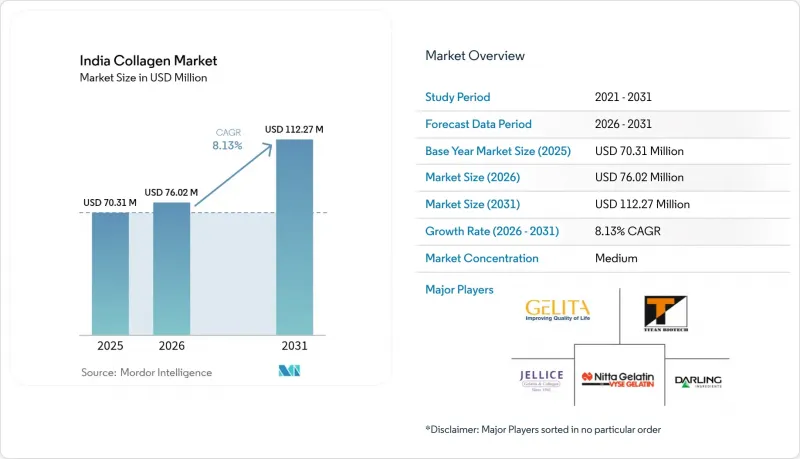
This report is Segmented by Source (Animal-Based, Marine-Based, Plant-Based), by Product Type (Gelatin, Hydrolyzed Collagen, and Native/Undenatured Collagen), by Form (Powder, Liquid), and by Application (Food and Beverages, Cosmetics and Personal Care, Dietary Supplements, Others). The Market Forecasts are Provided in Terms of Value (USD) and Volume (Tons).
India Collagen Market Trends and Insights
Aging Population and Beauty Consciousness
India's demographic transition presents distinct market opportunities for collagen products due to its large working-age population and accelerating aging trends. The country has the world's largest youth population, while its elderly segment is growing significantly. According to the United Nations Population Fund, the population aged 60 and above is expected to increase from 153 million in 2023 to 347 million by 2050. This demographic shift generates demand across therapeutic and lifestyle enhancement applications, driven by increased aging awareness and beauty consciousness. Clinical evidence demonstrating collagen's benefits for joint health, skin elasticity, and bone mineral density over 12-month periods has helped address consumer skepticism and increase market acceptance. The younger population segment increasingly uses collagen for preventive purposes, while older consumers focus on its therapeutic applications. States such as Kerala and Tamil Nadu, which are projected to reach peak population around 2040, are positioned to be early adopters of age-management products. While FSSAI regulations currently govern safety standards, potential oversight from the Central Drugs Standard Control Organization (CDSCO) may enhance quality requirements and lead to market consolidation.
Sports and Performance Nutrition
Sports and performance nutrition in India is experiencing significant growth due to increased government investment. The Ministry of Youth Affairs and Sports has allocated ₹3,790.50 crore for 2021-22 to 2025-26, expanding program coverage and improving sports infrastructure. This enhanced support is promoting athletic participation, which increases the demand for advanced nutrition solutions, including collagen supplements, among professional athletes and fitness enthusiasts. The regulatory oversight of protein claims has enhanced the market position of collagen peptides, supported by their Generally Recognized as Safe (GRAS) status and proven benefits in diabetes management and joint health. The adoption of performance nutrition products is growing in metropolitan areas, driven by increased gym memberships and fitness awareness. Specialized formulations, such as Rousselot's Nextida GC, which demonstrates a 42% reduction in post-meal glucose spikes, expand the market beyond traditional joint health applications. The Food Safety and Standards Authority of India's (FSSAI) strict protein supplement regulations present opportunities for compliant collagen manufacturers. Additionally, the younger demographic's preference for clean-label, scientifically validated nutrition products strengthens collagen's market position compared to synthetic alternatives.
Raw-Material Supply Limitations
India's collagen supply chain faces structural constraints due to its dependence on imported raw materials for gelatin production. Marine collagen availability is restricted by seasonal fishing patterns and inadequate processing infrastructure. The concentration of seafood processing facilities in coastal states creates logistical challenges, while religious and cultural factors limit the availability of bovine and porcine raw materials. GELITA developed specialized technologies, such as RXL gelatin, to address processing constraints in the Asia-Pacific region, demonstrating industry recognition of infrastructure limitations. Marine-derived collagen prices fluctuate due to climate-related variations in fish catch volumes. The absence of an integrated cold-chain infrastructure between source locations and processing facilities increases raw material deterioration and operational costs. Manufacturers, especially smaller ones without long-term supply agreements, face supply security risks and currency exposure due to their reliance on imported specialized collagen.
Other drivers and restraints analyzed in the detailed report include:
- Expansion of Functional Food and Beverage Offerings
- Pet Health and Animal Nutrition
- Religious and Ethical Dietary Restrictions
For complete list of drivers and restraints, kindly check the Table Of Contents.
Segment Analysis
Animal-based collagen holds a dominant market share of 54.48% in 2025, supported by well-established supply chains and cost advantages. Marine-based collagen is experiencing rapid growth with a 9.05% CAGR through 2031, driven by sustainability considerations and broader religious dietary acceptance. Bovine collagen leads the animal segment due to abundant raw materials and existing processing infrastructure. However, its market reach is limited in regions with significant Hindu populations. Porcine collagen faces market limitations due to Islamic dietary restrictions, creating distribution challenges for manufacturers. Marine collagen, despite higher prices, offers religious acceptability and environmental benefits that attract environmentally conscious consumers. The utilization of fish processing waste provides a cost-effective source for marine collagen production.
Biotechnology advancements have enabled the development of plant-based collagen alternatives. These include laboratory-produced vegan collagen, created by introducing human collagen genes into microorganisms. While these alternatives provide cruelty-free options, their production costs exceed traditional collagen sources. The combination of increasing sustainability demands and religious dietary considerations supports the continued growth of marine collagen, despite its premium pricing.
Hydrolyzed collagen shows the highest growth rate at 8.64% CAGR through 2031, while gelatin maintains market dominance with a 48.05% share in 2025. Gelatin's market leadership position results from its widespread use in food and pharmaceutical applications, cost-effectiveness, and functional versatility across multiple end-uses. Native/undenatured collagen serves specific therapeutic segments, particularly in joint health applications where type II collagen's structural properties are essential and command premium prices.
Hydrolyzed collagen peptides are gaining increasing adoption in dietary supplements and cosmetics due to superior absorption rates, supported by clinical evidence. Manufacturers leverage advanced processing technologies to produce hydrolyzed collagen with specific molecular weights for different applications. For example, Rousselot's Nextida GC platform demonstrates the expanding applications of hydrolyzed collagen, achieving a 42% reduction in post-meal glucose levels and extending beyond traditional joint health markets.
Complete Report Scope:
- By Source
- Animal-Based
- Marine-Based
- Plant-Based
- By Product Type
- Gelatin
- Hydrolyzed Collagen
- Native/Undenatured Collagen
- By Form
- Powder
- Liquid
- By Application
- Food and Beverages
- Cosmetics and Personal Care
- Dietary Supplements
- Others
List of Companies Covered in this Report:
- Nitta Gelatin India Ltd
- Gelita AG
- Rousselot (Darling Ingredients)
- Jellice Group
- Wellbeing Nutrition
- HealthKart (HK Vitals)
- Carbamide Forte
- Titan Biotech
- Shiseido
- Dabur India
- Abbott India
- Herbalife Nutrition
- Cargill
- Darling Ingredients India
- Lumenis
- Cutera
- EndyMed Medical
- Integra LifeSciences
- Coloplast
- Smith & Nephew
- Johnson & Johnson
Additional Benefits:
- The market estimate (ME) sheet in Excel format
- 3 months of analyst support
TABLE OF CONTENTS
1 INTRODUCTION
- 1.1 Study Assumptions and Market Definition
- 1.2 Scope of the Study
2 RESEARCH METHODOLOGY
3 EXECUTIVE SUMMARY
4 MARKET LANDSCAPE
- 4.1 Market Overview
- 4.2 Market Drivers
- 4.2.1 Aging population and beauty consciousness
- 4.2.2 Sports and performance nutrition
- 4.2.3 Expansion of functional food and beverage offerings
- 4.2.4 Pet health and animal nutrition
- 4.2.5 Increasing vegan and specialty source options
- 4.2.6 Product label transparency and clean-label demand
- 4.3 Market Restraints
- 4.3.1 Raw-material supply limitations
- 4.3.2 Religious and ethical dietary restrictions
- 4.3.3 Stability and shelf-life issues
- 4.3.4 Evidence gap and consumer skepticism on efficacy
- 4.4 Supply-Chain Analysis
- 4.5 Regulatory and Technological Outlook
- 4.6 Porter's Five Forces Analysis
- 4.6.1 Threat of New Entrants
- 4.6.2 Bargaining Power of Buyers
- 4.6.3 Bargaining Power of Suppliers
- 4.6.4 Threat of Substitutes
- 4.6.5 Intensity of Competitive Rivalry
5 MARKET SIZE AND GROWTH FORECASTS (VALUE AND VOLUME)
- 5.1 By Source
- 5.1.1 Animal-Based
- 5.1.2 Marine-Based
- 5.1.3 Plant-Based
- 5.2 By Product Type
- 5.2.1 Gelatin
- 5.2.2 Hydrolyzed Collagen
- 5.2.3 Native/Undenatured Collagen
- 5.3 By Form
- 5.3.1 Powder
- 5.3.2 Liquid
- 5.4 By Application
- 5.4.1 Food and Beverages
- 5.4.2 Cosmetics and Personal Care
- 5.4.3 Dietary Supplements
- 5.4.4 Others
6 COMPETITIVE LANDSCAPE
- 6.1 Market Concentration
- 6.2 Strategic Moves
- 6.3 Market Ranking Analysis
- 6.4 Company Profiles {(includes Global level Overview, Market level overview, Core Segments, Financials as available, Strategic Information, Market Rank/Share for key companies, Products and Services, and Recent Developments)}
- 6.4.1 Nitta Gelatin India Ltd
- 6.4.2 Gelita AG
- 6.4.3 Rousselot (Darling Ingredients)
- 6.4.4 Jellice Group
- 6.4.5 Wellbeing Nutrition
- 6.4.6 HealthKart (HK Vitals)
- 6.4.7 Carbamide Forte
- 6.4.8 Titan Biotech
- 6.4.9 Shiseido
- 6.4.10 Dabur India
- 6.4.11 Abbott India
- 6.4.12 Herbalife Nutrition
- 6.4.13 Cargill
- 6.4.14 Darling Ingredients India
- 6.4.15 Lumenis
- 6.4.16 Cutera
- 6.4.17 EndyMed Medical
- 6.4.18 Integra LifeSciences
- 6.4.19 Coloplast
- 6.4.20 Smith & Nephew
- 6.4.21 Johnson & Johnson
7 MARKET OPPORTUNITIES AND FUTURE OUTLOOK

