PUBLISHER: Mordor Intelligence | PRODUCT CODE: 2113759

PUBLISHER: Mordor Intelligence | PRODUCT CODE: 2113759
India Automotive Camera - Market Share Analysis, Industry Trends & Statistics, Growth Forecasts (2026 - 2031)
According to Mordor Intelligence, the India automotive camera market size was valued at USD 302.21 million in 2025 and estimated to grow from USD 347.42 million in 2026 to reach USD 697.67 million by 2031, at a CAGR of 14.96% during the forecast period (2026-2031).
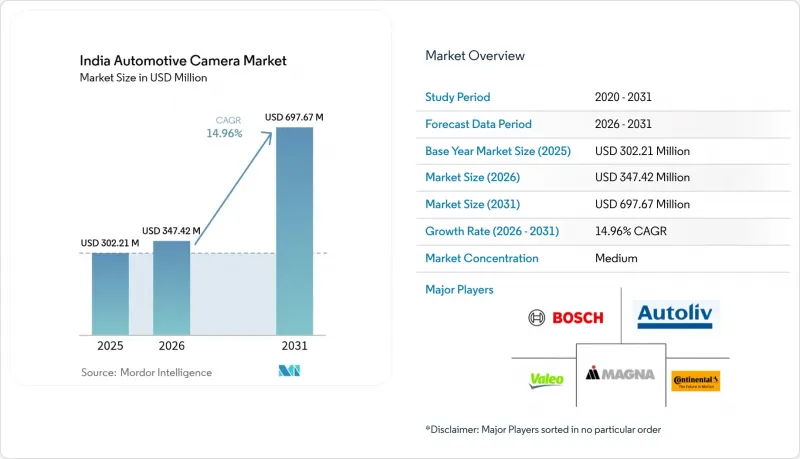
This report is Segmented by Vehicle Type (Passenger Vehicle and Commercial Vehicle), Camera Type (Viewing Camera and Sensing Camera), Application (ADAS, Parking and Surround View, and Driver Monitoring), Resolution (Up To 1 MP and More), Sales Channel (OEM-Fit and Aftermarket), Mounting Location (Front View, Rear View, and More), and Region. The Market Forecasts are Provided in Terms of Value (USD).
India Automotive Camera Market Trends and Insights
Stricter AIS-150 and Bharat NCAP Safety Mandates
Regulatory frameworks reshape the Indian automotive camera market as AIS-150 compels electronic stability control and advanced braking across vehicle categories beginning 2026. Bharat NCAP scores tie directly to camera-enabled ADAS, prompting Mahindra, Hyundai, and Tata to add Level 2 functions in mid-tier trims to secure higher ratings. Phased timelines help firms spread investment, yet small OEMs grapple with certification costs that ultimately favor suppliers holding proven safety credentials. Consumer awareness grows as NCAP star labels appear in showroom marketing, reinforcing camera demand nationwide.
Rising Demand for Parking-Assist and Surround-View Features
As urban areas grapple with congestion and dwindling parking spaces, there's a rising interest in camera-based driver assistance systems. Technologies like parking aids and surround-view cameras are in high demand, especially in premium vehicles that now boast sophisticated multi-camera setups for navigating tight city streets. Meanwhile, budget-friendly rear-view cameras are making waves in the aftermarket, with many drivers opting to enhance older vehicles for improved visibility. The surge in parking-related insurance claims underscores the growing consumer reliance on these visual aids, solidifying their presence across various vehicle segments.
Harsh Climatic and Road-Dust Conditions Impairing Sensors
Indian summers top 50 °C, monsoons bring torrents, and seasonal dust storms coat windscreens. These extreme fog lenses cause condensation in housings and degrade electronics. Owners often ignore frequent cleaning, leading to image loss that erodes trust. Suppliers respond with rugged IP-rated units and hydrophobic coatings, inflating bills of material and lengthening test cycles at dedicated climatic chambers.
Other drivers and restraints analyzed in the detailed report include:
- Declining CMOS Camera Costs and Localized Supply Chains
- Usage-Based Insurance Analytics Leveraging Camera Data
- Consumer Privacy Concerns on In-Cabin Monitoring
For complete list of drivers and restraints, kindly check the Table Of Contents.
Segment Analysis
Passenger models generated 71.63% of 2025 revenue, underscoring the Indian automotive camera market's focus on consumer safety features. Commercial fleets, however, will post a 16.98% CAGR as electrification rules and logistics digitization spur mandatory monitoring. Passenger-car demand matches rising disposable income and technology differentiation, while fleet operators chase lower insurance premiums and accident liability reductions.
Commercial sales cycles are longer, yet telematics-linked discounts yield rapid ROI. OEM line-fit solutions simplify compliance and warranty management for both segments, although retrofits still appeal to budget-minded transporters upgrading legacy trucks. Passenger car camera take-rates escalate with every model refresh, driven by competitive launches from Mahindra, Hyundai, and Tata that now bundle basic ADAS under INR 20 lakh (~ USD 22,500).
Viewing units held 62.74% of shipments in 2025 as consumers prioritized parking ease. Sensing cameras will advance at an 18.12% CAGR through 2031, fueled by stereo configurations supporting lane-keeping and collision avoidance. Mono setups dominate entry-level builds thanks to lower cost, while stereo platforms emerge in premium crossovers touting Level 2 assistance.
The Indian automotive camera market size for sensing modules gains as processors drop in price and vision algorithms run efficiently on vehicle controllers. Upgrade complexity introduces calibration service revenue for workshops and gives software-centric suppliers a fresh edge. Viewing cameras remain relevant but cede share as NCAP-driven active safety rules migrate from premium to mid-range trims.
Complete Report Scope:
- By Vehicle Type
- Passenger Vehicle
- Hatchback
- Sedan
- Sport Utility Vehicle and Multi-Purpose Vehicle
- Commercial Vehicle
- Light Commercial Vehicle
- Medium and Heavy Commercial Vehicle
- Passenger Vehicle
- By Camera Type
- Viewing Camera
- Sensing Camera
- Mono
- Stereo
- By Application
- ADAS
- Parking & Surround View
- Driver Monitoring
- By Resolution
- Up to 1 MP
- 2-5 MP
- Above 5 MP
- By Sales Channel
- OEM-Fit
- Aftermarket
- By Mounting Location
- Front View
- Rear View
- Side View
- Interior/In-Cabin
- By Region
- North
- South
- West
- East & North-East
List of Companies Covered in this Report:
- Robert Bosch GmbH
- Continental AG
- Valeo S.A.
- Panasonic Holdings Corporation
- Gentex Corporation
- Magna International Inc.
- Autoliv Inc.
- Denso Corporation
- LG Innotek Co., Ltd.
- Samsung Electro-Mechanics Co., Ltd.
- Omnivision Technologies, Inc.
- Motherson Sumi Wiring India Limited
- Pricol Limited
- Uno Minda Limited
- Hikvision Automotive Electronics Co., Ltd.
- Hero Electronix Private Limited
- Cubtek Inc.
- Mobileye Global Inc.
- Ficosa International S.A.
Additional Benefits:
- The market estimate (ME) sheet in Excel format
- 3 months of analyst support
TABLE OF CONTENTS
1 Introduction
- 1.1 Study Assumptions & Market Definition
- 1.2 Scope of the Study
2 Research Methodology
3 Executive Summary
4 Market Landscape
- 4.1 Market Overview
- 4.2 Market Drivers
- 4.2.1 Stricter AIS-150 and Bharat NCAP Safety Mandates
- 4.2.2 Rising Demand for Parking-Assist and ADAS Features
- 4.2.3 Declining CMOS Camera Costs and Localized Supply Chains
- 4.2.4 Volume Growth in Premium Hatchbacks and SUVs
- 4.2.5 PLI Incentives for Domestic Camera Module Manufacturing
- 4.2.6 Usage-Based Insurance Analytics Leveraging Camera Data
- 4.3 Market Restraints
- 4.3.1 Up-Front Cost Premiums in the Sub-INR-10-Lakh Segment
- 4.3.2 Harsh Climatic and Road-Dust Conditions Impairing Sensors
- 4.3.3 FX-Linked Import Dependence on Image Sensors
- 4.3.4 Consumer Privacy Concerns on in-Cabin Monitoring
- 4.4 Value / Supply-Chain Analysis
- 4.5 Regulatory Landscape
- 4.6 Technological Outlook
- 4.7 Porter's Five Forces
- 4.7.1 Threat of New Entrants
- 4.7.2 Bargaining Power of Buyers
- 4.7.3 Bargaining Power of Suppliers
- 4.7.4 Threat of Substitutes
- 4.7.5 Competitive Rivalry
5 Market Size and Growth Forecasts (Value, USD)
- 5.1 By Vehicle Type
- 5.1.1 Passenger Vehicle
- 5.1.1.1 Hatchback
- 5.1.1.2 Sedan
- 5.1.1.3 Sport Utility Vehicle and Multi-Purpose Vehicle
- 5.1.2 Commercial Vehicle
- 5.1.2.1 Light Commercial Vehicle
- 5.1.2.2 Medium and Heavy Commercial Vehicle
- 5.1.1 Passenger Vehicle
- 5.2 By Camera Type
- 5.2.1 Viewing Camera
- 5.2.2 Sensing Camera
- 5.2.2.1 Mono
- 5.2.2.2 Stereo
- 5.3 By Application
- 5.3.1 ADAS
- 5.3.2 Parking & Surround View
- 5.3.3 Driver Monitoring
- 5.4 By Resolution
- 5.4.1 Up to 1 MP
- 5.4.2 2-5 MP
- 5.4.3 Above 5 MP
- 5.5 By Sales Channel
- 5.5.1 OEM-Fit
- 5.5.2 Aftermarket
- 5.6 By Mounting Location
- 5.6.1 Front View
- 5.6.2 Rear View
- 5.6.3 Side View
- 5.6.4 Interior/In-Cabin
- 5.7 By Region
- 5.7.1 North
- 5.7.2 South
- 5.7.3 West
- 5.7.4 East & North-East
6 Competitive Landscape
- 6.1 Market Concentration
- 6.2 Strategic Moves
- 6.3 Market Share Analysis
- 6.4 Company Profiles (Includes Global level Overview, Market level overview, Core Segments, Financials as available, Strategic Information, Market Rank/Share, Products & Services, Recent Developments)
- 6.4.1 Robert Bosch GmbH
- 6.4.2 Continental AG
- 6.4.3 Valeo S.A.
- 6.4.4 Panasonic Holdings Corporation
- 6.4.5 Gentex Corporation
- 6.4.6 Magna International Inc.
- 6.4.7 Autoliv Inc.
- 6.4.8 Denso Corporation
- 6.4.9 LG Innotek Co., Ltd.
- 6.4.10 Samsung Electro-Mechanics Co., Ltd.
- 6.4.11 Omnivision Technologies, Inc.
- 6.4.12 Motherson Sumi Wiring India Limited
- 6.4.13 Pricol Limited
- 6.4.14 Uno Minda Limited
- 6.4.15 Hikvision Automotive Electronics Co., Ltd.
- 6.4.16 Hero Electronix Private Limited
- 6.4.17 Cubtek Inc.
- 6.4.18 Mobileye Global Inc.
- 6.4.19 Ficosa International S.A.
7 Market Opportunities & Future Outlook

