PUBLISHER: Mordor Intelligence | PRODUCT CODE: 2113984

PUBLISHER: Mordor Intelligence | PRODUCT CODE: 2113984
Temperature Management - Market Share Analysis, Industry Trends & Statistics, Growth Forecasts (2026 - 2031)
According to Mordor Intelligence, the temperature management market size is expected to increase from USD 3.20 billion in 2025 to USD 3.33 billion in 2026 and reach USD 4.03 billion by 2031, growing at a CAGR of 3.89% over 2026-2031.
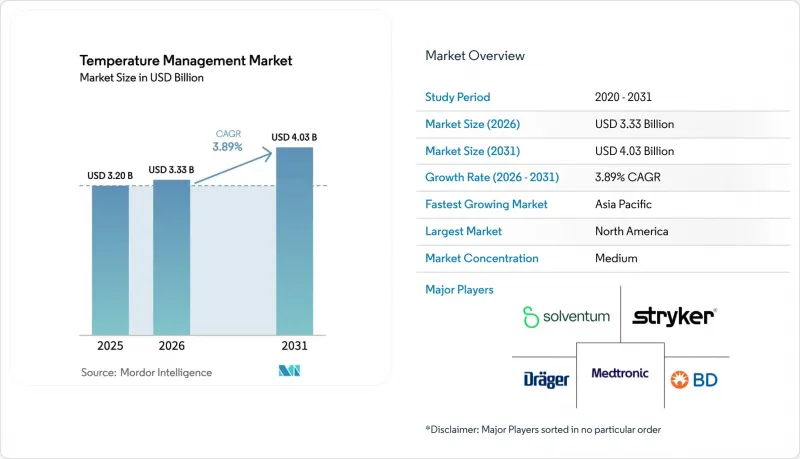
This report is Segmented by Product Type (Patient Warming Systems, Patient Cooling Systems, Accessories & Disposables), Application (Perioperative Care, Cardiac Arrest & Critical Care, Neurology & Stroke, Neonatal and Pediatric Care, Others), End User (Hospitals, and More), and Geography (North America, Europe, and More). The Market Forecasts are Provided in Terms of Value (USD).
Global Temperature Management Market Trends and Insights
Rising Prevalence of Chronic & Acute Conditions Requiring Temperature Control
Cardiovascular disease, stroke, and sepsis together prompted more than 30 million OECD hospitalizations in 2025, and all three benefit from precise temperature modulation to curtail neurological damage, coagulopathy, or organ failure. American Heart Association guidelines updated in 2024 require 32-36 °C cooling for 24 hours after cardiac arrest to reduce neurological sequelae. CDC data show 1.7 million U.S. sepsis hospitalizations in 2024; controlled normothermia lowers mortality by up to 12% in randomized trials. Asia-Pacific now records 13 million new strokes yearly, and early cooling within 6 hours improves 90-day outcomes, driving hospitals to expand device fleets. This epidemiological wave is expanding the temperature management market, particularly in neurocritical-care and cardiac-arrest units that demand rapid, servo-controlled systems. Procurement committees weigh evidence of shorter intensive-care stays and lower ventilator days when proactive temperature control is implemented.
Growing Global Surgical Volumes
Worldwide surgical procedures rebounded to roughly 400 million in 2024, exceeding pre-pandemic levels. Perioperative hypothermia below 36 °C occurs in up to 70% of patients under general anesthesia and heightens infection risk, transfusion requirements, and recovery times. The American Society of Anesthesiologists mandated active warming for procedures lasting more than 30 minutes in its 2024 advisory. Asia-Pacific leads growth: China performed 60 million inpatient surgeries in 2024 and India expanded capacity 12% year-over-year as district-level theaters opened. U.S. ambulatory surgical centers logged 28 million cases in 2024, adopting forced-air and conductive devices to meet Joint Commission norms. The temperature management market gains momentum as bariatric, robotic, and minimally invasive surgeries extend operative time and diminish endogenous heat production.
High Acquisition & Maintenance Costs
Advanced intravascular units list between USD 25,000 and USD 40,000, and disposable catheters cost USD 800-1,200 per patient, pressuring budgets under value-based payment. The American Hospital Association reported 62% of U.S. hospitals deferred capital purchases in 2024, placing temperature devices among the top-10 delayed categories. Ambulatory centers favor USD 10-15 forced-air blankets over high-capex alternatives to preserve margins. Service contracts add 8-12% of purchase price annually, covering calibration and software patches. Import duties and currency swings elevate landed costs in emerging markets; an Indian hospital buying a USD 30,000 system pays up to 30% extra in tariffs and logistics, lifting final outlay above USD 38,000. Such economics elongate replacement cycles and impede penetration in mid-tier facilities.
Other drivers and restraints analyzed in the detailed report include:
- Technological Advances in Intravascular & Surface Systems
- AI-Driven Predictive Thermoregulation Adoption in ICUs
- Product Recalls & Device Failures
For complete list of drivers and restraints, kindly check the Table Of Contents.
Segment Analysis
Patient Warming Systems, propelled by the perioperative rebound and updated ASA mandates, are forecast to increase at a 5.12% CAGR from 2026 to 2031. Forced-Air Warming maintains leadership due to USD 10-15 disposables and rapid deployment, yet infection-control concerns in orthopedic and cardiac theaters nurture conductive-blanket uptake. Blood and IV-Fluid Warmers gain momentum in trauma centers where rapid transfusion of cold blood risks coagulopathy. The temperature management market size for warming devices is projected to reach USD 1.95 billion by 2031, yet dual-mode innovators threaten forced-air incumbents with integrated precision and reduced airborne-particle load. Accessories and disposables dominate recurring revenue, locking institutions into single-supplier service contracts that enhance lifetime value.
Patient Cooling Systems continue to hold 48.81% of 2025 revenue but face headwinds from recent recalls and capital-budget scrutiny. Surface gel-pad systems remain ICU staples for fever management, whereas intravascular catheters capture neurology and cardiac-arrest protocols demanding +-0.2 °C control. The temperature management market share for surface cooling is expected to erode 2 percentage points by 2031 as dual-mode platforms proliferate. Evaporative units see renewed interest as emergency-department stock for heat-stroke spikes documented by the CDC. Integrated dual-mode designs, such as Thermogard XP, are carving niches in hybrid rooms where aortic arch repair alternates between deep hypothermia and rapid rewarming.
Complete Report Scope:
- By Product Type
- Patient Warming Systems
- Forced-air Warming Devices
- Conductive / Resistive Warming Devices
- Blood & IV-Fluid Warmers
- Integrated Dual-Mode Systems
- Patient Cooling Systems
- Surface Cooling Devices
- Intravascular Cooling Systems
- Evaporative / Air Cooling Systems
- Accessories & Disposables
- Patient Warming Systems
- By Application
- Perioperative Care
- Cardiac Arrest & Critical Care
- Neurology & Stroke
- Neonatal and Pediatric Care
- Others
- By End User
- Hospitals
- Ambulatory Surgical Centers
- Long-Term and Home-care Settings
- Others
- By Geography
- North America
- United States
- Canada
- Mexico
- Europe
- Germany
- United Kingdom
- France
- Italy
- Spain
- Rest of Europe
- Asia-Pacific
- China
- Japan
- India
- Australia
- South Korea
- Rest of Asia-Pacific
- Middle East and Africa
- GCC
- South Africa
- Rest of Middle East and Africa
- South America
- Brazil
- Argentina
- Rest of South America
- North America
Geography Analysis
North America retained 41.45% of 2025 revenue, bolstered by 50 million surgical procedures and early AI adoption in academic ICUs. The CDC heat-illness surge has pushed emergency departments to secure portable cooling devices, enlarging the temperature management market. Device recalls have forced procurement diversification, benefitting mid-tier vendors and spurring hospitals to negotiate dual-source contracts. Canada funds therapeutic hypothermia under provincial budgets, while Mexico's private chains add dual-mode systems to new hybrid theaters.
Asia-Pacific posts the highest regional CAGR at 5.05% for 2026-2031. China's CNY 1.55 trillion healthcare spend earmarks 1,000 county hospitals for surgical upgrades, each stipulating perioperative temperature control equipment. India's district-hospital expansion fuels forced-air blanket purchases, and private chains invest in intravascular cooling for neurocritical hubs. Japan's aging demographic elevates stroke-cooling demand, aided by 2024 reimbursement codes. South Korea leverages subsidies for domestic startups developing AI-integrated platforms. Australia's bushfire seasons heighten procurement of portable cooling units for emergency-department surge capacity.
Europe maintains significant share despite Medical Device Regulation (MDR) transition costs. Germany's Diagnosis-Related-Group codes incentivize therapeutic hypothermia post-cardiac arrest. NHS England's net-zero procurement policy favors energy-efficient conductive devices, nudging market share away from high-wattage forced-air systems. Heat-wave mortality in Italy and Spain catalyzes bulk orders for mobile cooling. Compliance hurdles under MDR have delayed small-firm launches, consolidating share among MDR-ready incumbents.
The Middle East & Africa benefit from mega-hospital projects under Saudi Vision 2030 and UAE Health Strategy 2025, each ICU bed budgeted with integrated temperature management systems. Field hospitals in Gulf nations now include industrial evaporative coolers for heat-stroke mass-casualty events. South Africa issues neonatal cooling tenders to cut birth-asphyxia deaths. South America records steady growth as Brazil's SUS funds perioperative warming upgrades and Argentina's private network chases accreditation.
- Augustine Surgical
- Barkey
- Baxter
- Beckton Dickinson
- Belmont Medical Technologies
- Cincinnati Sub-Zero Products
- Dragerwerk
- Ecolab
- Enthermics Medical Systems
- GE Healthcare
- Gentherm
- Geratherm Medical
- Inspiration Healthcare Group plc
- Medtronic
- Koninklijke Philips
- Smiths Group
- Solventum
- Stryker
- The 37Company
- Zoll Medical
Additional Benefits:
- The market estimate (ME) sheet in Excel format
- 3 months of analyst support
TABLE OF CONTENTS
1 Introduction
- 1.1 Study Assumptions & Market Definition
- 1.2 Scope of the Study
2 Research Methodology
3 Executive Summary
4 Market Landscape
- 4.1 Market Overview
- 4.2 Market Drivers
- 4.2.1 Rising prevalence of chronic & acute conditions requiring temperature control
- 4.2.2 Growing global surgical volumes
- 4.2.3 Technological advances in intravascular & surface systems
- 4.2.4 AI-driven predictive thermoregulation adoption in ICUs
- 4.2.5 Climate-change-induced surge in heat-illness emergencies
- 4.2.6 Portable TTM devices for pre-hospital / battlefield care
- 4.3 Market Restraints
- 4.3.1 High acquisition & maintenance costs
- 4.3.2 Product recalls & device failures
- 4.3.3 Tariff-driven component price volatility
- 4.3.4 Infection-control litigation slowing forced-air adoption
- 4.4 Value / Supply-Chain Analysis
- 4.5 Regulatory Landscape
- 4.6 Technological Outlook
- 4.7 Porter's Five Forces Analysis
- 4.7.1 Threat of New Entrants
- 4.7.2 Bargaining Power of Buyers
- 4.7.3 Bargaining Power of Suppliers
- 4.7.4 Threat of Substitutes
- 4.7.5 Competitive Rivalry
5 Market Size & Growth Forecasts (Value, USD)
- 5.1 By Product Type
- 5.1.1 Patient Warming Systems
- 5.1.1.1 Forced-air Warming Devices
- 5.1.1.2 Conductive / Resistive Warming Devices
- 5.1.1.3 Blood & IV-Fluid Warmers
- 5.1.1.4 Integrated Dual-Mode Systems
- 5.1.2 Patient Cooling Systems
- 5.1.2.1 Surface Cooling Devices
- 5.1.2.2 Intravascular Cooling Systems
- 5.1.2.3 Evaporative / Air Cooling Systems
- 5.1.3 Accessories & Disposables
- 5.1.1 Patient Warming Systems
- 5.2 By Application
- 5.2.1 Perioperative Care
- 5.2.2 Cardiac Arrest & Critical Care
- 5.2.3 Neurology & Stroke
- 5.2.4 Neonatal and Pediatric Care
- 5.2.5 Others
- 5.3 By End User
- 5.3.1 Hospitals
- 5.3.2 Ambulatory Surgical Centers
- 5.3.3 Long-Term and Home-care Settings
- 5.3.4 Others
- 5.4 By Geography
- 5.4.1 North America
- 5.4.1.1 United States
- 5.4.1.2 Canada
- 5.4.1.3 Mexico
- 5.4.2 Europe
- 5.4.2.1 Germany
- 5.4.2.2 United Kingdom
- 5.4.2.3 France
- 5.4.2.4 Italy
- 5.4.2.5 Spain
- 5.4.2.6 Rest of Europe
- 5.4.3 Asia-Pacific
- 5.4.3.1 China
- 5.4.3.2 Japan
- 5.4.3.3 India
- 5.4.3.4 Australia
- 5.4.3.5 South Korea
- 5.4.3.6 Rest of Asia-Pacific
- 5.4.4 Middle East and Africa
- 5.4.4.1 GCC
- 5.4.4.2 South Africa
- 5.4.4.3 Rest of Middle East and Africa
- 5.4.5 South America
- 5.4.5.1 Brazil
- 5.4.5.2 Argentina
- 5.4.5.3 Rest of South America
- 5.4.1 North America
6 Competitive Landscape
- 6.1 Market Concentration
- 6.2 Market Share Analysis
- 6.3 Company Profiles (includes Global level overview, Market level overview, Core Segments, Financials as available, Strategic Information, Market Rank/Share, Products & Services, Recent Developments)
- 6.3.1 Augustine Surgical
- 6.3.2 Barkey GmbH & Co. KG
- 6.3.3 Baxter International
- 6.3.4 Becton, Dickinson & Company
- 6.3.5 Belmont Medical Technologies
- 6.3.6 Cincinnati Sub-Zero Products
- 6.3.7 Dragerwerk AG & Co. KGaA
- 6.3.8 Ecolab Inc.
- 6.3.9 Enthermics Medical Systems
- 6.3.10 GE HealthCare
- 6.3.11 Gentherm Incorporated
- 6.3.12 Geratherm Medical AG
- 6.3.13 Inspiration Healthcare Group plc
- 6.3.14 Medtronic plc
- 6.3.15 Philips Healthcare
- 6.3.16 Smiths Medical (ICU Medical)
- 6.3.17 Solventum
- 6.3.18 Stryker Corporation
- 6.3.19 The 37Company
- 6.3.20 ZOLL Medical Corporation
7 Market Opportunities & Future Outlook
- 7.1 White-space & Unmet-need Assessment

