PUBLISHER: Mordor Intelligence | PRODUCT CODE: 2114067

PUBLISHER: Mordor Intelligence | PRODUCT CODE: 2114067
Fighter Aircraft - Market Share Analysis, Industry Trends & Statistics, Growth Forecasts (2026 - 2031)
According to Mordor Intelligence, the fighter aircraft market size was valued at USD 50.70 billion in 2025 and estimated to grow from USD 52.82 billion in 2026 to reach USD 64.84 billion by 2031, at a CAGR of 4.19% during the forecast period (2026-2031).
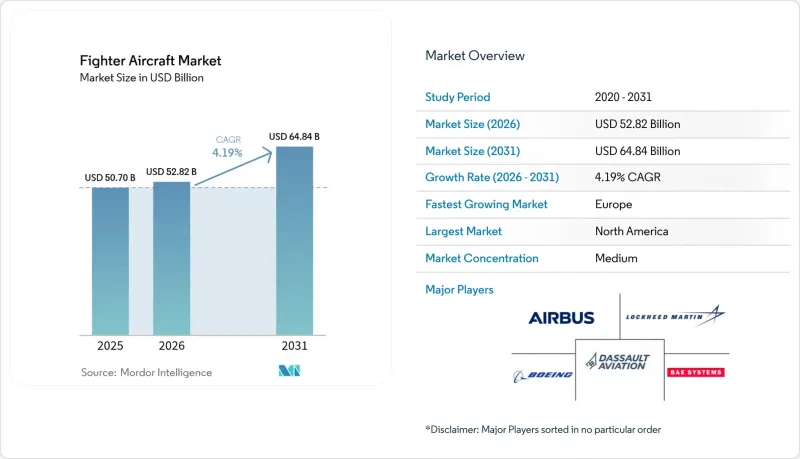
This report is Segmented by Take-Off and Landing (Conventional Take-Off and Landing, and More), Fighter Generation (4th Generation, and More), Engine Configuration (Single-Engine and Twin-Engine), Mission Role (Air-Superiority, and More), End User (Air Force, Naval Aviation, and More), and Geography (North America, Europe, and More). The Market Forecasts are Provided in Terms of Value (USD).
Global Fighter Aircraft Market Trends and Insights
Increasing Defense Budgets in Emerging APAC Economies
East Asian military spending rose to USD 411 billion in 2023, marking 6.2% annual growth that eclipsed the global average. India allocated USD 75 billion for defense in FY 2024-25, funneling roughly 30% of that toward capital projects such as the AMCA program. South Korea boosted its 2024 budget to USD 44.2 billion, prioritizing KF-21 production and F-35A expansion to deter regional threats. These sustained outlays underpin multi-year procurement pipelines for indigenous fighters and foreign military sales (FMS). Local production offsets, meanwhile, are catalyzing new joint-venture assembly lines and increasing long-term MRO workloads in the fighter aircraft market.
Recapitalization of Aging 4th-Generation Fleets with 5th-Generation Aircraft*
The US Air National Guard secured approval in 2025 to swap 54 F-15C/D jets for 42 F-35As and 21 F-15EXs, underscoring the urgency to retire maintenance-intensive airframes. Similar patterns prevail in Europe, where Spain ordered 25 additional Typhoons in 2024 and Finland's 64-unit F-35A program stays on track for 2030 completion. Escalating sustainment costs for legacy fighters-often aggravated by component cannibalization-are accelerating replacement schedules despite budget pressure. Operators also seek step-change stealth, sensor fusion, and electronic warfare (EW) performance unattainable via incremental upgrades. These tendencies anchor a stable demand baseline for 5th-generation jets through the decade.
Long Development Lead-Times and Cost Overruns
Weapons integration averages 38 months per store-aircraft combo, driving cumulative delays that balloon life-cycle cost projections. Europe's FCAS struggles to reconcile capability ambition with affordability, pushing milestone dates to the right. NGAD faces similar headwinds, with a unit-cost whisper number near USD 300 million sparking calls for program rescope. Prolonged design phases also risk obsolescence as threat envelopes evolve faster than certification queues. Customers, therefore, hedge with mixed fleets of proven 4.5th-generation platforms while monitoring next-gen maturation.
Other drivers and restraints analyzed in the detailed report include:
- Advanced Avionics Enabling Multi-Domain Operations
- Indigenous Fighter Programs for Strategic Sovereignty
- High Pilot-Training and Retention Costs
For complete list of drivers and restraints, kindly check the Table Of Contents.
Segment Analysis
Conventional CTOL aircraft generated 57.96% of the 2025 fighter aircraft market size, reflecting broad runway infrastructure and proven logistics chains. VTOL fighters, led by the F-35B, are rising at a 6.27% CAGR as European navies and the Indo-Pacific seek deck-launched capabilities for dispersed operations.
VTOL demand is further boosted by Agile Combat Employment doctrines that require flexibility under runway-denied conditions. STOL platforms remain niche but could see uplift as dispersed basing gains traction. These trends reshape OEM R&D budgets toward compact propulsion and thrust-vectoring modules to secure future fighter aircraft market share in carrier and expeditionary roles.
4.5th-generation designs controlled 41.37% of the fighter aircraft market share in 2025 amid ongoing upgrades to Typhoon, Rafale, and Super Hornet. Yet 6th-generation programs post an 8.16% CAGR, fueled by NGAD and GCAP roadmaps that feature adaptive engines, collaborative combat aircraft, and AI-enabled sensor fusion.
Producers of legacy 4th-generation fleets face dwindling order books as sustainment costs climb, pushing them toward service-life extensions and export financing solutions. In contrast, 5th-generation backlogs remain robust but are constrained by production chokepoints, keeping delivery slots full through 2030 even as 6th-generation demonstrators mature.
Complete Report Scope:
- By Take-off and Landing
- Conventional Take-off and Landing (CTOL)
- Short Take-off and Landing (STOL)
- Vertical Take-off and Landing (VTOL/STOVL)
- By Fighter Generation
- 4th Generation
- 4.5th Generation
- 5th Generation
- 6th Generation/NGAD
- By Engine Configuration
- Single-Engine
- Twin-Engine
- By Mission Role
- Air-Superiority
- Multi-Role
- Close-Air-Support/Strike
- By End User
- Air Force
- Naval Aviation
- Marine/Army Aviation
- By Geography
- North America
- United States
- Canada
- Mexico
- Europe
- United Kingdom
- France
- Germany
- Russia
- Rest of Europe
- Asia-Pacific
- China
- India
- Japan
- South Korea
- Rest of Asia-Pacific
- South America
- Brazil
- Rest of South America
- Middle East and Africa
- Middle East
- United Arab Emirates
- Saudi Arabia
- Rest of Middle East
- Africa
- South Africa
- Rest of Africa
- Middle East
- North America
Geography Analysis
North America generated 36.62% of the global fighter aircraft market revenue in 2025, anchored by F-35A, F-15EX, and forthcoming CCA orders. The region's share is stable, yet growth moderates as production ramps plateau and governmental focus tilts toward sustainability efficiencies.
Europe's fighter aircraft market size is forecasted to rise at a 6.43% CAGR. Russia's invasion of Ukraine catalyzed defense-spending uplifts exceeding NATO's 2% GDP pledge across multiple member states. FCAS and GCAP consortia inject substantial R&D outlays, while short-run deliveries of Typhoon Tranche 4 and Rafale F4 support immediate readiness.
Asia-Pacific exhibits bifurcated trajectories: US allies continue F-35 adoption, whereas China advances J-20 and J-31 production. India and South Korea pursue indigenous programs that stretch beyond 2030 but redirect local value addition upwards of 60%. Middle East operators prioritize turnkey capability, sustaining repeat F-15SA, F-35I, and Rafale contracts despite fiscal volatility linked to oil prices.
- Lockheed Martin Corporation
- The Boeing Company
- Airbus SE
- Saab AB
- Dassault Aviation SA
- BAE Systems plc
- United Aircraft Corporation
- Hindustan Aeronautics Limited
- Mitsubishi Heavy Industries, Ltd.
- Korea Aerospace Industries, Ltd.
- Turkish Aerospace Industries, Inc.
- Leonardo S.p.A.
- Embraer S.A.
- Textron Inc.
- Northrop Grumman Corporation
- Kawasaki Heavy Industries, Ltd.
Additional Benefits:
- The market estimate (ME) sheet in Excel format
- 3 months of analyst support
TABLE OF CONTENTS
1 INTRODUCTION
- 1.1 Study Assumptions and Market Definition
- 1.2 Scope of the Study
2 RESEARCH METHODOLOGY
3 EXECUTIVE SUMMARY
4 MARKET LANDSCAPE
- 4.1 Market Overview
- 4.2 Market Drivers
- 4.2.1 Increasing defense budgets in emerging APAC economies
- 4.2.2 Recapitalization of aging 4th-gen fleets with 5th-gen aircraft
- 4.2.3 Advanced avionics enabling multi-domain operations
- 4.2.4 Indigenous fighter programs for strategic sovereignty
- 4.2.5 Rapid prototyping and digital-twin design workflows
- 4.2.6 Export-credit and G-to-G financing packages
- 4.3 Market Restraints
- 4.3.1 Long development lead-times and cost overruns
- 4.3.2 High pilot-training and retention costs
- 4.3.3 Environmental/noise-emission regulations at airbases
- 4.3.4 Geopolitical export and ITAR compliance hurdles
- 4.4 Value Chain Analysis
- 4.5 Regulatory Landscape
- 4.6 Technological Outlook
- 4.7 Porter's Five Forces Analysis
- 4.7.1 Threat of New Entrants
- 4.7.2 Bargaining Power of Buyers
- 4.7.3 Bargaining Power of Suppliers
- 4.7.4 Threat of Substitutes
- 4.7.5 Intensity of Competitive Rivalry
5 MARKET SIZE AND GROWTH FORECASTS (VALUE)
- 5.1 By Take-off and Landing
- 5.1.1 Conventional Take-off and Landing (CTOL)
- 5.1.2 Short Take-off and Landing (STOL)
- 5.1.3 Vertical Take-off and Landing (VTOL/STOVL)
- 5.2 By Fighter Generation
- 5.2.1 4th Generation
- 5.2.2 4.5th Generation
- 5.2.3 5th Generation
- 5.2.4 6th Generation/NGAD
- 5.3 By Engine Configuration
- 5.3.1 Single-Engine
- 5.3.2 Twin-Engine
- 5.4 By Mission Role
- 5.4.1 Air-Superiority
- 5.4.2 Multi-Role
- 5.4.3 Close-Air-Support/Strike
- 5.5 By End User
- 5.5.1 Air Force
- 5.5.2 Naval Aviation
- 5.5.3 Marine/Army Aviation
- 5.6 By Geography
- 5.6.1 North America
- 5.6.1.1 United States
- 5.6.1.2 Canada
- 5.6.1.3 Mexico
- 5.6.2 Europe
- 5.6.2.1 United Kingdom
- 5.6.2.2 France
- 5.6.2.3 Germany
- 5.6.2.4 Russia
- 5.6.2.5 Rest of Europe
- 5.6.3 Asia-Pacific
- 5.6.3.1 China
- 5.6.3.2 India
- 5.6.3.3 Japan
- 5.6.3.4 South Korea
- 5.6.3.5 Rest of Asia-Pacific
- 5.6.4 South America
- 5.6.4.1 Brazil
- 5.6.4.2 Rest of South America
- 5.6.5 Middle East and Africa
- 5.6.5.1 Middle East
- 5.6.5.1.1 United Arab Emirates
- 5.6.5.1.2 Saudi Arabia
- 5.6.5.1.3 Rest of Middle East
- 5.6.5.2 Africa
- 5.6.5.2.1 South Africa
- 5.6.5.2.2 Rest of Africa
- 5.6.5.1 Middle East
- 5.6.1 North America
6 COMPETITIVE LANDSCAPE
- 6.1 Market Concentration
- 6.2 Strategic Moves
- 6.3 Market Share Analysis
- 6.4 Company Profiles (includes Global level Overview, Market level overview, Core Segments, Financials as available, Strategic Information, Market Rank/Share for key companies, Products and Services, and Recent Developments)
- 6.4.1 Lockheed Martin Corporation
- 6.4.2 The Boeing Company
- 6.4.3 Airbus SE
- 6.4.4 Saab AB
- 6.4.5 Dassault Aviation SA
- 6.4.6 BAE Systems plc
- 6.4.7 United Aircraft Corporation
- 6.4.8 Hindustan Aeronautics Limited
- 6.4.9 Mitsubishi Heavy Industries, Ltd.
- 6.4.10 Korea Aerospace Industries, Ltd.
- 6.4.11 Turkish Aerospace Industries, Inc.
- 6.4.12 Leonardo S.p.A.
- 6.4.13 Embraer S.A.
- 6.4.14 Textron Inc.
- 6.4.15 Northrop Grumman Corporation
- 6.4.16 Kawasaki Heavy Industries, Ltd.
7 MARKET OPPORTUNITIES AND FUTURE OUTLOOK
- 7.1 White-space and Unmet-need Assessment

