PUBLISHER: Mordor Intelligence | PRODUCT CODE: 2115029

PUBLISHER: Mordor Intelligence | PRODUCT CODE: 2115029
Asia-Pacific Fighter Aircraft - Market Share Analysis, Industry Trends & Statistics, Growth Forecasts (2026 - 2031)
According to Mordor Intelligence, the Asia-Pacific fighter aircraft market size was valued at USD 11.89 billion in 2025 and estimated to grow from USD 12.56 billion in 2026 to reach USD 16.49 billion by 2031, at a CAGR of 5.60% during the forecast period (2026-2031).
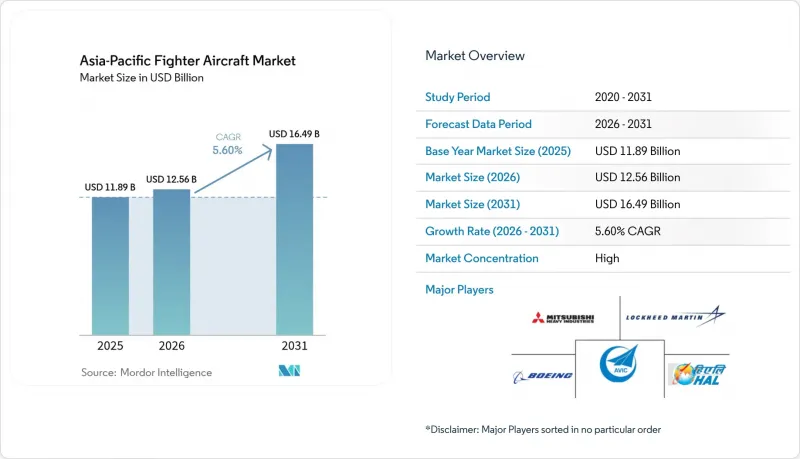
This report is Segmented by Take-Off and Landing (Conventional Take-Off and Landing, and More), Fighter Generation (4th Generation, 4. 5th Generation, and More), Engine Configuration (Single-Engine and Twin-Engine), Mission Role (Air-Superiority, and More), End User (Air Force, and More), and Geography (China, India, Japan, and More). The Market Forecasts are Provided in Terms of Value (USD).
Asia-Pacific Fighter Aircraft Market Trends and Insights
Escalating Defense Budgets Amid Rising Regional Tensions
Regional defense outlays climbed to USD 433 billion in 2024, a 7.80% jump that directly underwrites higher fighter procurement lines. China allocated USD 314 billion and Japan boosted its budget by 21% to USD 55.3 billion, enabling multi-year contract awards that lock in output for the Asia-Pacific fighter aircraft market. Taiwan's USD 16.50 billion spending emphasizes air-defense platforms, while South Korea's USD 2.9 billion F-15K upgrade shows legacy fleet refresh absorbing expanded funding. Policymakers see airpower as an asymmetric lever in potential multi-domain conflicts, sustaining high capital expenditure on combat aircraft. Local-content mandates, such as India's 30% offset threshold, further channel new money into domestic industrial ecosystems, reinforcing near-term demand.
Fleet Modernization Replacing 3rd-Generation Fighters
Retirement of Jaguars, MiG-29s, and other legacy assets compels steady intake of newer jets, anchoring the Asia-Pacific fighter aircraft market well beyond pure fleet expansion. India alone needs 35-40 fresh airframes each year to hold squadron numbers as older types phase out. Thailand's USD 3.65 billion Gripen E/F award over rival bids, plus Indonesia's USD 8.1 billion Rafale order, highlight modernization choices that prioritize technology transfer alongside performance. Upgrade paths sustain production lines and fund R&D for next-step platforms, while HAL's goal of 30 Tejas Mk1A jets annually by 2027 illustrates how domestic suppliers ride the same replacement wave.
Steep Acquisition and Life-Cycle Costs
Unit prices between USD 40-116 million and life-cycle expenses that often double program outlays squeeze smaller defense budgets, slowing orders within the Asia-Pacific fighter aircraft market. With defense spending ranging from 0.78% of GDP in Indonesia to 4.09% in Myanmar, affordability gaps push nations toward light combat jets, used platforms, or leasing. The KAI FA-50's USD 700 million Philippine follow-on order underlines how lower-cost fighters with logistics packages appeal to constrained buyers. OEMs respond through performance-based logistics and export-credit financing, yet capital intensity remains a structural brake.
Other drivers and restraints analyzed in the detailed report include:
- 6th-Generation R&D Collaborations Accelerate Procurement Cycles
- Export-Linked Financing and Tech-Transfer Packages Widen Buyer Base
- ITAR and Export-Control Constraints on Critical Subsystems
For complete list of drivers and restraints, kindly check the Table Of Contents.
Segment Analysis
Conventional CTOL aircraft dominated the Asia-Pacific fighter aircraft market with 57.92% share in 2025, mirroring entrenched land-based force structures. VTOL platforms, although niche, are forecast to record a 6.62% CAGR as carrier programs and distributed basing concepts raise demand. Japan's decision to embark F-35Bs on Izumo-class vessels demonstrates how VTOL capability extends reach without new supercarriers. Meanwhile, China's Type 003 Fujian carrier and envisioned Type 004 nuclear ship will amplify VTOL procurement once indigenous designs mature.
Technological advances in thrust-vectoring reduce the payload-range penalties historically associated with VTOL, enhancing attractiveness for expeditionary roles. Combined with evolving ICAO guidelines that enable military VTOL operations in controlled civil airspace, the segment's role in regional humanitarian response augments its growth trajectory within the Asia-Pacific fighter aircraft market.
4.5th-generation jets held 41.25% Asia-Pacific fighter aircraft market share in 2025, thanks to a balance of proven reliability and upgraded avionics. 6th-generation efforts such as GCAP and NGAD are projected to post an 8.15% CAGR, even though prototypes remain in development. The lingering utility of 4th-generation fleets sustains upgrade business, while 5th-generation purchases fill interim capability gaps.
Manufacturers capitalize on bridge upgrades-active electronically scanned array radars, infrared search-track, and network gateways-to keep incumbents relevant ahead of 6th-generation arrival. China's unveiling of advanced prototypes exerts competitive pressure, prompting earlier commitments that bolster the Asia-Pacific fighter aircraft market size for next-generation platforms.
Complete Report Scope:
- By Take-off and Landing
- Conventional Take-off and Landing (CTOL)
- Short Take-off and Landing (STOL)
- Vertical Take-off and Landing (VTOL/STOVL)
- By Fighter Generation
- 4th Generation
- 4.5th Generation
- 5th Generation
- 6th Generation/NGAD
- By Engine Configuration
- Single-Engine
- Twin-Engine
- By Mission Role
- Air-Superiority
- Multi-Role
- Close-Air-Support/Strike
- By End User
- Air Force
- Naval Aviation
- Marine/Army Aviation
- By Geography
- China
- India
- Japan
- South Korea
- Indonesia
- Rest of Asia-Pacific
List of Companies Covered in this Report:
- Hindustan Aeronautics Limited (HAL)
- Mitsubishi Heavy Industries, Ltd.
- Korea Aerospace Industries, Ltd.
- PT Dirgantara Indonesia
- Kawasaki Heavy Industries, Ltd.
- The Boeing Company
- Airbus SE
- Aviation Industry Corporation of China
- United Aircraft Corporation
- Lockheed Martin Corporation
- Saab AB
Additional Benefits:
- The market estimate (ME) sheet in Excel format
- 3 months of analyst support
TABLE OF CONTENTS
1 INTRODUCTION
- 1.1 Study Assumptions and Market Definition
- 1.2 Scope of the Study
2 RESEARCH METHODOLOGY
3 EXECUTIVE SUMMARY
4 MARKET LANDSCAPE
- 4.1 Market Overview
- 4.2 Market Drivers
- 4.2.1 Escalating defense budgets amid rising regional tensions
- 4.2.2 Fleet modernization replacing 3rd-generation fighters
- 4.2.3 6th-generation R&D collaborations accelerate procurement cycles
- 4.2.4 Export-linked financing and tech-transfer packages widen buyer base
- 4.2.5 Indigenous fighter programs unlock domestic spending
- 4.2.6 Carrier-air-wing expansion (China, India, Japan) drives naval fighter demand
- 4.3 Market Restraints
- 4.3.1 Steep acquisition and life-cycle costs
- 4.3.2 ITAR and export-control constraints on critical subsystems
- 4.3.3 Engine and semiconductor supply-chain bottlenecks
- 4.3.4 Production backlogs and delivery slippages
- 4.4 Value Chain Analysis
- 4.5 Regulatory Landscape
- 4.6 Technological Outlook
- 4.7 Porter's Five Forces Analysis
- 4.7.1 Threat of New Entrants
- 4.7.2 Bargaining Power of Buyers
- 4.7.3 Bargaining Power of Suppliers
- 4.7.4 Threat of Substitutes
- 4.7.5 Intensity of Competitive Rivalry
5 MARKET SIZE AND GROWTH FORECASTS (VALUE)
- 5.1 By Take-off and Landing
- 5.1.1 Conventional Take-off and Landing (CTOL)
- 5.1.2 Short Take-off and Landing (STOL)
- 5.1.3 Vertical Take-off and Landing (VTOL/STOVL)
- 5.2 By Fighter Generation
- 5.2.1 4th Generation
- 5.2.2 4.5th Generation
- 5.2.3 5th Generation
- 5.2.4 6th Generation/NGAD
- 5.3 By Engine Configuration
- 5.3.1 Single-Engine
- 5.3.2 Twin-Engine
- 5.4 By Mission Role
- 5.4.1 Air-Superiority
- 5.4.2 Multi-Role
- 5.4.3 Close-Air-Support/Strike
- 5.5 By End User
- 5.5.1 Air Force
- 5.5.2 Naval Aviation
- 5.5.3 Marine/Army Aviation
- 5.6 By Geography
- 5.6.1 China
- 5.6.2 India
- 5.6.3 Japan
- 5.6.4 South Korea
- 5.6.5 Indonesia
- 5.6.6 Rest of Asia-Pacific
6 COMPETITIVE LANDSCAPE
- 6.1 Market Concentration
- 6.2 Strategic Moves
- 6.3 Market Share Analysis
- 6.4 Company Profiles (includes Global level Overview, Market level overview, Core Segments, Financials as available, Strategic Information, Market Rank/Share for key companies, Products and Services, and Recent Developments)
- 6.4.1 Hindustan Aeronautics Limited (HAL)
- 6.4.2 Mitsubishi Heavy Industries, Ltd.
- 6.4.3 Korea Aerospace Industries, Ltd.
- 6.4.4 PT Dirgantara Indonesia
- 6.4.5 Kawasaki Heavy Industries, Ltd.
- 6.4.6 The Boeing Company
- 6.4.7 Airbus SE
- 6.4.8 Aviation Industry Corporation of China
- 6.4.9 United Aircraft Corporation
- 6.4.10 Lockheed Martin Corporation
- 6.4.11 Saab AB
7 MARKET OPPORTUNITIES AND FUTURE OUTLOOK
- 7.1 White-space and Unmet-need Assessment

