PUBLISHER: Mordor Intelligence | PRODUCT CODE: 2114301

PUBLISHER: Mordor Intelligence | PRODUCT CODE: 2114301
North America Flavors And Fragrances - Market Share Analysis, Industry Trends & Statistics, Growth Forecasts (2026 - 2031)
According to Mordor Intelligence, the North America flavors and fragrances market size stood at USD 11.36 billion in 2026 and is projected to reach USD 14.05 billion by 2031, advancing at a 4.34% CAGR through the forecast period.
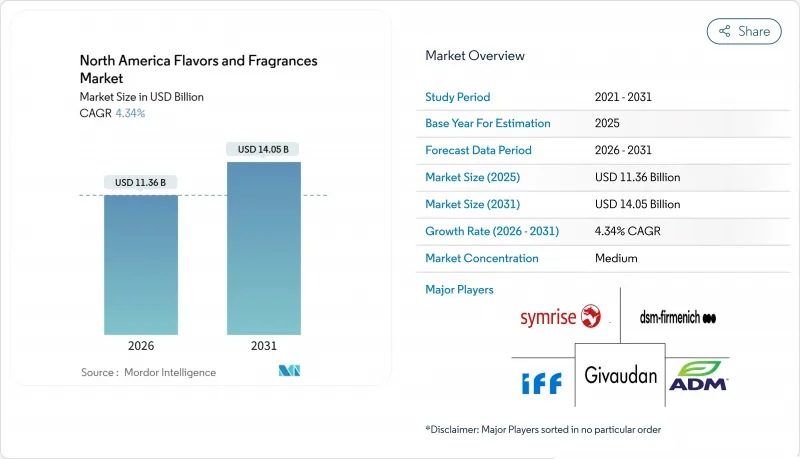
This report is Segmented by Product Type (Flavors and Fragrances), Application (Food and Beverages, Personal Care, Beauty and Cosmetics, and More), and Geography (United States, Mexico, Canada, and the Rest of North America). The Market Forecasts are Provided in Terms of Value (USD).
North America Flavors And Fragrances Market Trends and Insights
Rising demand for clean-label and natural ingredients
Consumer preferences in North America are increasingly influencing the flavors and fragrances market, with a notable shift toward natural and clean-label ingredients. Growing skepticism toward synthetic additives is prompting manufacturers to source USDA organic-certified ingredients, positioning these products as safer and more transparent options. Retail shelf space, once dominated by nature-identical compounds, is now being occupied by organic and naturally derived flavors, reflecting a significant transformation driven by consumer demand. This trend is particularly evident in the United States, where 36% of consumers prefer foods labeled as natural, emphasizing a strong market segment that prioritizes authenticity, traceability, and perceived health benefits. The commercial impact of this shift is demonstrated by robust sales growth for organic products. To meet consumer expectations, manufacturers are developing natural and organic flavor compounds that cater to health-conscious buyers and those seeking clean-label alternatives. In 2024, U.S. sales of organic food products reached USD 65.4 billion, highlighting consumers' willingness to pay a premium for products aligned with natural and clean-label preferences .
Expansion of convenience and ready to eat (RTE) foods
The increasing popularity of convenience and ready-to-eat (RTE) foods is driving demand for innovative food flavors, as consumers prioritize quick and easy meal solutions without compromising on taste. Products such as meal kits, frozen entrees, and pre-packaged snacks require flavors that remain appealing over extended shelf lives while catering to diverse taste preferences. In 2024, 82% of adults in the U.S. reported consuming ultra-processed foods, underscoring the widespread reliance on convenient options and the resulting opportunities for flavor innovation . Taste and convenience are key factors influencing product choices. Moreover, the report revealed that 62% of consumers identified taste and 59% identified convenience as the primary reasons for selecting ultra-processed foods. This highlights the importance of high-quality, appealing flavors in driving repeat purchases. Consequently, food manufacturers are increasingly adopting tailored flavor solutions, including natural and clean-label options, to enhance consumer satisfaction and capitalize on growth opportunities across retail, online, and foodservice channels.
High research and development costs for stable, clean-label alternatives
L25: Developing natural flavor systems that align with the performance and cost profiles of synthetic alternatives requires extensive multi-year research and development investments, which many mid-tier suppliers find challenging to sustain. The variability in botanical extraction yields further complicates this process. Vanilla bean harvests are influenced by weather conditions in Madagascar and Indonesia, while citrus oil production is affected by freeze risks in Florida and California. These fluctuations compel formulators to maintain buffer inventories or resort to synthetic alternatives, which can compromise clean-label objectives. Smaller flavor companies are either consolidating or exiting the natural segment, thereby ceding market share to larger players such as Givaudan, IFF, Symrise, and Firmenich, which can distribute research and development costs across their global customer bases. This trend is less pronounced in Mexico, where price sensitivity limits the demand for premium natural ingredients. However, in the United States and Canada, clients increasingly expect suppliers to demonstrate robust innovation pipelines, creating higher barriers to entry for new or smaller competitors.
Other drivers and restraints analyzed in the detailed report include:
- Premiumization in beauty and personal care
- Innovations in biotechnology and precision fermentation for sustainable flavors
- Stringent Regulatory Scrutiny
For complete list of drivers and restraints, kindly check the Table Of Contents.
Segment Analysis
Flavors accounted for 54.18% of North America's revenue in 2025, driven by reformulation mandates in packaged foods and beverages. Fragrances are projected to grow at an annual rate of 5.37% through 2031, as beauty and personal care brands emphasize ingredient transparency and premiumization. Within the flavors segment, natural variants are gaining market share at the expense of synthetic and nature-identical options. This shift is influenced by retailer clean-label initiatives and consumer skepticism toward chemical-sounding ingredient names. Synthetic flavors continue to offer cost advantages in applications where performance outweighs label appeal, such as industrial bakery mixes and low-cost confectionery. However, they face challenges due to the FDA's stricter definitions and retailer exclusion lists.
Natural fragrances encounter technical challenges in certain applications. For instance, essential oils oxidize under alkaline conditions commonly found in detergents, and their volatility limits scent longevity compared to synthetic musks designed for slow release. The International Fragrance Association's 51st Amendment, effective June 2023, restricted 48 materials, including legacy synthetic musks. This regulation has accelerated reformulation timelines and created opportunities for suppliers with extensive natural-ingredient portfolios.
Complete Report Scope:
- By Product Type
- Flavors
- Synthetic
- Natural
- Nature-Identical
- Fragrances
- Synthetic
- Natural
- Flavors
- By Application
- Food and Beverages
- Savory and Snacks
- Dairy Products
- Bakery
- Confectionery
- Meat Products
- Beverages
- Others
- Personal Care
- Beauty and Cosmetics
- Household Products
- Other Applications (Industrial, pharmaceuticals, etc)
- Food and Beverages
- By Geography
- United States
- Canada
- Mexio
- Rest of North America
List of Companies Covered in this Report:
- Givaudan SA
- dsm-firmenich
- International Flavors & Fragrances (IFF)
- Symrise AG
- The Archer Daniels Midland Company (ADM)
- Sensient Technologies
- MANE Group
- Takasago International Corporation
- Kerry Group
- Koninklijke DSM NV
- Robertet Group
- T. Hasegawa Co. Ltd.
- Treatt PLC
- Bell Flavors & Fragrances
- Huabao International
- Aurochemicals
- McCormick & Company
- Kalsec Inc.
- Flavorchem Corporation
- Blue Pacific Flavors
Additional Benefits:
- The market estimate (ME) sheet in Excel format
- 3 months of analyst support
TABLE OF CONTENTS
1 INTRODUCTION
- 1.1 Study Assumptions and Market Definition
- 1.2 Scope of the Study
2 RESEARCH METHODOLOGY
3 EXECUTIVE SUMMARY
4 MARKET LANDSCAPE
- 4.1 Market Overview
- 4.2 Market Drivers
- 4.2.1 Rising demand for clean-label and natural ingredients
- 4.2.2 Expansion of convenience and ready to eat (RTE) foods
- 4.2.3 Premiumization in beauty and personal care
- 4.2.4 Innovations in biotechnology and precision fermentation for sustainable flavors
- 4.2.5 Increasing popularity of exotic, ethnic, and fusion flavors
- 4.2.6 Technological advancements like AI-driven flavor formulation and encapsulation
- 4.3 Market Restraints
- 4.3.1 High research and development costs for stable, clean-label alternatives
- 4.3.2 Stringent regulatory scrutiny
- 4.3.3 Consumer skepticism toward "natural" claims requiring third-party certifications
- 4.3.4 Limited shelf life and batch variability of natural extracts
- 4.4 Supply Chain Analysis
- 4.5 Regulatory and Technological Outlook
- 4.6 Porter's Five Forces Analysis
- 4.6.1 Threat of New Entrants
- 4.6.2 Bargaining Power of Buyers
- 4.6.3 Bargaining Power of Suppliers
- 4.6.4 Threat of Substitutes
- 4.6.5 Intensity of Competitive Rivalry
5 MARKET SIZE AND GROWTH FORECATS (VALUE)
- 5.1 By Product Type
- 5.1.1 Flavors
- 5.1.1.1 Synthetic
- 5.1.1.2 Natural
- 5.1.1.3 Nature-Identical
- 5.1.2 Fragrances
- 5.1.2.1 Synthetic
- 5.1.2.2 Natural
- 5.1.1 Flavors
- 5.2 By Application
- 5.2.1 Food and Beverages
- 5.2.1.1 Savory and Snacks
- 5.2.1.2 Dairy Products
- 5.2.1.3 Bakery
- 5.2.1.4 Confectionery
- 5.2.1.5 Meat Products
- 5.2.1.6 Beverages
- 5.2.1.7 Others
- 5.2.2 Personal Care
- 5.2.3 Beauty and Cosmetics
- 5.2.4 Household Products
- 5.2.5 Other Applications (Industrial, pharmaceuticals, etc)
- 5.2.1 Food and Beverages
- 5.3 By Geography
- 5.3.1 United States
- 5.3.2 Canada
- 5.3.3 Mexio
- 5.3.4 Rest of North America
6 COMPETITIVE LANDSCAPE
- 6.1 Market Concentration
- 6.2 Strategic Moves
- 6.3 Market Share Analysis
- 6.4 Company Profiles {(includes Global level Overview, Market level overview, Core Segments, Financials as available, Strategic Information, Market Rank/Share for key companies, Products and Services, and Recent Developments)}
- 6.4.1 Givaudan SA
- 6.4.2 dsm-firmenich
- 6.4.3 International Flavors & Fragrances (IFF)
- 6.4.4 Symrise AG
- 6.4.5 The Archer Daniels Midland Company (ADM)
- 6.4.6 Sensient Technologies
- 6.4.7 MANE Group
- 6.4.8 Takasago International Corporation
- 6.4.9 Kerry Group
- 6.4.10 Koninklijke DSM NV
- 6.4.11 Robertet Group
- 6.4.12 T. Hasegawa Co. Ltd.
- 6.4.13 Treatt PLC
- 6.4.14 Bell Flavors & Fragrances
- 6.4.15 Huabao International
- 6.4.16 Aurochemicals
- 6.4.17 McCormick & Company
- 6.4.18 Kalsec Inc.
- 6.4.19 Flavorchem Corporation
- 6.4.20 Blue Pacific Flavors
7 MARKET OPPORTUNITIES AND FUTURE OUTLOOK

